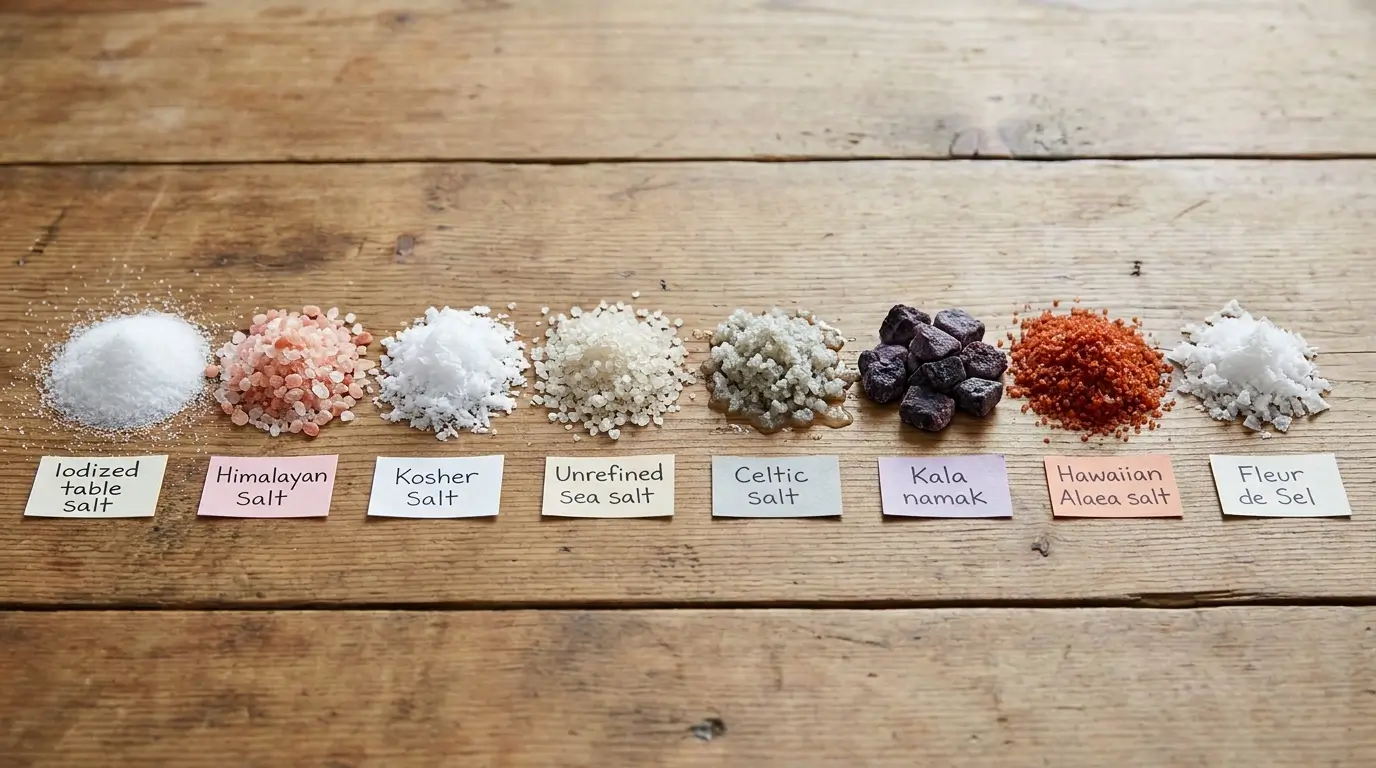
Walk down the salt aisle of any well-stocked grocery store in 2026 and you will face a wall of options: iodized table salt, sea salt in three grain sizes, kosher salt in at least two brands, pink Himalayan salt, grey Celtic salt, black lava salt, Fleur de Sel, and possibly a finishing flake from a coastal producer you have never heard of. The variety is genuine. So is the confusion.
This guide cuts through it. For each major salt type, the comparison covers what it actually is, how its mineral composition and texture differ from pink salt, how it performs in key cooking applications, and when it is the right choice — and when it is not.
One clarification before the comparisons begin: “pink salt” throughout this article means Himalayan pink salt — the rock salt from the Khewra Mine in Pakistan that dominates the specialty salt category. Other pink salts (Hawaiian Alaea, Peruvian Maras) are covered in their own sections. Pink curing salt is excluded entirely because it is a meat-curing compound, not a cooking seasoning — the full explanation is in the pink curing salt guide.
The Framework: What to Actually Compare
Salt comparisons in food media tend to collapse into two unhelpful extremes: either dismissing all specialty salts as marketing gimmicks (“just use table salt, it’s all NaCl”) or treating mineral content as a nutritional leaderboard (“this one has 84 trace minerals”). Neither framing is useful.
The dimensions that actually matter when comparing salts are:
Composition — what percentage is sodium chloride, and what trace minerals are present in what quantities? This affects both flavor and, to a limited extent, nutrition.
Texture and crystal structure — grain size, crystal shape, hardness, and how quickly it dissolves. This is the single biggest driver of practical differences between salts in the kitchen.
Flavor — both the intensity of saltiness and the character of any mineral notes. Importantly: differences that are detectable when salt is used as a finishing agent are often undetectable when salt is dissolved during cooking.
Iodine content — whether the salt has added iodine, which matters for people who rely on salt as their primary dietary iodine source.
Best applications — which cooking tasks each salt genuinely excels at, versus where the differences are negligible.
Price and availability — because a salt you cannot find or afford is not a practical choice.
With those dimensions established, here is how pink salt compares to each major alternative.
Pink Salt vs Table Salt
Table salt is the baseline against which all other salts are measured. It is produced by dissolving underground salt deposits or evaporating brine, then refining the resulting liquid to remove trace minerals. The output is an extremely pure sodium chloride — typically 99%+ NaCl — to which two additives are almost always included: an anti-caking agent (usually calcium silicate or sodium aluminosilicate) to prevent clumping, and potassium iodide as a public health supplement.
The key differences from pink salt:
Iodine: This is the most nutritionally significant difference. Iodized table salt is one of the most effective public health interventions in modern food history — the near-elimination of iodine deficiency disorders in iodized-salt-using populations is well documented. Himalayan pink salt contains no added iodine. If you switch entirely from iodized table salt to pink salt and do not get adequate iodine from seafood, dairy, or eggs, this is a genuine nutritional gap worth addressing.
Trace minerals: Table salt has been refined to remove them. Pink salt retains them. The health significance of this difference at typical serving sizes is minimal — the trace minerals in a day’s worth of pink salt do not move the needle on your nutritional intake — but the flavor significance is slightly more real. Fine table salt has a sharper, more aggressive salinity. Pink salt has a slightly rounder, softer finish.
Anti-caking agents: Table salt contains them; pink salt does not. For most cooking this is irrelevant. For applications where salt purity matters — curing, fermentation, making salt-preserved foods — the absence of additives in pink salt is an advantage.
Texture: Fine table salt has very small, uniform, highly soluble crystals that dissolve almost instantly. It is the most reliable choice for baking, where predictable dissolution and consistent measurement are important. Pink salt, unless very finely milled, dissolves more slowly.
Measurement: Because coarse pink salt crystals are larger and less dense than fine table salt, a teaspoon of coarse pink salt contains less sodium than a teaspoon of table salt. This matters in recipes measured by volume. When precision matters, measure salt by weight, not by spoon.
Bottom line: For cooking applications where salt is dissolved into a dish, fine pink salt and iodized table salt are largely interchangeable from a flavor perspective. Table salt wins on iodine content, price, dissolution speed, and baking reliability. Pink salt wins on absence of additives and mild mineral character as a finishing salt.
Pink Salt vs Sea Salt
Sea salt is produced by evaporating modern seawater — either in traditional open-air pans or by industrial evaporation. It is the broadest category in the salt market, encompassing everything from cheap industrial sea salt (functionally identical to refined table salt) to hand-harvested artisan finishing salts.
The most meaningful distinction is between pink salt’s ancient, mineral-locked rock origin and sea salt’s modern ocean origin. Both yield predominantly sodium chloride. The trace mineral profiles differ — sea salt tends to be higher in magnesium and sulfate; pink salt is distinctly higher in potassium and iron. Neither is categorically “more mineral-rich”; they are different.
One scientifically documented difference: multiple peer-reviewed studies have detected microplastic particles in commercially produced sea salts, reflecting the microplastic burden in modern ocean water. Himalayan pink salt, mined from a deposit sealed for hundreds of millions of years, does not carry this contamination. The health implications of microplastics in food remain an active area of research, and current dietary guidance does not flag sea salt as a risk — but the difference is real.
For the full side-by-side breakdown of texture, mineral content, flavor, and specific use cases, see the dedicated article on pink salt vs sea salt.
Pink Salt vs Kosher Salt
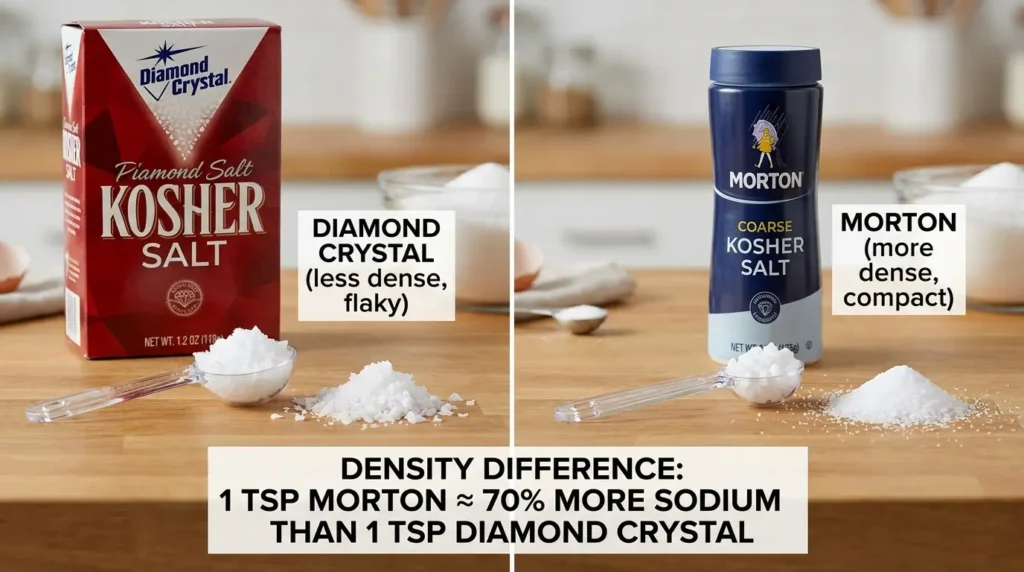
Kosher salt is the workhorse salt of professional kitchens. Despite the name — which refers to its use in the koshering process of drawing blood from meat, not to it being kosher-certified — it is widely used by chefs regardless of religious context. The two dominant brands in most markets are Diamond Crystal and Morton, and they behave differently enough in cooking that professional recipes often specify which one.
What it is: Kosher salt is a coarse, minimally processed rock salt or evaporated salt with large, irregular flake-like crystals and no additives (no iodine, no anti-caking agents in most versions). Its crystal structure is what defines it — the large, flat, rough-edged crystals are easy to pinch and control by hand, adhere well to meat surfaces, and dissolve at a rate that suits seasoning before cooking.
How it differs from pink salt:
Texture: Kosher salt crystals are large and flat — almost flake-like in the case of Diamond Crystal, slightly denser in Morton. They adhere to food surfaces well when applied by hand. Pink salt coarse crystals are chunkier and more three-dimensional, less suited to the fingertip-pinch technique that makes kosher salt so popular in professional kitchens.
Density and measurement: This is where kosher salt gets complicated. Diamond Crystal kosher salt is very light and airy — one cup weighs roughly 135g. Morton kosher salt is denser — one cup weighs roughly 240g. Table salt weighs around 288g per cup. Coarse Himalayan pink salt sits somewhere between Diamond Crystal and Morton. Substituting any of these by volume without adjustment will under- or over-salt a dish. Weight measurement is the only reliable approach when switching between salt types.
Flavor: In direct tasting, most people find kosher salt delivers a clean, pure salinity without the mineral notes of pink salt or grey sea salts. It is intentionally neutral — designed to season food without adding its own character.
No color or visual appeal: Kosher salt is white. If you are using a finishing salt for visual impact — pink crystals against a dark chocolate dessert or a sliced steak — kosher salt provides no equivalent effect.
Where kosher salt wins outright: Dry brining meat, seasoning pasta water by the palmful, any technique where the cook seasons by touch and eye rather than measuring by spoon. The large crystal size makes it easier to control application rate and see exactly where salt has been applied.
Where pink salt wins: Visual impact, mild mineral complexity as a finishing salt, and salt block cooking — an application that simply has no kosher salt equivalent.
Pink Salt vs Celtic Grey Salt
Celtic grey salt (Sel Gris) is a hand-harvested French Atlantic sea salt, raked from the bottom of salt pans in the Guérande region and retaining the grey clay minerals from the pan floor. It is characteristically moist, coarse, and heavily mineral in flavour — the most aggressively mineral-flavored salt in mainstream availability.
Mineral content: Celtic grey salt consistently outscores Himalayan pink salt on mineral diversity and concentration. It is substantially higher in magnesium, which gives it a complex, slightly bitter mineral edge. If mineral complexity is what you want from a finishing salt, Celtic grey is a more pronounced expression of it than pink salt.
Moisture: Celtic grey salt is harvested wet and sold moist — it clumps easily and does not flow freely. It cannot be used in a standard salt shaker or grinder without modifications. Pink salt, by contrast, is dry and free-flowing. For table use and grinding, pink salt is significantly more convenient.
Flavor: Celtic grey has a bold, complex, assertive mineral character that suits robust proteins — red meat, roasted root vegetables, hearty stews. Its bitterness, if used as a finishing salt on something delicate, can overpower. Pink salt’s milder mineral note is more versatile across a wider range of dishes.
Visual: Celtic grey salt is, as the name implies, grey. For plating applications where a finishing salt needs to be visually striking, pink salt is the stronger choice.
Pink Salt vs Kala Namak (Black Salt)
Kala namak is a kiln-fired rock salt from the Indian subcontinent, produced by heating salt with harad seeds, amla, bark, and other ingredients in a sealed kiln. The result is a salt with a distinctive sulfurous character — a pungent, egg-like aroma and flavor caused by hydrogen sulfide and iron sulfide compounds produced during firing.
This is perhaps the most unusual comparison in this article because kala namak is not simply a seasoning salt in the way the others are — it is a flavor ingredient with a strong, specific character.
Where it differs from pink salt: The sulfurous flavor of kala namak is intentional and central to its use. It is an essential seasoning in South Asian cuisines, used in chaat masala, raitas, and fruit salads, and has gained popularity in vegan cooking as an egg flavor substitute in scrambled tofu, vegan omelets, and similar preparations. You would never use it where a neutral salinity is wanted.
Common ground with pink salt: Both are rock salts from South Asian deposits. Both contain iron compounds that affect their color. Both are sold in specialty food markets. That is approximately where the similarity ends.
Pink Salt vs Hawaiian Alaea Salt
Hawaiian Alaea salt is a sea salt blended with volcanic red clay (alaea), giving it a pink-to-rust color and an earthy, assertive mineral flavor that is genuinely distinct from Himalayan pink salt despite the visual similarity.
The most important distinction: Alaea’s color comes from added volcanic clay, not from iron oxide within the salt crystals. The mineral contribution and flavor come from that clay — which is rich in iron-bearing minerals and silica — rather than from the underlying salt.
Flavor: Alaea has a distinctly earthy character that pink salt lacks. Side by side as finishing salts, they taste noticeably different. Alaea suits Hawaiian preparations, grilled proteins, and dishes where an earthy mineral note adds something. Pink salt’s milder profile is more neutral and universally applicable.
Availability and price: Authentic Hawaiian Alaea is a specialty product, less widely available than Himalayan pink salt and generally priced at the higher end of finishing salts. Pink salt is available in supermarkets globally.
For the detailed head-to-head comparison — including traditional uses of Alaea, specific flavor pairing recommendations, and how to tell authentic Alaea from imitations — see pink salt vs Hawaiian Alaea.
Pink Salt vs Fleur de Sel
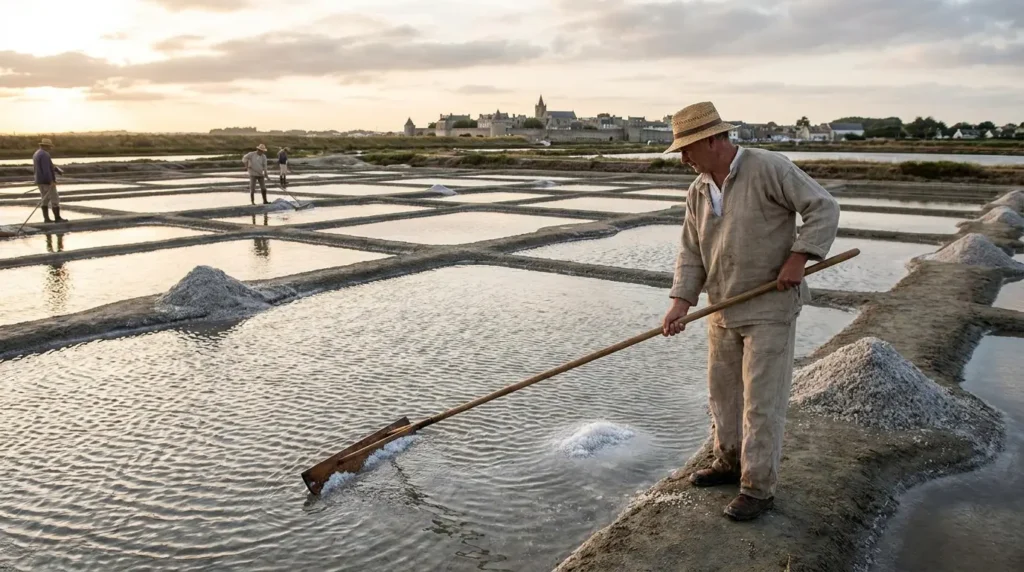
Fleur de Sel is widely considered the most prestigious finishing salt in Western culinary tradition. It is hand-skimmed from the surface of salt pans in France’s Guérande, Camargue, and Île de Ré regions — only on sunny, windy days, only from the delicate crust that forms on the water’s surface — and carries a price that reflects both its labor-intensive production and its reputation.
Where Fleur de Sel outperforms pink salt: As a pure finishing salt on delicate food, the best Fleur de Sel is exceptional. Its crystals are thin, flat, and slightly moist — they dissolve in delicate layers on the palate rather than all at once, producing a more complex textural experience than any rock salt. On a freshly sliced tomato, a piece of dark chocolate, or a lightly dressed salad, it delivers a finishing experience that pink salt does not match.
Where pink salt competes or wins: Price (Fleur de Sel is expensive), availability (pink salt is everywhere), versatility (Fleur de Sel is a finishing-only salt; pink salt works across cooking applications), and visual impact (pink crystals are more distinctive on a plate than white Fleur de Sel).
For everyday cooking, Fleur de Sel is an indulgence reserved for dishes where a finishing salt is the final flourish. Pink salt is the practical daily-driver that can also serve as a finishing salt with genuinely good results.
The Master Comparison Table
| Salt | Type | Iodine | Mineral character | Best for | Relative price |
|---|---|---|---|---|---|
| Himalayan pink salt | Rock salt | No | Mild, lightly mineral | Finishing, grinding, cooking, salt blocks | Mid |
| Iodized table salt | Refined rock/evaporated | Yes | Neutral (refined) | Baking, everyday cooking, iodine intake | Low |
| Sea salt (unrefined) | Evaporated sea salt | No | Mild–moderate mineral | General cooking, finishing | Low–mid |
| Kosher salt | Rock or evaporated | No | Clean, neutral | Dry brining, professional cooking, by-hand seasoning | Low |
| Celtic grey salt | Sea salt (pan floor) | No | Strong, assertive mineral | Robust proteins, bold dishes | Mid–high |
| Kala namak | Kiln-fired rock salt | No | Sulfurous, egg-like | South Asian cuisine, vegan egg preparations | Mid |
| Hawaiian Alaea | Sea salt + volcanic clay | No | Earthy, assertive | Hawaiian cuisine, grilled proteins | High |
| Fleur de Sel | Hand-skimmed sea salt | No | Delicate, complex | Premium finishing on delicate foods | High |
| Peruvian Maras | Spring-fed evaporation | No | Complex, nuanced | Premium finishing | High |
Which Salt for Which Job
For everyday cooking where salt dissolves into the dish: Fine pink salt, fine sea salt, and kosher salt are all excellent. The differences are negligible in a dissolved context. Use whichever you have. Measure by weight if precision matters.
For dry brining meat before roasting or grilling: Kosher salt is the professional standard. Its large crystals adhere well, it draws out and reabsorbs surface moisture effectively, and it is easy to apply by hand in controlled quantities.
For finishing a steak, roasted vegetables, or eggs: Coarse pink salt flakes, Maldon sea salt, Fleur de Sel, or Celtic grey depending on the intensity of mineral character you want. Pink salt is the most neutral and universally flattering; Celtic grey is the boldest.
For finishing a dessert: Pink salt finishing flakes against chocolate or caramel are visually striking and the mild mineral note works well against sweet flavors. Fleur de Sel is the classical choice for high-end patisserie.
For baking: Fine table salt or fine sea salt. Predictable dissolution and volume measurement accuracy matter more here than mineral character. If using pink salt in baking, measure by weight.
For the table in a grinder: Pink salt (with a hardened grinder), coarse sea salt, or kosher salt.
For iodine intake: Iodized table salt is still the simplest and most reliable dietary iodine source. If you use specialty salts as your primary salt, get iodine from seafood, dairy, eggs, or a supplement.
For South Asian or vegan egg applications: Kala namak is irreplaceable — nothing else produces its sulfurous flavor profile.
For Hawaiian cuisine: Alaea salt is the authentic choice. Pink salt is a neutral substitute if Alaea is unavailable, but the dish will taste different.
For deeper reading on any single comparison — especially the most commonly searched ones — the cluster articles go further on each pairing: the sea salt comparison and Hawaiian Alaea comparison are the most detailed. And if you are still building your understanding of what pink salt itself is before comparing it to others, the pink salt guide is the foundation.