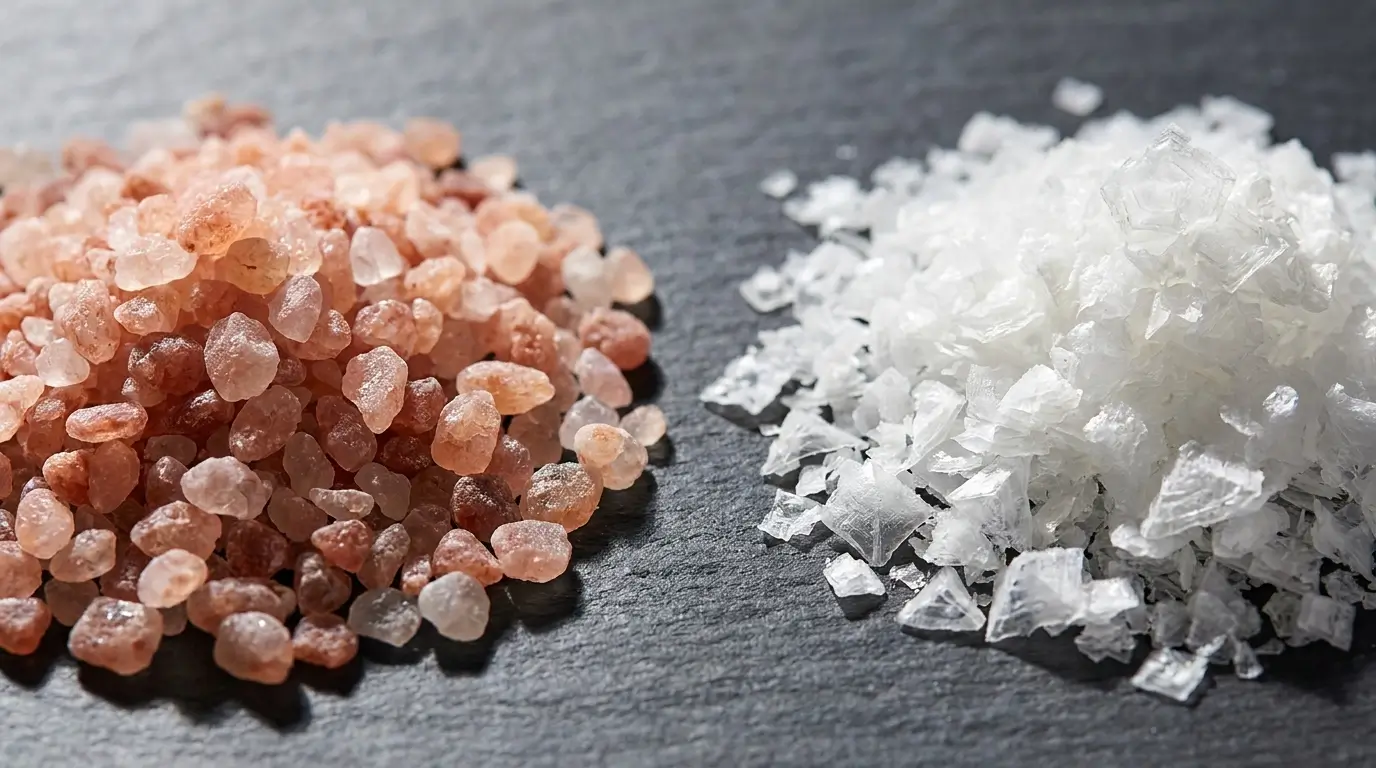
Pink salt and sea salt are not the same product. They are both predominantly sodium chloride, but they differ in geological origin, crystal structure, trace mineral profile, contamination risk, and how they behave across specific cooking applications. For most everyday kitchen tasks those differences are minor. For a handful of specific uses — finishing dishes, grinding at the table, curing food, or choosing a salt you will use daily as your only seasoning — they are meaningful enough to drive a deliberate choice.
This article makes those differences concrete, application by application, without overstating them.
The Core Distinction in One Paragraph
Himalayan pink salt is a rock salt — a solid mineral deposit that formed when an ancient inland sea evaporated approximately 600 million years ago, and has been sealed underground in Pakistan’s Salt Range ever since. It is mined, minimally processed, and sold in the crystal form it was extracted in. Its pink color comes from trace iron oxide locked inside the crystals during the deposit’s geological formation.
Sea salt is produced by evaporating modern seawater — today’s ocean water, channeled into pans or processed industrially and allowed to crystallize. It is a contemporary product, harvested from living ocean water, with a mineral profile that reflects the composition of the modern sea. It comes in dozens of varieties from coastlines worldwide, ranging from cheap industrially evaporated commodity salt to hand-harvested artisan finishing salts with globally recognized reputations.
The fundamental difference is one of time and source: ancient underground deposit versus modern ocean. Both yield mostly sodium chloride. What surrounds that NaCl — the trace minerals, the crystal structure, the contaminants or their absence — is where the practical differences live.
How Each One Forms
Pink Salt: A 600-Million-Year Geological Process
The Himalayan pink salt available in shops today began as a shallow, warm inland sea during the late Precambrian era. As that sea gradually evaporated, the minerals it held in solution crystallized out and settled in thick layers on the seafloor — sodium chloride predominantly, but accompanied by trace amounts of dozens of other mineral compounds, including the iron-bearing minerals that would eventually give the salt its color.
Over the following hundreds of millions of years, those mineral layers were buried under sediment, compressed by the weight of overlying rock, and eventually caught up in the tectonic collision between the Indian and Eurasian plates that built the Himalayan mountain range. That collision sealed the salt deposit underground, protected it from dissolution by rainwater, and preserved it in the dense, hard mineral form miners excavate today at the Khewra Salt Mine in Punjab, Pakistan.
The geological isolation matters for one practical reason: a deposit sealed underground since before complex life existed on Earth has not been exposed to anything that has happened to the surface environment since. No modern ocean pollutants, no industrial runoff, no atmospheric contamination from fossil fuel combustion. For a deeper look at the full geological and geographic story, see where does Himalayan pink salt come from.
Sea Salt: Evaporation of Modern Seawater
Sea salt production begins with today’s ocean water — the same water that covers 71% of the Earth’s surface and has been continuously cycling through the global water system for billions of years. Modern seawater is approximately 3.5% dissolved minerals by weight, of which sodium chloride constitutes roughly 85%. The remainder includes magnesium, sulfate, calcium, potassium, bromide, and dozens of other compounds.
To produce sea salt, seawater is either channeled into shallow coastal pans and evaporated by sun and wind — the traditional method used for millennia — or processed through industrial evaporation and crystallization systems. As water evaporates and mineral concentration increases, sodium chloride crystallizes first and is harvested, dried, and sold.
What this means: sea salt is a living product of living ocean water. Its mineral profile reflects the contemporary ocean’s composition. Its production is happening now, in water that has been in contact with the modern surface environment — including everything that has entered that environment in recent decades.
Mineral Composition Side by Side
Both pink salt and sea salt are overwhelmingly sodium chloride. The trace mineral differences are real, well-documented in peer-reviewed analysis, and genuinely modest in terms of nutritional impact at typical serving sizes.
Himalayan pink salt — representative mineral profile:
| Mineral / Component | Approximate concentration |
|---|---|
| Sodium chloride (NaCl) | 95–98% by weight |
| Potassium | 3,000–4,000 mg/kg |
| Calcium | 400–600 mg/kg |
| Magnesium | 100–200 mg/kg |
| Iron (as Fe₂O₃) | 30–50 mg/kg |
| Sulfate | ~1,200 mg/kg |
| Other trace elements | < 1% combined |
Unrefined sea salt — representative mineral profile:
| Mineral / Component | Approximate concentration |
|---|---|
| Sodium chloride (NaCl) | 94–98% by weight |
| Magnesium | 400–1,000 mg/kg |
| Sulfate | 2,000–4,000 mg/kg |
| Calcium | 200–500 mg/kg |
| Potassium | 400–700 mg/kg |
| Bromide | traces |
| Other trace elements | < 1% combined |
The most notable compositional differences:
Pink salt is higher in potassium and iron. The elevated iron is what produces the color. The elevated potassium is a consistent finding in Khewra salt analyses.
Sea salt is higher in magnesium and sulfate. Magnesium in particular is substantially higher in most sea salts than in Himalayan pink salt. This has a direct flavor consequence — magnesium compounds contribute a slight bitter edge that is more pronounced in some sea salts and almost absent in pink salt.
An important caveat on sea salt variation: “Sea salt” is a category, not a single product. A French Atlantic Fleur de Sel, an Australian Murray River salt, and a cheap Mediterranean industrially evaporated sea salt are all “sea salt” and can have meaningfully different mineral profiles. The figures above represent a reasonable average for unrefined sea salt; specific products will vary. Himalayan pink salt, all sourced from a single mine, is considerably more consistent.
What these mineral differences mean nutritionally: At a typical daily salt consumption of 5–10 grams, the additional potassium in pink salt or the additional magnesium in sea salt does not move the needle on anyone’s nutritional intake compared to what they get from food. The minerals are genuinely present. Choosing between these salts for their trace mineral content is not a meaningful nutritional strategy — the difference shows up in flavor, not in blood panels.
Texture and Crystal Structure
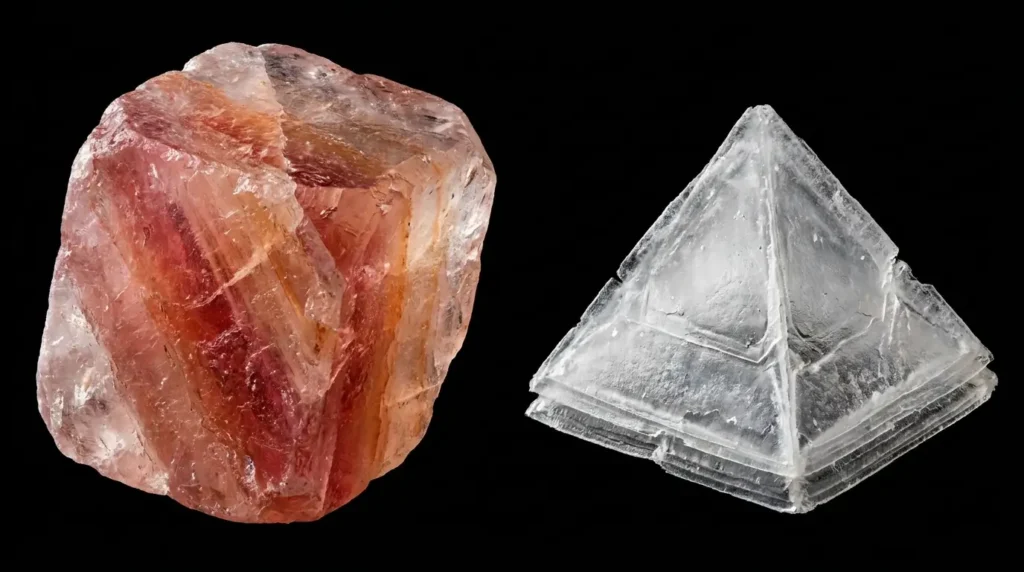
Texture is the most practically significant difference between pink salt and most sea salts in the kitchen — more so than mineral content, and more so than flavor when salt is cooked into dishes.
Pink salt is a rock salt. Its crystals are dense, three-dimensional, and relatively hard — formed under geological pressure over millions of years rather than through surface evaporation. On the Mohs hardness scale, Himalayan pink salt rates approximately 7. For context, most ceramic grinder mechanisms are rated for materials up to hardness 7; cheap ceramic grinders fail quickly when loaded with pink salt. A quality hardened ceramic or steel burr grinder is required for long-term use.
Fine-milled pink salt dissolves reasonably quickly in water and performs well in cooking. Coarse pink salt crystals dissolve noticeably more slowly — which is an advantage as a finishing salt (they stay intact on the surface of food longer, delivering concentrated flavor) and a minor disadvantage in applications where rapid dissolution matters.
Sea salt crystals vary enormously depending on the production method and source:
- Industrial evaporated sea salt produces small, cuboid crystals very similar to table salt — fine, highly soluble, and consistent.
- Traditional pan-harvested sea salt (coarse Atlantic salt, Mediterranean grey salt) produces larger, irregular crystals with rough surfaces that adhere well to food.
- Fleur de Sel produces thin, flat, slightly moist flakes that dissolve in delicate successive layers on the palate — a textural experience no rock salt fully replicates.
- Maldon sea salt produces large, hollow pyramid-shaped crystals with a distinctive crunch and rapid, clean dissolution.
The practical upshot: pink salt and sea salt each have crystal forms suited to different applications. For grinding at the table, pink salt’s large hard crystals in a quality mill deliver a satisfying result — but require the right equipment. For finishing delicate dishes where a light, layered dissolution is the goal, the best sea salt finishing flakes (Maldon, Fleur de Sel) are difficult to match.
Flavor: What the Blind Taste Tests Actually Show
The honest answer about flavor differences between pink salt and sea salt is more nuanced than most guides admit — because the method of application changes whether a difference is detectable at all.
When dissolved into cooked food: Multiple controlled blind taste tests — including assessments by professional chefs and food scientists — consistently find that people cannot reliably distinguish Himalayan pink salt from a quality unrefined sea salt when both are added during cooking and dissolved into a dish. The trace mineral differences are simply too dilute relative to the overall flavor environment of a cooked soup, sauce, or braise to register on the palate. If your primary use of salt is seasoning food during cooking, the flavor difference between pink salt and sea salt is practically negligible.
When used as a finishing salt: The difference becomes more perceptible — and for a specific reason. A finishing salt dissolves directly on the tongue without dilution, so the mineral character of the salt itself is what you are tasting. Here, the differences in magnesium content and crystal structure become detectable:
- Pink salt has low magnesium, giving it a clean, round, mildly mineral finish — soft rather than sharp.
- Sea salts with higher magnesium content (Celtic grey salt, some Atlantic sea salts) have a more complex, slightly bitter mineral edge.
- Pure, refined sea salt with low residual minerals tastes similar to fine table salt — clean and sharp.
- Fleur de Sel has a moist, layered dissolution that creates a textural experience independent of its mineral character.
Neither profile is objectively superior. Pink salt’s mild finish is more broadly flattering across different foods — it adds salinity without imposing a strong mineral character. Assertive sea salts suit robust preparations where that mineral complexity adds dimension.
The “84 minerals” flavor claim: Marketing for Himalayan pink salt frequently attributes its superior flavor to having 84 trace minerals. Controlled testing does not support the idea that the mineral trace content is the primary driver of any perceived flavor difference. Crystal structure, dissolution rate, and magnesium concentration are more strongly correlated with detectable flavor variation. The minerals are real; the specific flavor attribution is oversimplified.
Iodine: The Most Overlooked Difference
Neither Himalayan pink salt nor natural sea salt contains added iodine. This is a meaningful practical distinction from iodized table salt that gets far too little attention in specialty salt discussions.
Iodine deficiency was one of the most widespread preventable nutritional problems of the 20th century. The introduction of iodized salt — standard table salt with added potassium iodide — in iodizing programs beginning in the 1920s dramatically reduced iodine deficiency disorders in participating countries. Those programs worked because table salt was essentially universal.
As specialty salts have grown in market share and more households have switched from iodized table salt to pink salt, sea salt, or other non-iodized alternatives as their primary seasoning salt, iodine intake has become a consideration worth being explicit about.
The practical guidance: If Himalayan pink salt or sea salt is your household’s primary salt and your diet does not regularly include seafood (especially fish and shellfish), dairy products, or eggs, iodine intake is worth monitoring. None of the specialty salts discussed in this article — pink salt, Fleur de Sel, Maldon, Celtic grey, Hawaiian Alaea — are iodized. This is not a reason to avoid them, but it is a reason to be aware of your total diet.
Microplastics: A Documented Difference Worth Understanding
One of the most searched topics in pink salt vs sea salt comparisons is microplastics — and unlike many health claims in the salt category, this one is grounded in peer-reviewed research.
Multiple published studies have detected microplastic particles in commercially available sea salts from multiple countries and production regions. A frequently cited 2018 analysis in Environmental Science & Technology examined sea salts from 21 countries and found microplastics in the majority of samples tested. Subsequent Korean research published in Environmental Science & Technology Letters found detectable microplastics in 90% of sea salt samples analyzed. The presence reflects the documented microplastic burden in modern ocean water, from which sea salt is produced.
Himalayan pink salt, extracted from a deposit that has been sealed underground since hundreds of millions of years before synthetic plastics were invented, does not carry microplastic contamination. This has been confirmed in independent testing of Khewra-sourced salt.
The appropriate framing: The health implications of dietary microplastic exposure remain an active and unresolved area of research. Current food safety agencies have not issued dietary guidance recommending people avoid sea salt on the basis of microplastic content, and the quantities found per serving are considered very low. This is not an alarm — it is a real and documented difference between two products, worth knowing without overstating.
Cooking Performance by Application
| Application | Pink Salt | Sea Salt | Notes |
|---|---|---|---|
| Seasoning during cooking | ✅ Excellent | ✅ Excellent | No detectable difference when dissolved into dishes |
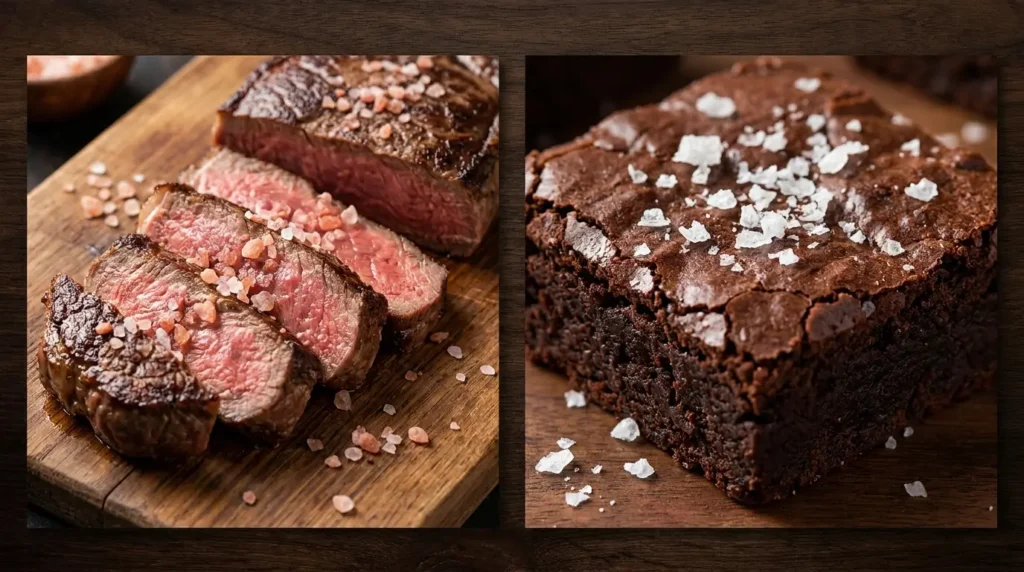
| Finishing meat | ✅ Excellent (coarse) | ✅ Excellent (Maldon, coarse) | Pink salt milder; Maldon crunchier and sharper |
| Finishing desserts | ✅ Very good (flakes) | ✅ Very good (Fleur de Sel, Maldon) | Pink color distinctive against dark chocolate |
| Finishing delicate dishes | ✅ Good | ✅ Better (Fleur de Sel) | Fleur de Sel’s layered dissolution is superior |
| Baking | ⚠️ Use fine grain; weigh don’t measure by volume | ✅ Fine sea salt works well | Volume measurements unreliable across salt types |
| Dry brining | ✅ Good (coarse) | ✅ Good (coarse) | Either works; kosher salt is the professional standard |
| Brining (wet) | ✅ Yes | ✅ Yes | Use fine grain for both |
| Table grinding | ✅ Excellent — but needs hardened grinder | ✅ Good | Pink salt requires quality hardened grinder (Mohs ~7) |
| Salt block cooking | ✅ Unique to pink salt | ❌ Not available | No sea salt equivalent for block/slab cooking |
| Visual impact on plating | ✅ High — distinctive rose color | ✅ Variable — Fleur de Sel and Maldon also elegant | |
| Fermentation / preserving | ✅ Good (no additives) | ✅ Good (no additives if unrefined) | Both better than iodized table salt for ferments |
Price and Availability
Himalayan pink salt is now widely available at supermarkets, health food stores, kitchen retailers, and online sellers globally. It is no longer a specialty product in terms of access — it sits alongside table salt and standard sea salt in most grocery stores. Pricing is mid-range for the specialty salt category: more expensive than table salt or bulk sea salt, broadly comparable to quality unrefined sea salts at similar grain sizes.
Sea salt spans the widest price range of any salt category — from cheap industrially evaporated sea salt priced at or below table salt, to artisan finishing salts (Fleur de Sel, premium Maldon, hand-harvested Atlantic grey salt) priced significantly above pink salt. If you are comparing pink salt to commodity sea salt, pink salt is more expensive. If you are comparing it to premium finishing sea salts, it is often comparable or cheaper.
Counterfeiting risk: The Himalayan pink salt market has a documented counterfeiting problem. Products sold as “Himalayan” that are either not from Khewra, blended with lower-grade salts, or dyed regular rock salt have been identified in market analyses. Sea salt from established regional producers (France, Portugal, the UK, Australia, Japan) generally has lower counterfeiting risk because regional origin is easier to verify and the market for specific branded sea salts is more mature. For guidance on verifying Himalayan pink salt authenticity before purchasing, see how to spot fake Himalayan pink salt.
Frequently Asked Questions
Yes, in virtually all cooking applications. Use fine pink salt where fine sea salt is called for, coarse pink salt where coarse sea salt is called for. When substituting by volume, taste and adjust — different crystal sizes have different densities, so volume-for-volume substitutions are not always accurate. For precision baking, measure by weight.
Neither salt is a health food in any meaningful clinical sense — both are sodium chloride used as a seasoning, and neither provides nutritionally significant quantities of trace minerals at normal serving sizes. Pink salt has a documented absence of microplastics; sea salt has a documented absence (in most commercial varieties) of iron oxide coloring. Neither difference is large enough to constitute a health recommendation either way.
The different crystal structures refract light differently. Pink salt’s dense rock crystals have a faceted, translucent quality. Sea salt crystals — especially Fleur de Sel and Maldon — are hollow, flaky, or irregular in ways that scatter light differently. Color aside, the physical structure of the crystals is genuinely distinct.
Fine-milled pink salt dissolves at a comparable rate to fine sea salt. Coarse pink salt crystals dissolve more slowly than equivalent grain-size sea salt because rock salt crystals are denser and harder. If fast dissolution matters — for brines, quick sauces, or dissolving salt in cold water — use fine grain regardless of which type you choose.
Both work in a quality grinder. The critical difference is that pink salt (Mohs hardness ~7) requires a hardened ceramic or steel burr mechanism. Cheap grinders with standard ceramic burrs will degrade quickly with pink salt. Most coarse sea salts are softer and more forgiving of lower-end grinders. If you already own a grinder and are not sure of its mechanism quality, sea salt is the safer choice.
For the broader context of how pink salt compares to the full range of salt types — kosher, table, Celtic grey, kala namak, and Fleur de Sel — see the pink salt vs other salts guide. And if you want the foundational picture of what pink salt actually is before comparing it to anything, the pink salt guide covers the origin, geology, and composition in full.