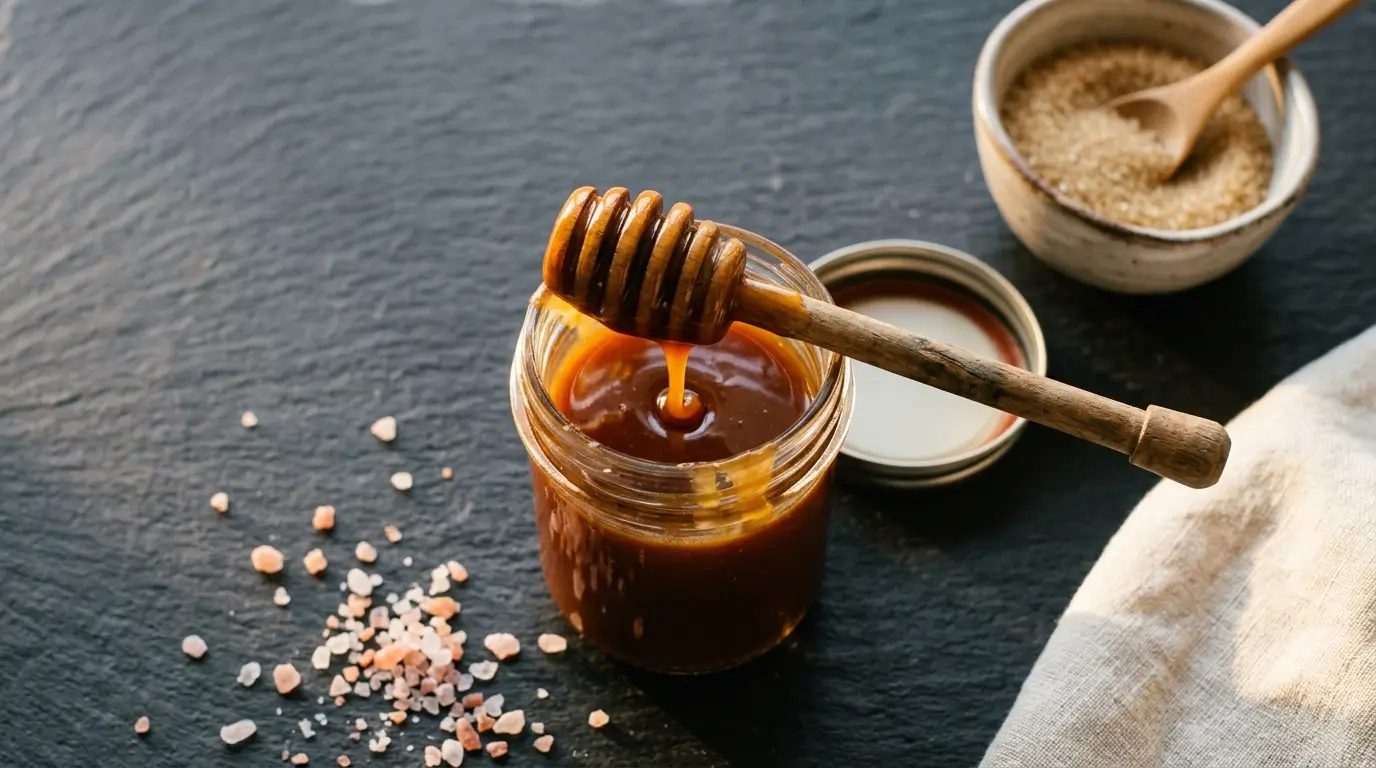
This pink salt caramel sauce takes 15 minutes, uses 4 pantry staples, and finishes with a pinch of flaky pink Himalayan salt that sets it apart from every jar of store-bought caramel you’ve ever tasted. The salt doesn’t just balance sweetness — it contributes a clean, subtle mineral note that lingers after every bite. Make it once on a Sunday afternoon and you’ll have a jar in your refrigerator for the rest of the month.
Ingredients
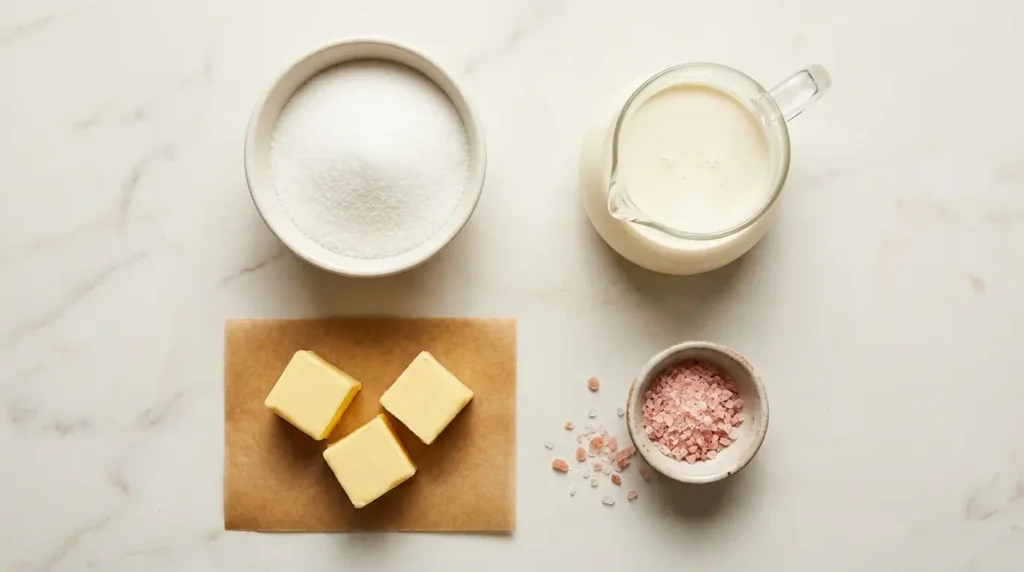
The recipe works with four ingredients:
- 1 cup (200g) granulated white sugar
- ½ cup (120ml) heavy cream, warmed
- 3 tablespoons (42g) unsalted butter, cut into cubes
- ½ teaspoon flaky pink Himalayan salt, plus more to taste at the finish
Why heavy cream, not milk: Milk lacks the fat content required for a stable emulsion. The sauce will separate or seize at temperature. Use heavy cream at 36% fat or above.
Why unsalted butter: Salt control belongs entirely to the pink Himalayan flakes you add at the end. Salted butter introduces an unpredictable amount of sodium and muddies the mineral finish that makes this caramel distinctive.
How to Make Pink Salt Caramel Sauce
There are two ways to melt sugar into caramel: the dry method and the wet method. The dry method — used here — produces a deeper amber color and a slightly more complex, almost butterscotch-edged flavor. The trade-off is that it moves fast and requires your full attention.
Equipment: A heavy-bottomed stainless steel or light-colored saucepan (at least 2-quart capacity), a silicone spatula, and a clean glass jar for storage. Do not use a nonstick pan — nonstick coatings degrade at the temperatures required for caramelization (320–350°F / 160–177°C).
Step 1 — Dry-melt the sugar
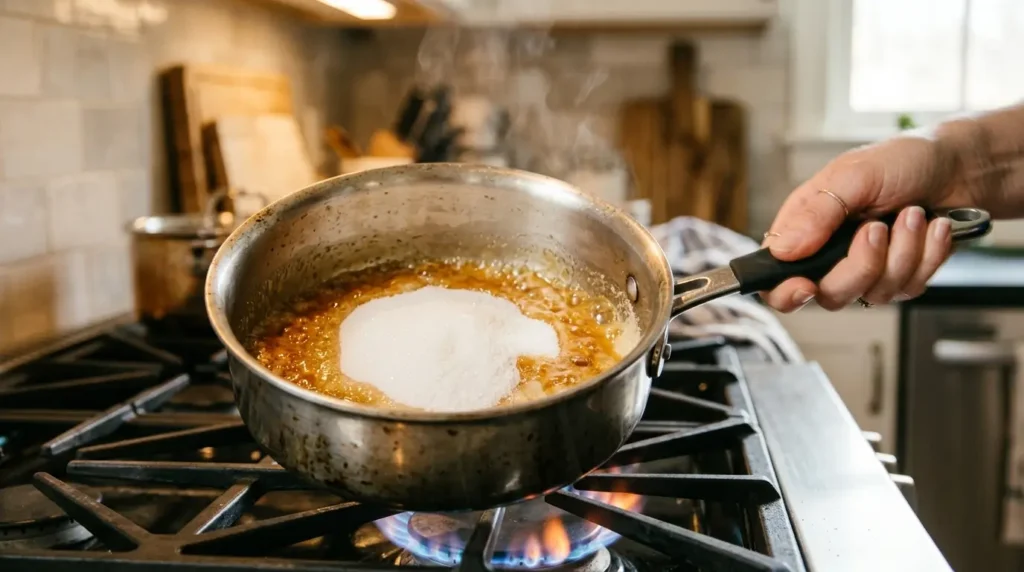
Pour the granulated sugar into your saucepan in an even, level layer. Set the heat to medium. Do not stir. After 2–3 minutes, the edges will begin to liquefy and turn pale gold.
Step 2 — Swirl, don’t stir
Once the edges start to melt, gently swirl the pan to nudge unmelted sugar toward the liquid center. Vigorous stirring encourages recrystallization — avoid it. Continue swirling every 30 seconds. The sugar will progress through pale gold, golden amber, and finally deep amber over 5–7 minutes total. Your target is a rich copper-brown color at around 340–350°F (171–177°C). If it begins to smell bitter or the edges start to smoke, move immediately to the next step — it’s approaching burned.
Step 3 — Add the cream carefully
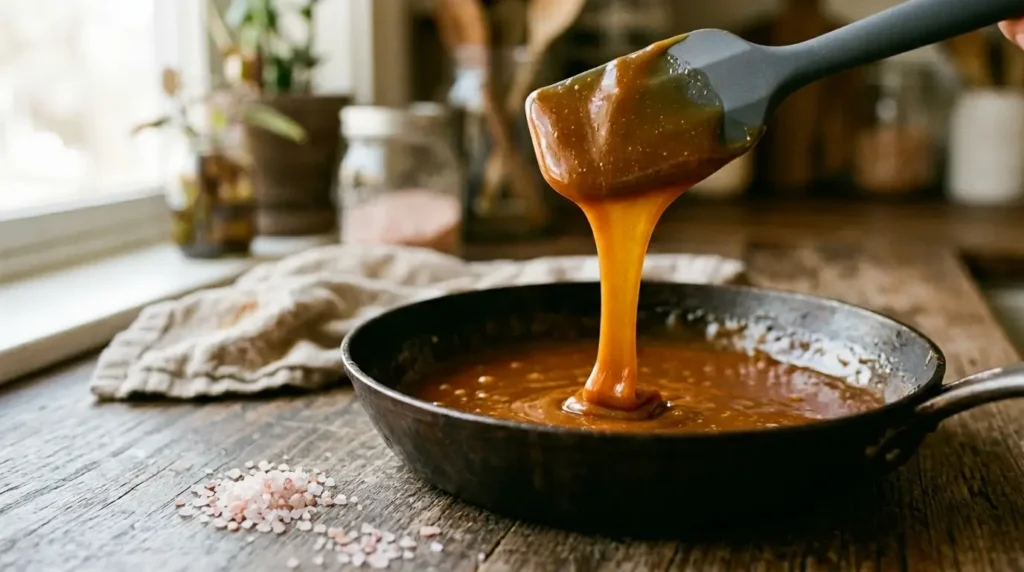
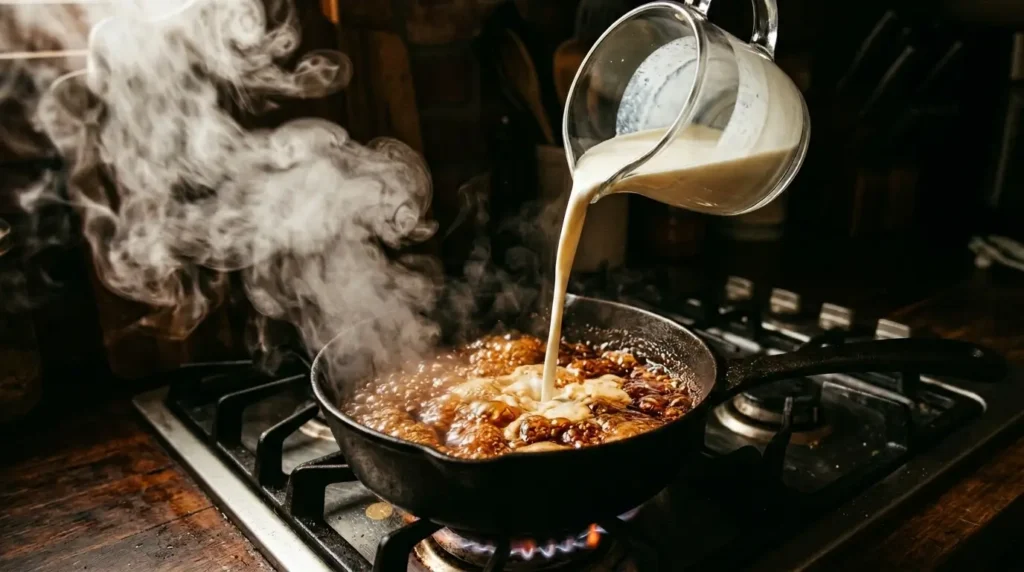
Remove the pan from the heat. Pour in the warm heavy cream all at once. The mixture will bubble aggressively — this is expected. Stir from the bottom with your spatula until the bubbling subsides and the sauce is smooth.
Warm the cream first. Cold cream hitting molten sugar causes violent splatter and can seize the caramel into a solid mass. Thirty seconds in the microwave is enough; you want warm, not hot.
Step 4 — Stir in the butter
Return the pan to low heat. Add the butter cubes one at a time, stirring each piece fully into the sauce before adding the next. This process emulsifies the fat into the sugar and gives the finished sauce its glossy, pourable consistency.
Step 5 — Finish with pink salt
Remove from heat. Stir in ½ teaspoon of flaky pink Himalayan salt. Taste the sauce, and if you want a more pronounced mineral finish — the kind that makes artisan salted caramels memorable — add another small pinch. Pour into a glass jar and allow it to cool for 10 minutes before using.
PrintPink Salt Caramel Sauce
This pink salt caramel sauce takes 15 minutes, uses 4 pantry staples, and finishes with a pinch of flaky pink Himalayan salt that sets it apart from every jar of store-bought caramel you’ve ever tasted. The salt adds a clean, subtle mineral note that lingers after every bite. Make it once and you’ll have a jar in your refrigerator for the rest of the month.
- Prep Time: 5
- Cook Time: 10
- Total Time: 15
- Yield: 1 cup (about 8 servings)
- Category: Sauce
- Method: Stovetop
- Cuisine: American
Ingredients
- 1 cup (200g) granulated white sugar
- ½ cup (120ml) heavy cream, warmed
- 3 tablespoons (42g) unsalted butter, cut into cubes, room temperature
- ½ teaspoon flaky pink Himalayan salt, plus more to taste at the finish
Instructions
- Dry-melt the sugar. Pour the granulated sugar into a heavy-bottomed saucepan in an even, level layer. Set the heat to medium. Do not stir. After 2–3 minutes the edges will begin to liquefy and turn pale gold.
- Swirl, don’t stir. Once the edges start to melt, gently swirl the pan to move unmelted sugar toward the liquid center. Continue swirling every 30 seconds. The sugar will progress through pale gold, golden amber, and finally deep amber over 5–7 minutes. Target a rich copper-brown color at around 340–350 °F (171–177 °C). If it begins to smell bitter or the edges smoke, move immediately to the next step.
- Add the cream carefully. Remove the pan from the heat. Pour in the warm heavy cream all at once — the mixture will bubble aggressively. Stir from the bottom with a silicone spatula until the bubbling subsides and the sauce is smooth.
- Stir in the butter. Return the pan to low heat. Add the butter cubes one at a time, stirring each piece fully into the sauce before adding the next. This emulsifies the fat into the caramel and creates a glossy, pourable consistency.
- Finish with pink salt. Remove from heat. Stir in ½ teaspoon of flaky pink Himalayan salt. Taste and add another pinch if you want a more pronounced mineral finish. Pour into a clean glass jar and cool for 10 minutes before using.
Notes
Warm your cream before you need it. Cold cream hitting molten sugar causes violent splatter and can seize the caramel solid. Thirty seconds in the microwave is enough.
Use a light-colored pan. A dark or nonstick pan hides the amber color change until it’s too late. Stainless steel or an enameled saucepan is ideal.
Storage: Refrigerator up to 1 month; room temperature (cool, dark pantry) up to 2 weeks; freezer up to 3 months. To re-liquefy, microwave in 15-second bursts or set the jar in a bowl of warm water.
Troubleshooting — grainy / crystallized caramel: Caused by stirring too early. For the dry method, only swirl — never stir. To rescue: add 1 tablespoon of water and return to low heat to re-dissolve.
Troubleshooting — burned caramel: No fix; start fresh. Use a light-colored pan and do not leave the stove during the final 2 minutes.
Troubleshooting — caramel seized when cream was added: Always warm the cream first. If it seizes, return to low heat and stir patiently — it will re-melt within 3–4 minutes.
Troubleshooting — too thin: Cook over medium-low for 2–3 more minutes, stirring constantly. The sauce also thickens as it cools.
Troubleshooting — too thick: Stir in 1 tablespoon of warm heavy cream over low heat until smooth.
Why Pink Salt Makes a Better Caramel
Standard table salt does work in caramel, but it dissolves completely and delivers a flat, sharp bite at the back of the palate. Flaky pink Himalayan salt behaves differently in two meaningful ways.
Texture: Flaky crystals don’t fully dissolve into the sauce. Instead, they remain partially intact, creating small bursts of salt flavor as you eat. That contrast — smooth, sweet caramel punctuated by a sudden hit of mineral — is exactly what separates a standout salted caramel from a forgettable one.
Flavor: Pink Himalayan salt has a subtler, rounder salinity than table salt. Its trace mineral content gives it a faint mineral finish that reads as complexity rather than sharpness. It doesn’t make the sauce taste saltier; it makes it taste more complete.
This is the same principle behind finishing any dish with flaky salt rather than cooking salt. If you want a deeper dive into when and why finishing salts matter, see our guide to pink salt finishing flakes.
Storage
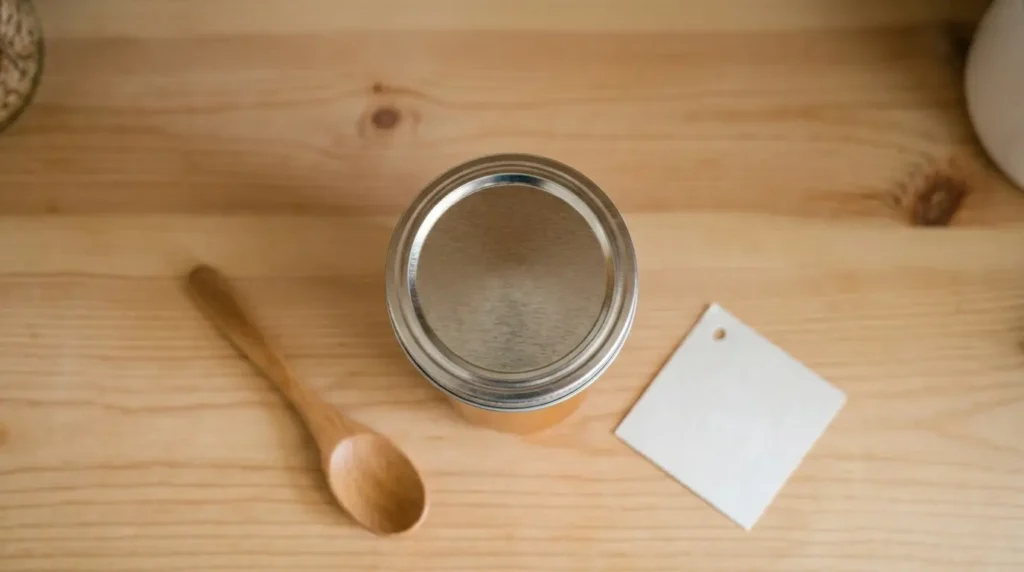
Transfer the cooled sauce to a clean glass jar with a tight-fitting lid.
- Room temperature (cool, dark pantry): up to 2 weeks
- Refrigerated: up to 1 month
- Frozen: up to 3 months — thaw overnight in the refrigerator
Refrigerated caramel thickens to a spreadable, almost toffee-like consistency. To return it to a pourable sauce, microwave the open jar in 15-second increments, stirring between each, until it loosens. Alternatively, set the jar in a bowl of warm water for 5 minutes — slower, but more controlled.
What to Use It On
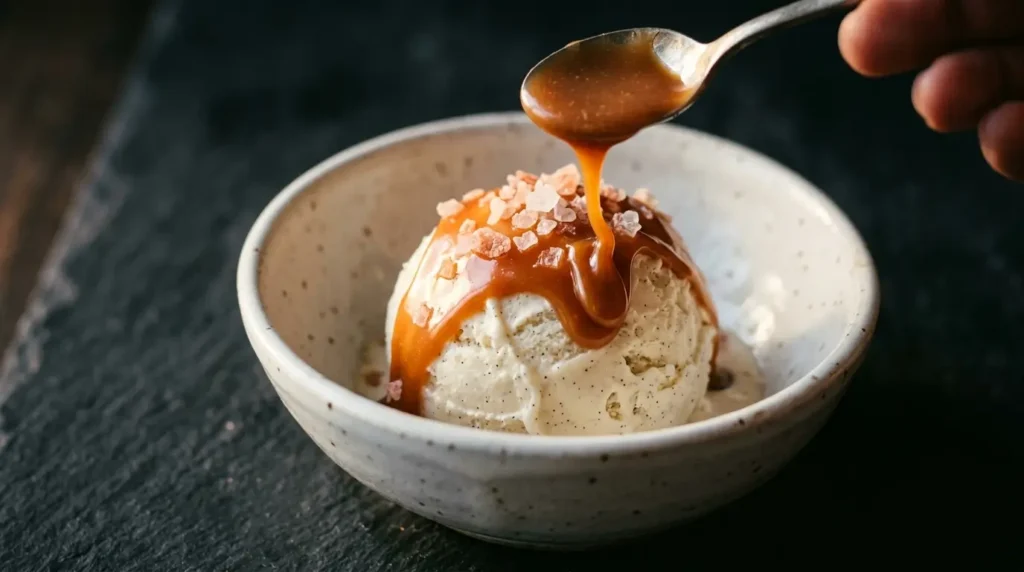
Once you have a jar of this himalayan salt caramel in the refrigerator, the uses are genuinely endless. Here are the ones worth highlighting:
Vanilla ice cream: The classic application. A generous spoonful while the sauce is still slightly warm, the salt amplifying the vanilla and cutting through the richness of the cream.
Baked or fresh apples: Whether you’re dipping raw slices or spooning sauce over a baked apple, the slight bitterness of apple skin plays off the sweet caramel the same way the salt does.
Brownies: Drizzle over fudge brownies right out of the oven, or swirl a tablespoon into the batter before baking for a marbled effect that bakes into the crumb.
Cheesecake: As a finishing pour over plain New York cheesecake in place of fruit compote. The salt cuts through the density of the cream cheese beautifully.
Coffee: A tablespoon stirred into strong black coffee with a splash of cream makes a genuinely good caramel latte without the sugar-syrup sweetness of café versions.
This sauce also pairs naturally with pink salt chocolate chip cookies — use it as a warm dip or drizzle it over the cookies straight from the oven.
Troubleshooting
The most common caramel failures each have a specific cause and, in several cases, a fix.
The caramel crystallized and turned grainy.
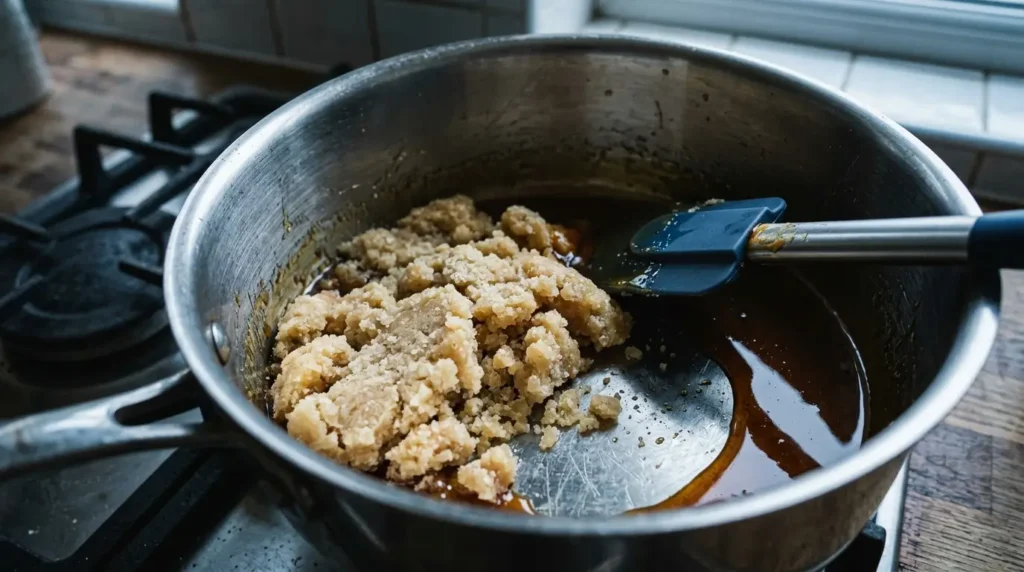
This almost always results from stirring too early or too aggressively. Disturbing sugar molecules during melting can trigger a chain reaction of recrystallization that turns your amber sauce into a gritty, lumpy mass. For the dry method: do not stir, only swirl. If crystallization starts before all the sugar has melted, you can sometimes rescue it by adding one tablespoon of water and returning to low heat to re-dissolve the crystals. If the entire pan has seized solid, it’s more efficient to start over.
The caramel burned.
Caramelized sugar passes through its ideal window — roughly 340–350°F (171–177°C) — quickly, and the window between perfect and bitter-burned is only about 20°F (11°C) wide. If your sauce tastes acrid, it cannot be corrected; start fresh. Two things help: use a light-colored or stainless saucepan so you can accurately read the amber color, and do not walk away from the stove during the final 2 minutes of caramelization.
The sauce seized when I added the cream.
Cold cream hitting molten sugar causes the sugar to harden into a solid clump at the bottom of the pan. Always warm your cream before it’s needed. If the caramel does seize, don’t panic — return the pan to low heat and stir patiently. The seized sugar will usually re-melt into the warmed cream within 3–4 minutes.
The sauce is too thin.
Return the finished sauce to the stove over medium-low heat and cook for an additional 2–3 minutes, stirring constantly. Caramel sauce thickens as it reduces and thickens further as it cools. A sauce that appears slightly loose at 170°F (77°C) will set to the correct consistency at room temperature. Chill it briefly in the refrigerator if you need faster results.
The sauce is too thick.
Stir in a tablespoon of warm heavy cream and mix over low heat until smooth and pourable. Add in small increments — it’s easier to thin a sauce than to thicken one.
For more pink salt recipes where a single finishing ingredient changes the entire dish, explore the recipes section.