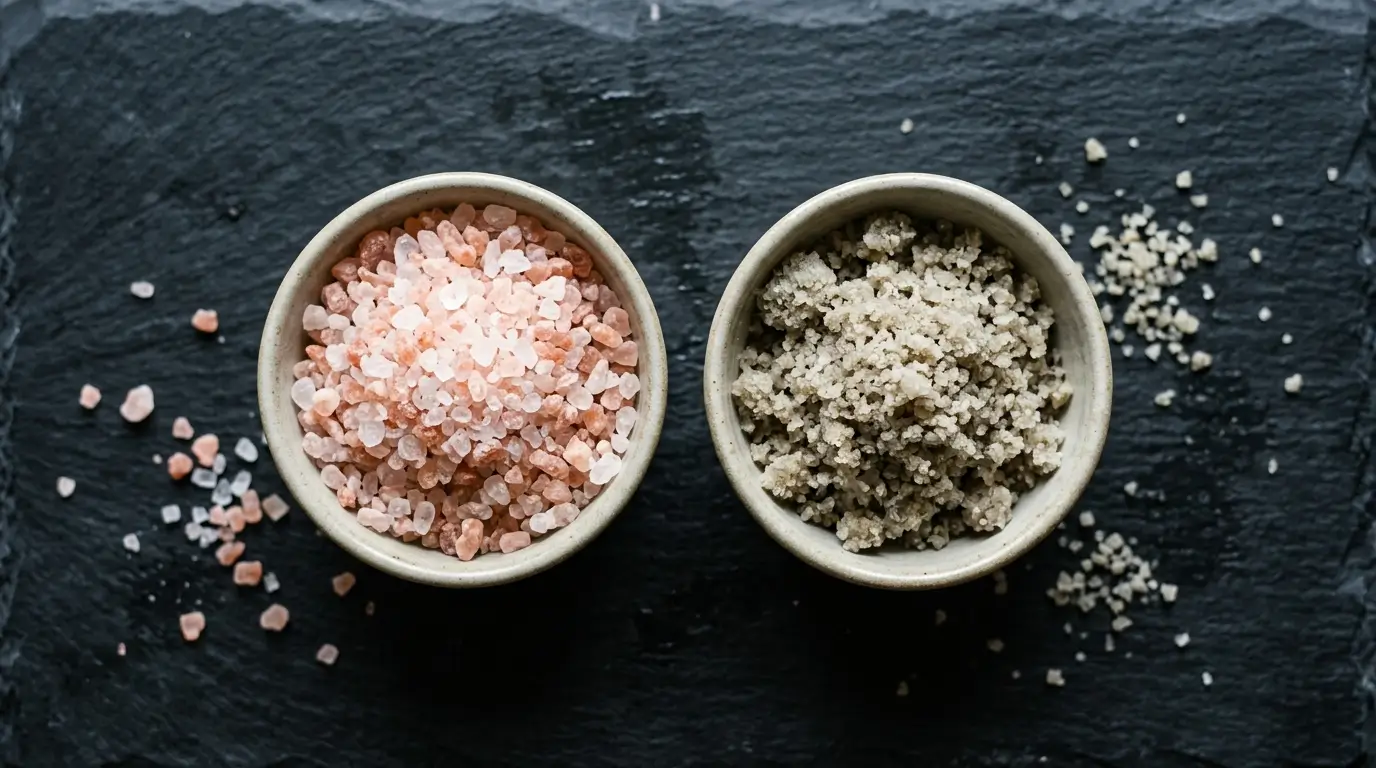
Pink Himalayan salt and Celtic sea salt are two of the most popular artisan salts on the market, and they are often mentioned in the same breath. Both carry a premium price tag, both are sold as less processed alternatives to table salt, and both attract buyers who care about where their food comes from. But they are fundamentally different products — different origins, different mineral makeups, different textures, and notably different moisture levels that matter a great deal the moment you bring either one into a baking recipe.
This comparison covers what actually sets them apart and helps you decide which one deserves a place on your counter.
Quick Verdict
For dry seasoning, grilling, and finishing, pink Himalayan salt is the easier, more predictable choice. It is bone-dry, free-flowing, and consistent in texture across brands.
For bold, briny flavor and high-mineral cooking, Celtic sea salt (also called sel gris, or grey salt) delivers something Himalayan cannot — genuine oceanic salinity backed by naturally occurring magnesium and trace minerals from coastal clay. The trade-off is moisture: Celtic salt is wet by nature, which changes how you measure it, how you store it, and how it performs in baked goods.
Neither is universally better. They solve different problems.
How Each Salt Is Harvested
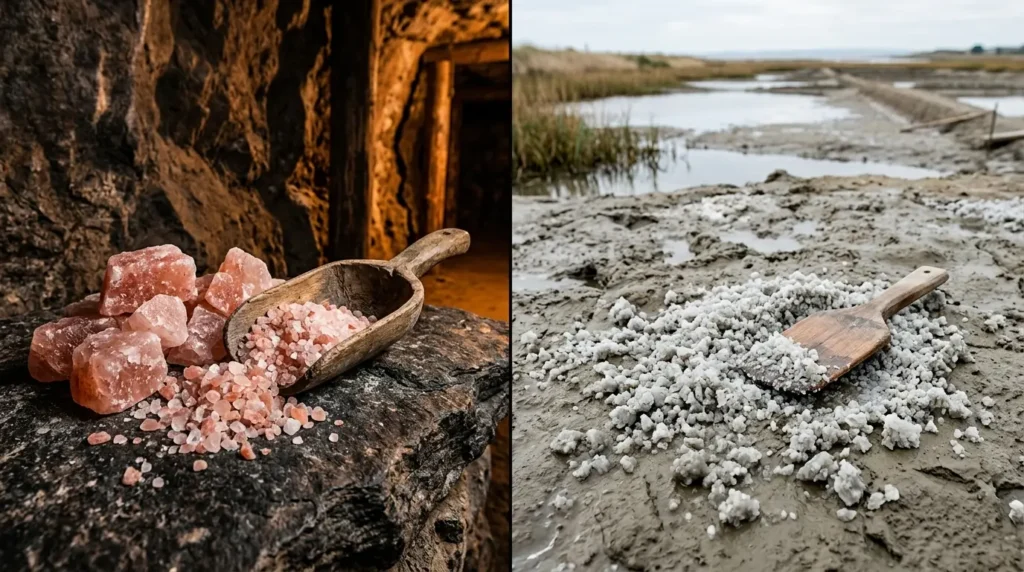
Pink Himalayan salt is mined. It comes from the Khewra Salt Mine in Punjab, Pakistan — one of the largest and oldest salt mines in the world — where ancient seabed deposits formed roughly 250 million years ago. The salt is extracted by hand or mechanical mining, then crushed, sorted, and packaged with minimal processing. Its pink color comes from trace iron oxide embedded in the crystal structure. Because it has been sealed underground for hundreds of millions of years, it contains no seawater moisture and arrives at your kitchen completely dry.
Celtic sea salt is harvested. It comes from the shallow tidal salt marshes along the coast of Brittany in northwestern France, though similar grey salts are also produced in Portugal and other Atlantic coastal regions. Traditional paludiers (salt farmers) guide Atlantic seawater into a system of clay-lined pools called oeillets and wait for the sun and wind to evaporate the water over weeks. The crystals are hand-raked before they fully dry, which is exactly what keeps Celtic salt moist. The grey color comes from the clay minerals in the harvesting beds, and that clay contributes a portion of the mineral content as well.
The contrast in origin sets up every difference that follows.
Moisture Content: The Most Practical Difference
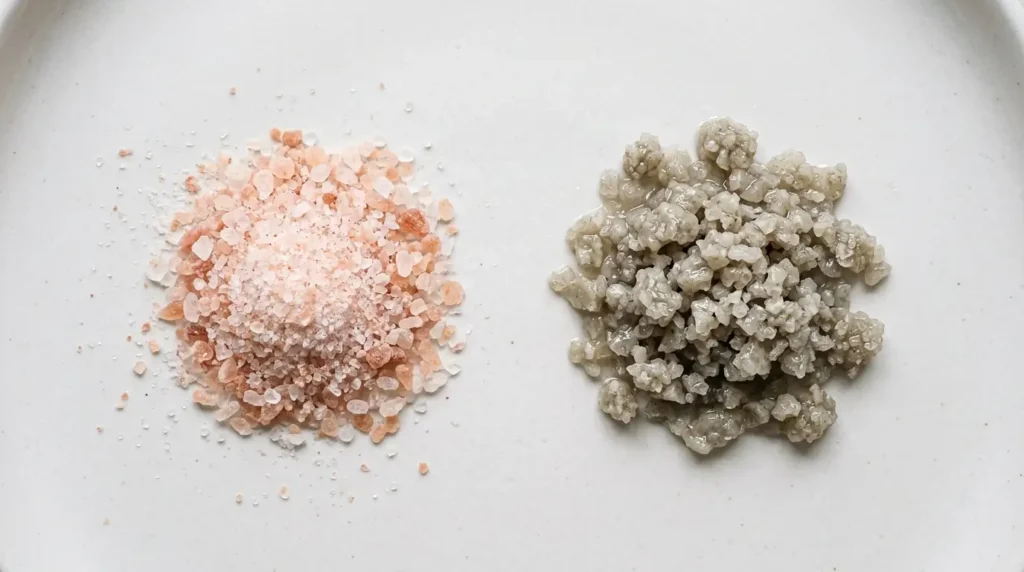
Celtic sea salt retains 10 to 15 percent moisture by weight. Pink Himalayan salt contains essentially zero.
This gap is not a flaw in Celtic salt — it is a deliberate characteristic. The moisture preserves a softer crystal that dissolves readily and carries a more complex flavor. But it creates very practical consequences in the kitchen:
Measuring by volume is unreliable with Celtic salt. Because the crystals clump and pack differently depending on how much moisture they are holding on a given day, a teaspoon of Celtic sea salt can vary significantly in actual sodium content. For everyday seasoning at the table or finishing a dish, this inconsistency is barely noticeable. For baking, it matters. A bread or cookie recipe calling for a precise amount of salt by volume can be thrown off by Celtic salt’s variability. If you bake regularly with Celtic salt, weighing it on a kitchen scale is the more accurate approach.
Celtic salt can introduce extra water into baked recipes. In a recipe like sourdough bread or shortbread cookies where hydration percentages matter, the residual moisture in Celtic salt is a real variable. Experienced bakers account for it; beginners rarely realize it is happening.
Pink Himalayan salt behaves predictably. It flows freely, measures consistently, and does not add moisture to anything. For baking, it is the lower-risk option.
Storage differs too. Celtic salt should be kept in a ceramic crock or any container that allows slight airflow. If sealed in an airtight jar, its moisture can cause it to cake into a solid mass. Pink Himalayan salt can be stored in any container and will not clump.
Mineral Profiles
Both salts contain trace minerals beyond sodium chloride, though the amounts are small and the profiles differ.
| Mineral | Pink Himalayan Salt | Celtic Sea Salt |
|---|---|---|
| Sodium chloride | ~85% | ~80–84% |
| Magnesium | Trace | Higher (absorbed from clay beds) |
| Iron | Higher (source of pink color) | Low |
| Calcium | Trace | Trace |
| Potassium | Trace | Trace |
| Moisture | ~0% | 10–15% |
Celtic sea salt’s standout mineral is magnesium, which it absorbs in meaningful quantities from the clay-lined harvesting pools. Pink Himalayan salt’s standout is iron, which gives it its characteristic color but is present in tiny quantities relative to any dietary significance.
Both salts contain trace amounts of 80-plus minerals, a figure you will see often in marketing. The honest context is that sodium chloride makes up the overwhelming majority of both salts, and the trace minerals — while real and measurable — are present in amounts too small to meaningfully affect your nutrition at normal serving sizes. The flavor and texture differences are genuine; the mineral health claims are largely overstated for both products.
Taste
Pink Himalayan salt tastes clean and mildly salty. Many cooks describe it as a purer, slightly softer version of table salt, without the metallic edge that iodized salt can carry. It does not have a strong flavor identity of its own; it seasons food rather than flavoring it.
Celtic sea salt tastes more complex — brinier, with a slight mineral earthiness that reflects both its coastal origin and the clay-mineral content. It is noticeably more assertive. On a slice of buttered bread or sprinkled over a piece of fish, Celtic salt’s flavor is present in a way that pink salt’s is not. Some tasters detect a faint sweetness alongside the saltiness.
For finishing — the final flick of salt over a finished dish — Celtic salt tends to contribute more to the eating experience. For background seasoning in a recipe where the salt is one of many components, the flavor difference between the two becomes harder to detect.
Cost per Ounce
Both salts sit in a similar premium price tier, though Celtic salt often costs slightly more, particularly for hand-harvested French sel gris from established producers.
As a rough benchmark:
- Pink Himalayan salt (fine or coarse): typically $0.30–$0.60 per ounce for well-known brands in bulk bags; higher for small specialty jars.
- Celtic sea salt (coarse grey): typically $0.40–$0.80 per ounce for quality French-harvested versions; Portuguese and domestic Atlantic versions trend lower.
Neither salt is an everyday grocery budget item in the way that table salt is, but both are accessible enough that cost is rarely the deciding factor for home cooks who have already chosen to buy artisan salt.
Best Use for Each
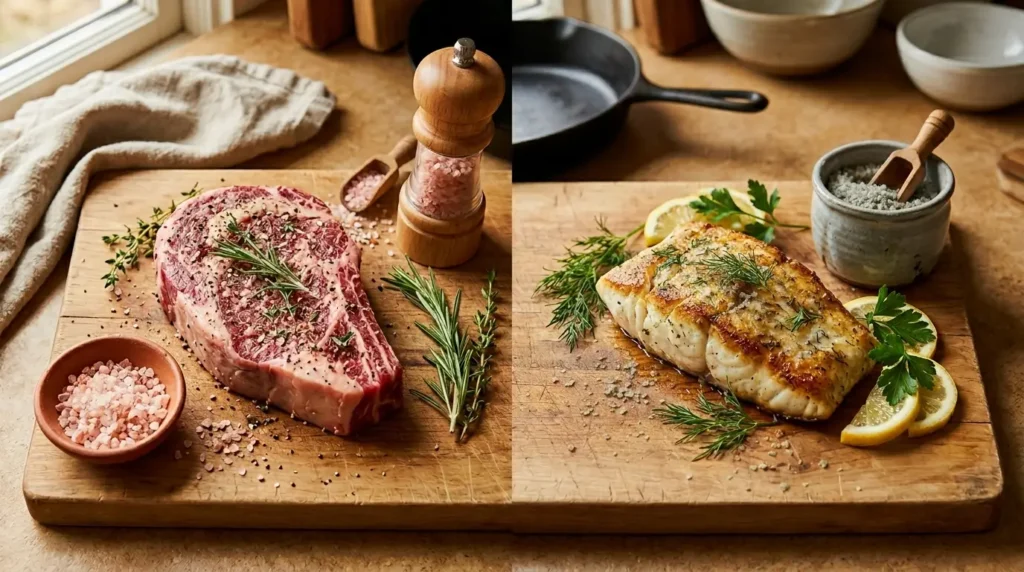
Pink Himalayan salt is best for:
- Baking — its dry, consistent texture is the safer choice when a recipe depends on precise salt measurement
- Grilling and dry rubs — it adheres well to meat without adding moisture
- Salt mills and grinders — its low moisture content means it will not clog the mechanism
- Salt blocks — Himalayan salt block cooking is done with pink Himalayan salt specifically
- Everyday kitchen use — it flows freely and is easy to pinch and sprinkle
Celtic sea salt is best for:
- Finishing seafood, fish, and vegetables — its briny, complex flavor shines when it is not buried in a dish
- Bread baking (by weight) — experienced bakers appreciate the depth it adds to sourdough and rustic loaves
- Cheesemaking and fermentation — the mineral content is valued in traditional preservation
- Fleur de sel applications — the hand-harvested top-skimmed crystals (fleur de sel) are the most delicate version, reserved for finishing
- Cooking at the table — where the salt’s flavor can be appreciated directly
Which to Keep in Your Pantry
If you can only keep one, the choice comes down to how you cook.
Keep pink Himalayan salt if you bake regularly, use a salt mill, or want a reliable all-purpose salt that behaves predictably in any application. Its consistency and dryness make it the lower-friction everyday option.
Keep Celtic sea salt if you want a salt with stronger flavor character and don’t mind the moisture variability — especially if you cook a lot of seafood, are drawn to traditional French or Portuguese food culture, or you weigh your salt rather than measure by volume.
Keep both if you want to use the best tool for the job. Pink salt as the workhorse for cooking and baking; Celtic salt for finishing and table use. Many serious home cooks do exactly this, and neither salt is expensive enough to make the duplication impractical.
The Bottom Line
Pink salt and Celtic sea salt are more different than they appear side by side on a store shelf. The origin is different — ancient mine versus living tidal flat. The texture is different — powder-dry versus damp and chunky. The flavor is different — clean and neutral versus briny and mineral. And crucially, the moisture content makes them behave differently the moment you start measuring them in a baking recipe.
Neither is a superior salt in the absolute sense. Pink Himalayan salt wins on convenience, consistency, and ease of use. Celtic sea salt wins on flavor complexity and a genuinely interesting harvest tradition. Understanding those differences is what lets you reach for the right one.
For a broader look at how pink salt compares to other alternatives, see our guide to pink salt vs other salts. If you are specifically comparing to regular sea salt, the pink salt vs sea salt article covers that in depth.