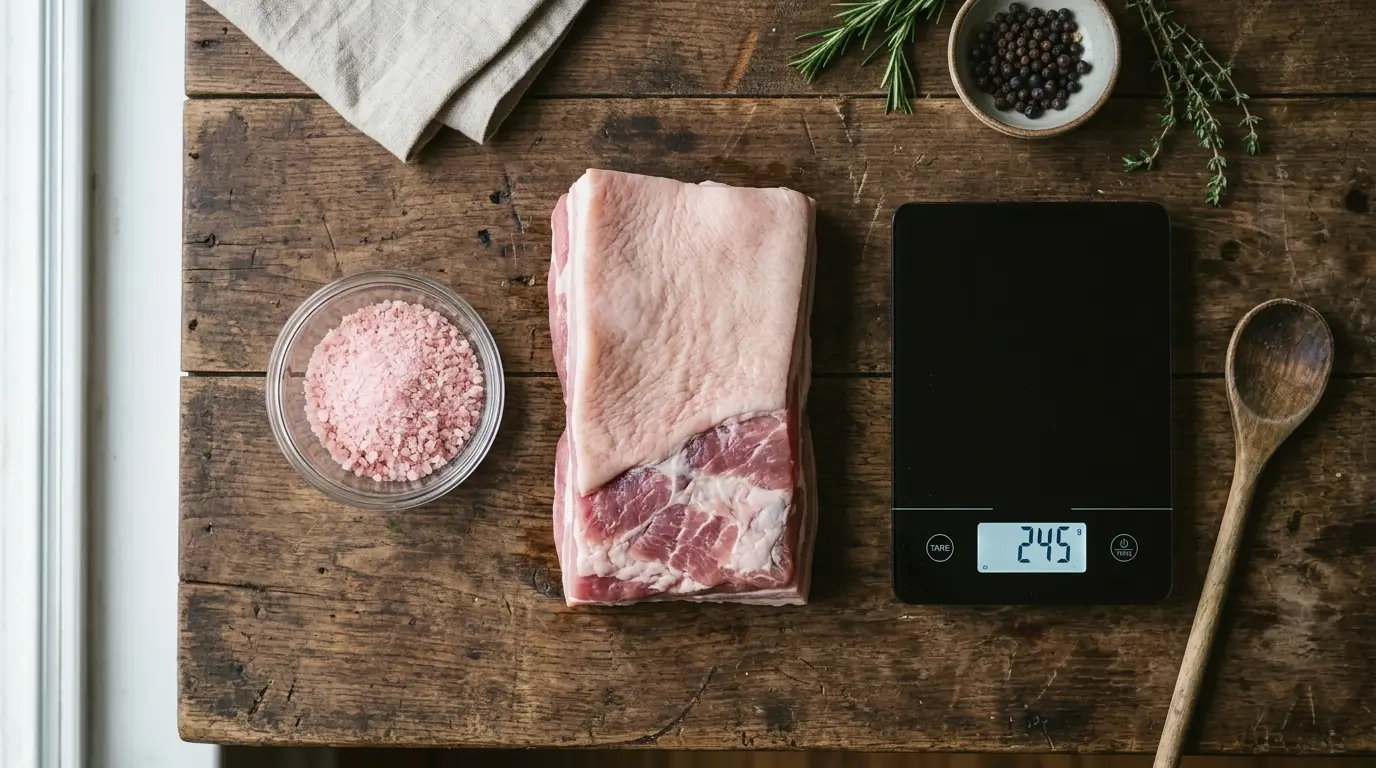
Pink curing salt is one of the most misunderstood ingredients in home charcuterie — and also one of the most important to get right. Used correctly, it prevents dangerous bacterial growth in cured meats and gives bacon, ham, and jerky their characteristic color and flavor. Used incorrectly, it poses a serious health risk.
This guide covers everything you need to use pink curing salt safely: the correct ratios, the difference between Prague Powder #1 and #2, dry-cure versus wet-brine methods, and the mistakes that home curers make most often.
Before diving in, one critical point: if you arrived here searching for information about Himalayan pink salt — the mineral-rich rock salt used as a cooking seasoning — you’re in the wrong place. Pink curing salt and Himalayan pink salt are entirely different products. Read our complete guide to pink curing salt for a full explanation of what sets them apart and why confusing the two is dangerous.
The Fundamental Rule: 1 Teaspoon per 5 Pounds of Meat
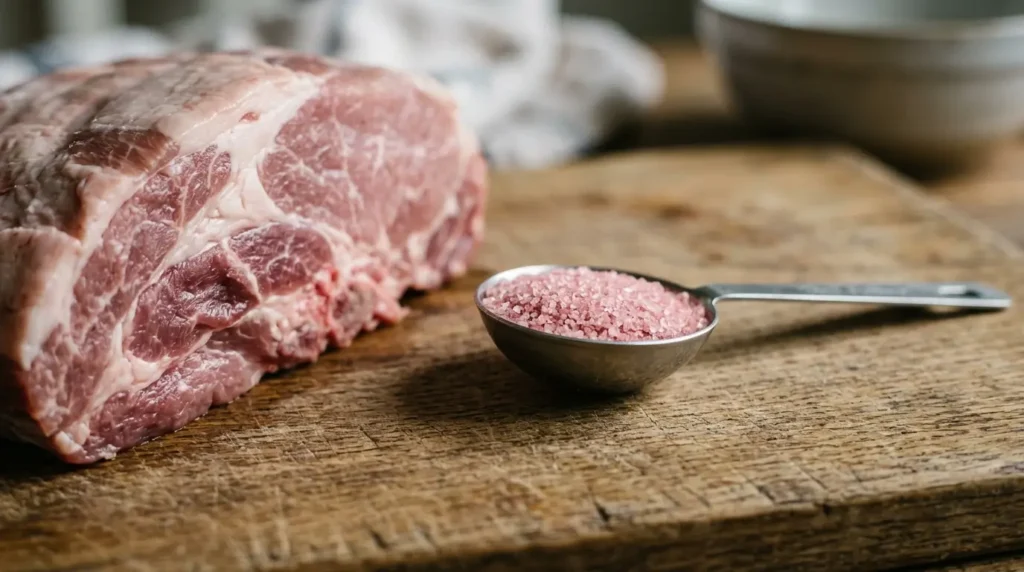
For home curing with Prague Powder #1, the standard measurement is:
1 level teaspoon (approximately 5.7 grams) of Prague Powder #1 per 5 pounds (2.27 kg) of meat.
This ratio — roughly 0.25% by weight of curing salt relative to the weight of the meat — is the baseline used by the USDA and by professional charcutiers alike. Every application method (dry cure, wet brine, injection) starts from this number.
Do not exceed it. More curing salt does not mean more protection or better flavor. It means excess sodium nitrite in the finished product, which is harmful in high concentrations.
Why Precision Matters
Pink curing salt — sold under brand names like InstaCure #1, DQ Curing Salt, and Prague Powder #1 — contains approximately 6.25% sodium nitrite by weight, with the rest being regular sodium chloride. The nitrite is what does the preservation work: it inhibits Clostridium botulinum, the bacterium responsible for botulism, and prevents the oxidation that causes rancidity in cured fats.
Sodium nitrite is effective in very small quantities. The same properties that make it an effective preservative also make it toxic in overdose. The USDA’s regulatory limit for nitrite in cured meat products is 156 parts per million (ppm), which corresponds closely to the 1 tsp per 5 lb ratio.
Home curers sometimes reason that “a little more won’t hurt.” That reasoning is wrong. The margin between effective and excessive is narrow, and scale errors — especially when working with large batches — can push a product well past safe levels. This is why weighing ingredients on a precision scale is strongly preferred over measuring by volume. More on that below.
Dry Cure Method
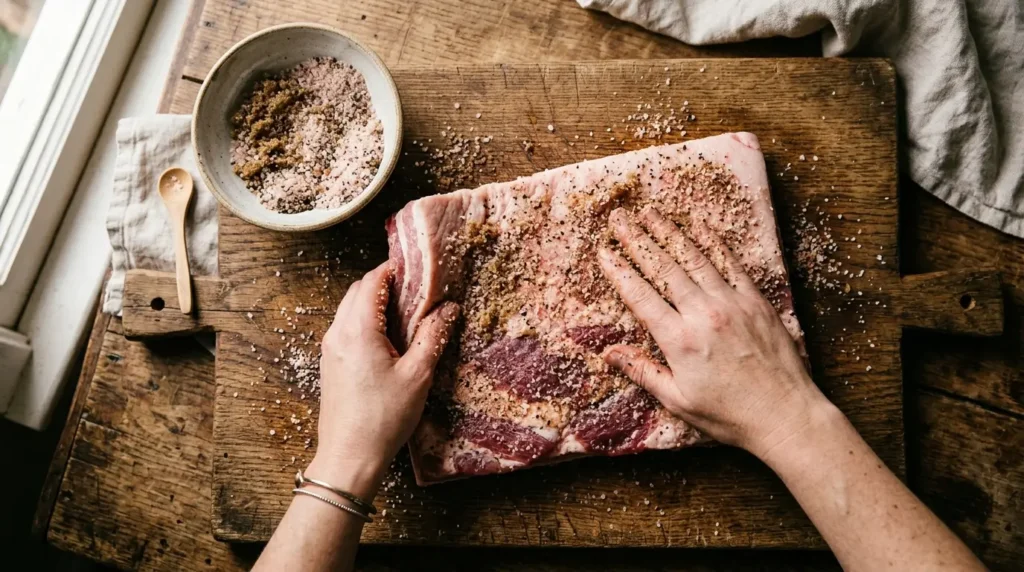
A dry cure rubs the curing mixture directly into the surface of the meat. This method works well for bacon, pancetta, ham, and duck prosciutto — cuts where the cure has enough surface area to penetrate the meat over several days.
Standard dry cure formula (per 5 lbs / 2.27 kg of meat):
- 1 tsp (5.7g) Prague Powder #1
- 2–3 tbsp kosher salt (adjust for your taste preference)
- 1–2 tbsp sugar, brown sugar, or maple syrup (optional, flavor only)
- Aromatics as desired (black pepper, garlic, juniper berries)
Steps:
- Weigh the meat before mixing the cure so your measurements are accurate.
- Combine the Prague Powder #1 with the salt and any other dry ingredients. Mix thoroughly — even distribution matters.
- Apply the mixture evenly to every surface of the meat, pressing it into any folds or crevices.
- Place the meat in a zip-lock bag or vacuum-seal bag and refrigerate at 36–40°F (2–4°C).
- Cure for approximately 1 day per ½ inch of thickness, or follow the specific recipe for the cut you’re working with.
- Flip the bag or re-apply if needed to ensure the cure reaches all surfaces as the meat releases liquid.
- After curing, rinse off the surface cure and proceed to smoking, cooking, or air-drying depending on the recipe.
Do not skip step 2. Unmixed curing salt that clumps on one area of the meat creates uneven nitrite distribution — one section may be over-cured while another is inadequately protected.
Wet Brine (Equilibrium Cure) Method
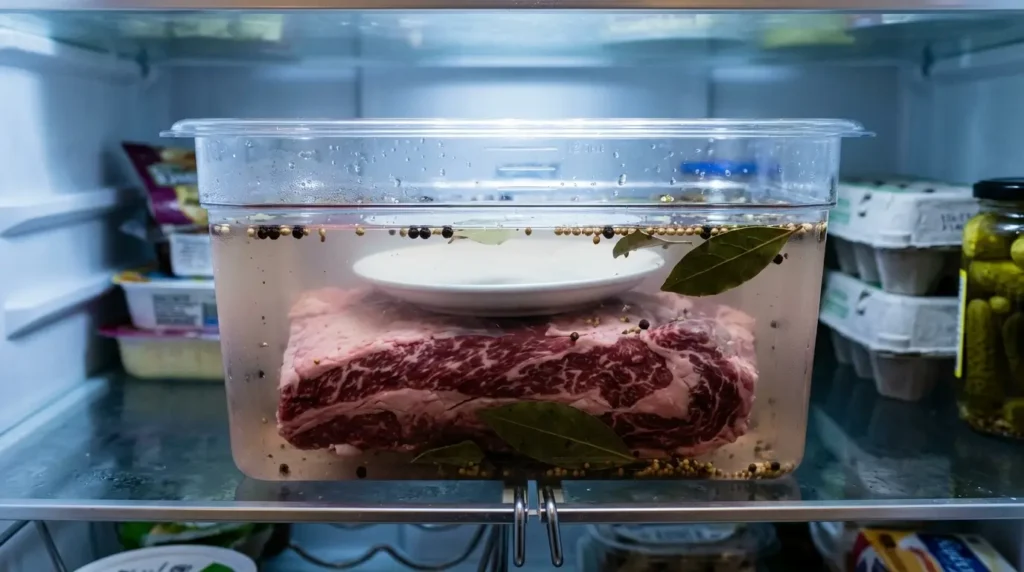
A wet brine — also called a pickle cure — dissolves the pink curing salt in water and submerges the meat. This method is well-suited to corned beef, pastrami, cured whole hams, and turkey breast. It produces a more evenly distributed cure and works faster on thicker cuts.
Standard wet brine ratio (for 1 gallon / 3.8L of water):
- 1 oz (28g) Prague Powder #1
- 1 cup (230g) kosher salt
- ½ cup (100g) sugar
- Aromatics (bay leaf, peppercorns, clove, coriander — as desired)
Combine the ingredients in water, stir to dissolve fully, and chill the brine to below 40°F before adding the meat. The meat must be fully submerged throughout the cure. Use a weight or plate to keep it under the surface if it floats.
Brine cure times depend on the cut:
- Thin cuts (turkey breast, pork belly): 5–7 days
- Corned beef brisket: 7–10 days
- Whole ham leg: 3–5 days per inch of thickness at the thickest point
For very thick cuts, food scientist Michael Ruhlman and co-author Brian Polcyn, in their authoritative reference Charcuterie, recommend injection brining — using a meat injector to deliver the brine into the center of thick muscles — in addition to surface submerging. This eliminates the risk of the center of a large cut remaining under-cured while the exterior over-cures.
Prague Powder #1 vs. Prague Powder #2: Which to Use
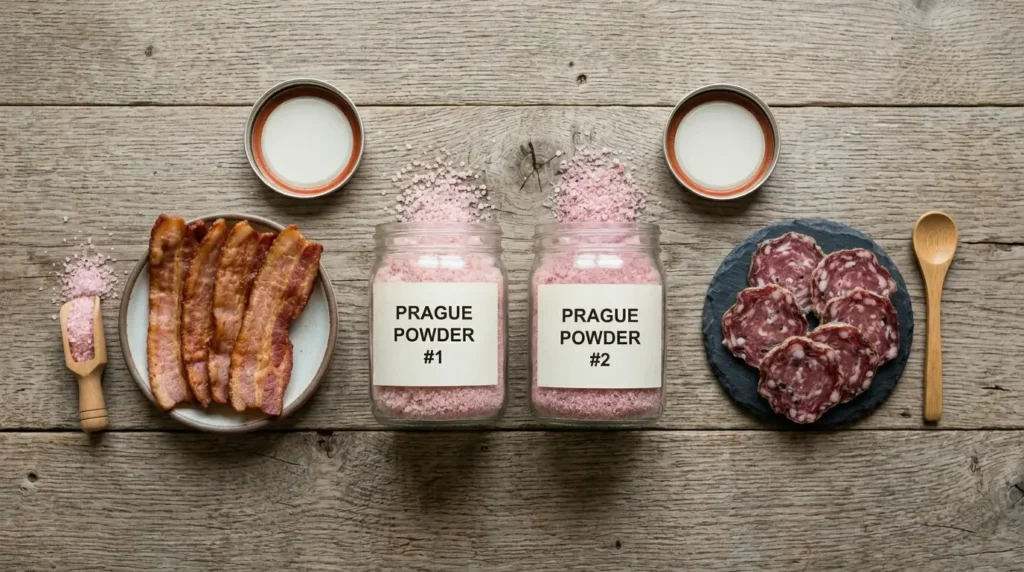
This is the most common point of confusion among first-time curers.
Prague Powder #1 (Pink Cure #1, InstaCure #1): Contains 6.25% sodium nitrite. Used for short-cure applications — anything that will be cooked or smoked within two weeks. Use it for:
- Bacon
- Canadian bacon
- Ham (cooked)
- Hot dogs and cooked sausages
- Corned beef and pastrami
- Jerky (if smoking at low temps)
Prague Powder #2 (Pink Cure #2, InstaCure #2): Contains 6.25% sodium nitrite and 4% sodium nitrate. The nitrate acts as a slow-release reservoir, converting to nitrite over time during long air-drying processes. Use it for:
- Dry-cured salami and pepperoni
- Dry-cured ham (prosciutto-style, country ham)
- Coppa and bresaola
- Any product that will cure for more than two weeks without cooking
Do not substitute one for the other. Using Prague Powder #2 in a quick-smoked bacon won’t ruin the product, but it adds unnecessary nitrate. Far more dangerous: using Prague Powder #1 in a 6-month dry-cured salami, which would leave the product without long-term nitrite protection as the sodium nitrite breaks down in the early weeks.
If you’re unsure which one applies to your recipe, the simplest rule is: If it will be cooked or smoked, use #1. If it will hang and air-dry for weeks, use #2.
Scales and Measurement: Use a Digital Kitchen Scale
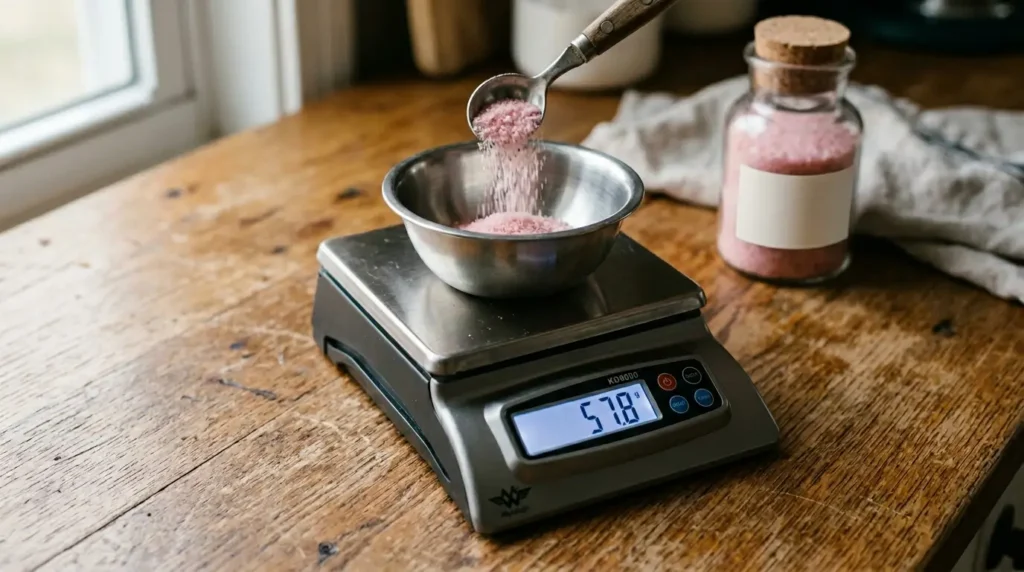
Volume measurements (teaspoons, tablespoons) are adequate for small home batches when you’re curing 5 lbs of meat at a time. For anything larger, or whenever you want precision, use a digital kitchen scale with 0.1g resolution.
Why this matters: 1 tsp of Prague Powder #1 weighs approximately 5.7 grams. If your spoon is slightly heaped or your pink curing salt is finely ground versus coarse, that weight can vary by 10–15%. Over 25 pounds of meat, a 15% variation in nitrite becomes meaningful.
The weight-based formula for Prague Powder #1 is: 2.5 grams of curing salt per kilogram of meat (or approximately 1.13g per pound).
Write this number down. Weigh your meat. Multiply. Weigh the curing salt on the scale. Mix it with your other cure ingredients before applying.
What Not to Do
Do not use pink curing salt as a seasoning salt. It is not a finishing salt, a cooking salt, or a table salt. It is an ingredient used in precise quantities for a specific purpose. Sprinkling it on food the way you would use regular salt is dangerous.
Do not confuse it with Himalayan pink salt. Both are pink. Both look like coarse salt. They are entirely different — if you’re not sure which is which, read our breakdown of pink curing salt versus Himalayan pink salt before opening either container.
Do not cure at room temperature. The protective effect of nitrite requires refrigerated conditions to be reliable. Curing meat at room temperature — even for a few hours — invites bacterial growth that curing salt alone cannot prevent.
Do not omit the cure from any recipe that calls for it. Some home cooks skip the curing salt to avoid nitrites, thinking the smoked product is “preserved enough.” Low-and-slow smoking, particularly in the 150–200°F range, creates conditions favorable to botulism without nitrite protection. The USDA recommends curing salt for all smoked meat products that do not reach an internal temperature of 160°F throughout.
Storage and Labeling
Pink curing salt must be stored in a clearly labeled, sealed container separate from your cooking salt, baking supplies, and spice rack. The pink dye is there specifically to make it visually distinct — but accidents happen when containers are unmarked.
Label every container with:
- Product name (“Prague Powder #1” or “Prague Powder #2”)
- Date of purchase
- Lot number if available (in case of a product recall)
Store in a cool, dry place away from heat sources and direct sunlight. Properly stored, pink curing salt has a shelf life of several years. Check for caking or unusual moisture before use, which can indicate exposure to humidity — this affects the weight-per-teaspoon measurement and can make dosing less reliable.
Keep it out of reach of children and pets. The quantity that would cause harm is small relative to what a container holds.
Summary
Pink curing salt is a precise, safety-critical ingredient — not a health risk when used correctly, and not interchangeable with any other salt. The core rules are simple:
- Use 1 tsp (5.7g) of Prague Powder #1 per 5 lbs of meat, or weigh it at 2.5g per kilogram.
- Use #1 for cooked and smoked products; use #2 for long air-dried cures.
- Cure under refrigeration at all times.
- Label your storage containers and keep them separated from cooking salts.
If you follow those four principles, pink curing salt is no more dangerous than any other specialized cooking ingredient — and considerably less forgiving when those principles are ignored.