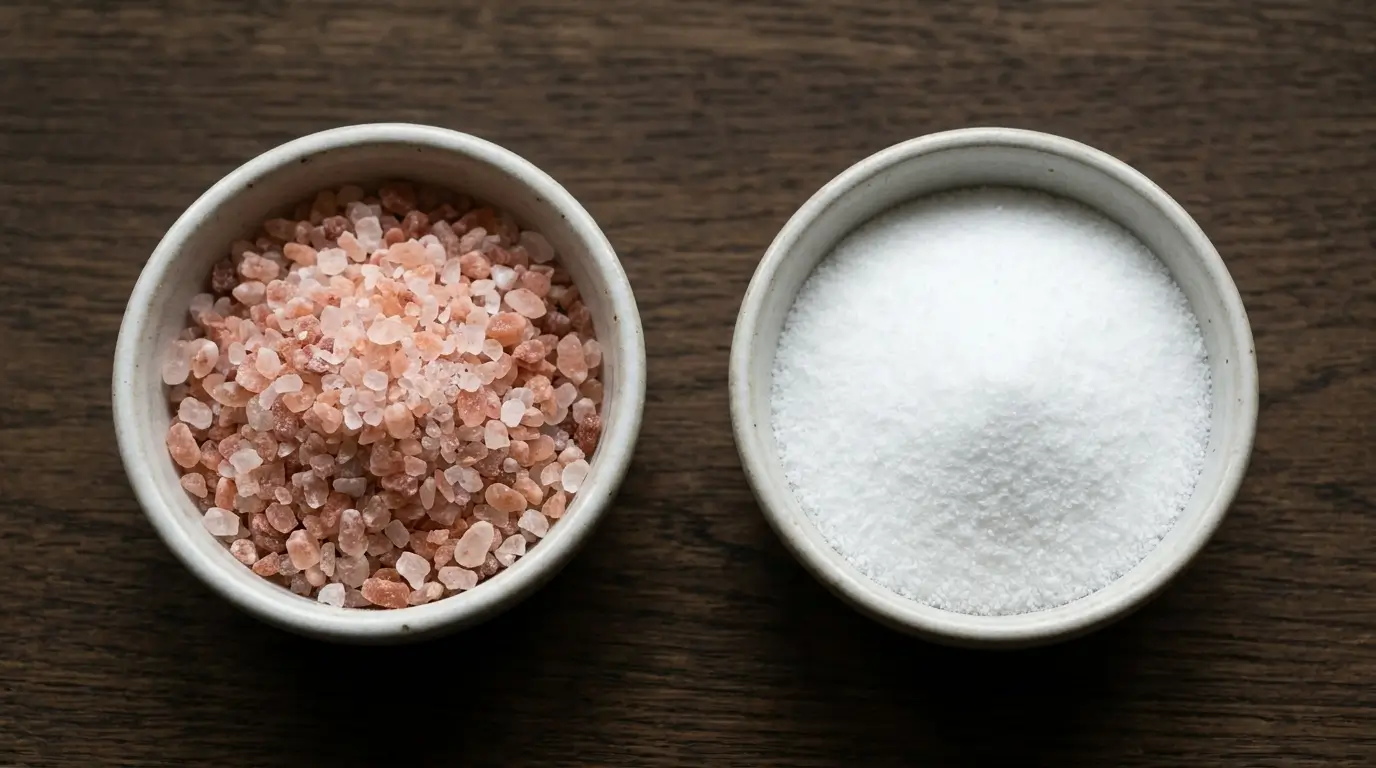
When you compare Himalayan pink salt vs table salt, the surprising part is how similar the two actually are. Both are made almost entirely of sodium chloride, so swapping in pink salt isn’t a low-sodium hack or a health upgrade over the regular salt already in your pantry. The real differences are smaller and more practical: pink salt is mined in large, minimally processed crystals and carries a handful of trace minerals that give it its color, while ordinary table salt is refined into a fine, consistent grain and, in most U.S. brands, fortified with iodine.
That last point, iodine, is the one difference with real nutritional weight behind it. Everything else, from crystal size to price to flavor, comes down to how you plan to cook. Here’s what the evidence actually shows about sodium, iodine, minerals, taste, and the best use for each salt.
The quick version:
- Both salts are chemically almost identical: overwhelmingly sodium chloride.
- Table salt is usually iodized in the U.S.; Himalayan pink salt naturally is not.
- Sodium by weight is nearly the same; sodium by teaspoon can differ because larger pink salt crystals leave more air in the spoon.
- Pink salt’s trace minerals (iron, calcium, potassium, magnesium) are real but far too small in a normal serving to change your nutrition.
- Neither salt is “healthier” for blood pressure — sodium affects the body the same way no matter what color the crystal is.
Himalayan Pink Salt vs Table Salt: Quick Comparison
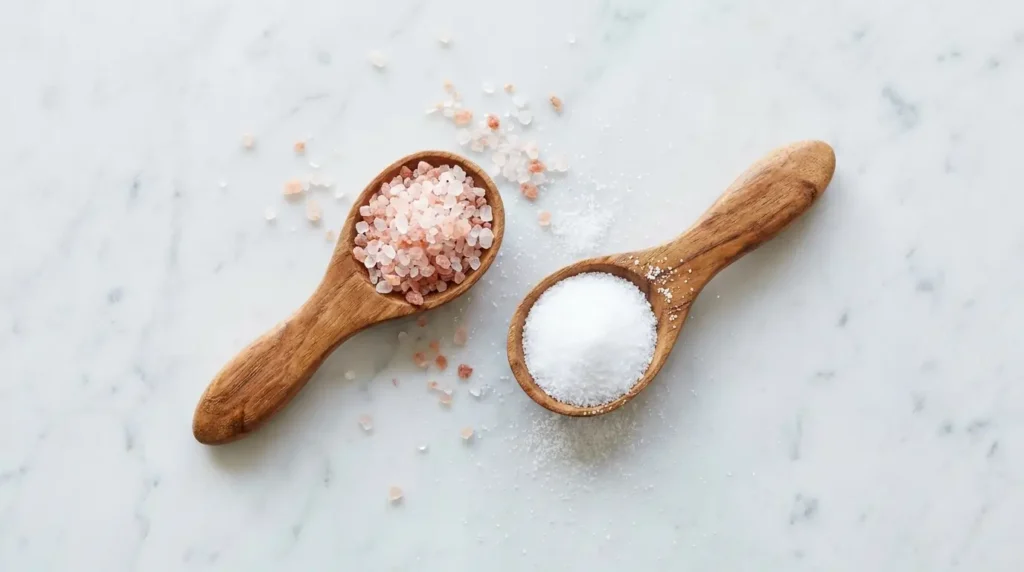
Here’s how the two stack up at a glance. Each row is explained in more detail further down the page.
| Category | Himalayan Pink Salt | Table Salt |
|---|---|---|
| Source | Rock salt mined from ancient deposits, mostly the Khewra Salt Mine in Pakistan | Mined salt deposits or evaporated seawater and brine |
| Processing | Minimally processed — washed, crushed, or ground | Heavily refined and purified |
| Sodium by weight | Roughly 96–99% sodium chloride | Roughly 97–99%+ sodium chloride |
| Sodium by teaspoon | Often lower in coarse forms; varies by grind | About 2,300 mg per level teaspoon (fine grain) |
| Iodine | Negligible; not typically fortified | Often fortified with potassium iodide (check the label) |
| Trace minerals | Iron, calcium, potassium, magnesium — about 1–4% of total weight | Largely removed during refining |
| Texture | Fine to coarse crystals, flakes, or solid blocks | Uniform, fine grain |
| Flavor | Same basic salty taste; texture affects how it’s perceived | Same basic salty taste; dissolves quickly |
| Price | Higher per gram | Lower per gram |
| Best uses | Finishing, salt grinders, serving, general cooking | Baking, everyday cooking, dietary iodine source |
What Is Himalayan Pink Salt?
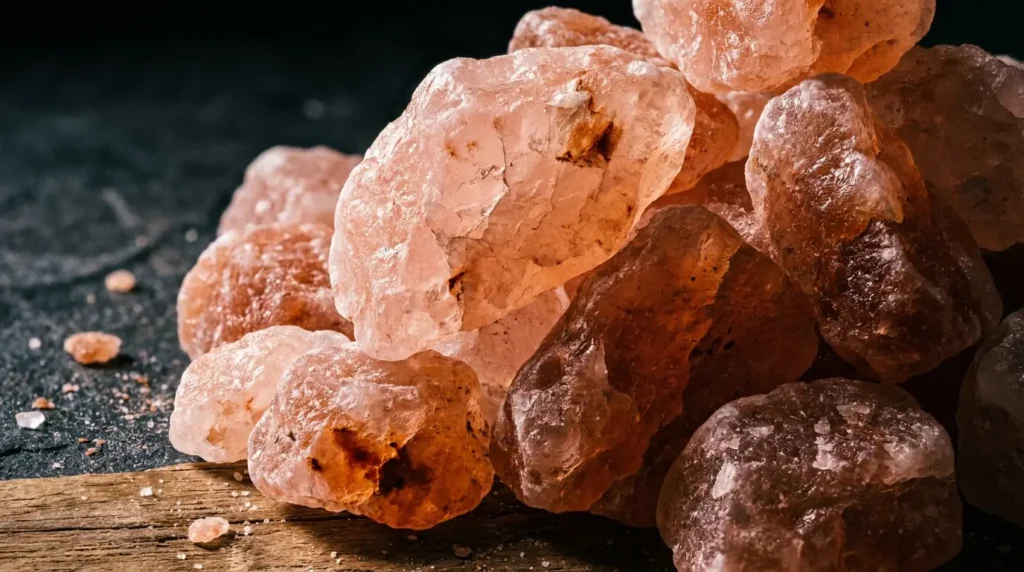
Himalayan pink salt is rock salt cut from ancient underground deposits, most of it from the Khewra Salt Mine in Pakistan’s Punjab region. The deposit formed hundreds of millions of years ago as an ancient sea evaporated and was gradually buried and compressed. Miners extract the salt and process it minimally — washing, crushing, or grinding it rather than refining it the way table salt is refined. Trace iron oxide and other minerals give it a color that ranges from pale pink to deep rust. It’s sold as fine grains, coarse crystals, flakes, or solid blocks used for grilling and serving. For more on where it comes from and how it’s produced, see our full guide to what Himalayan pink salt is.
What Is Table Salt?
Table salt is mined from underground deposits or produced by evaporating brine, then refined to remove minerals and other impurities until it’s nearly pure sodium chloride. That refining, combined with a fine, uniform grain, is why table salt measures so predictably from teaspoon to teaspoon — a real advantage for baking and any recipe where exact ratios matter.
Most iodized table salt sold in the U.S. also contains a small amount of potassium iodide for iodine, dextrose to help stabilize that iodide, and an anti-caking agent such as calcium silicate to keep the fine crystals from clumping in humid weather. None of these additives are required — plain, non-iodized salt and canning or pickling salt without anti-caking agents are also widely sold — but they’re what make ordinary iodized table salt shelf-stable and easy to measure.
Mineral Composition
The difference between pink salt and table salt here is real, but small. By weight, pink salt is typically about 96 to 99 percent sodium chloride, with calcium, magnesium, potassium, iron, and a long list of other trace elements making up the remaining 1 to 4 percent — the same minerals responsible for its color. Refined table salt, by comparison, has almost all of those trace elements removed during processing.
A peer-reviewed analysis of retail pink salt found that one teaspoon (about 5 grams) supplies roughly 13 mg of calcium, 13 mg of magnesium, and 12 mg of potassium — each amounting to a small fraction, well under 5 percent, of a typical adult’s daily target for that nutrient. The minerals are genuinely there; they’re just too dilute in a normal serving to make a nutritional difference. For the full lab breakdown of individual minerals, see Himalayan pink salt minerals.
Sodium: Which Salt Has Less?
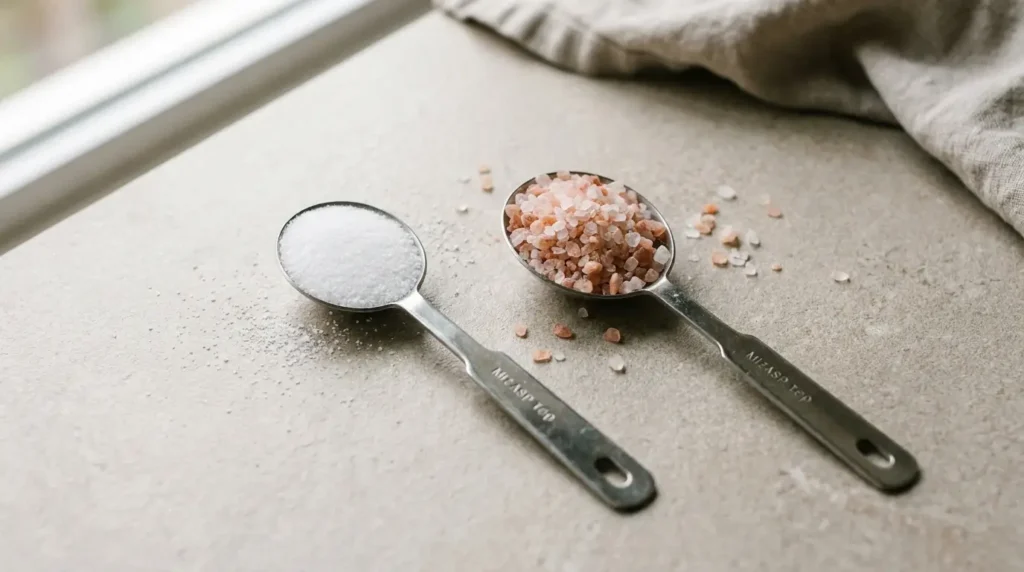
Sodium is where the marketing gets confusing, because the honest answer depends on whether you’re measuring by weight or by spoon.
Sodium by Weight
Gram for gram, pink salt and table salt are close enough to call a tie. Both are overwhelmingly sodium chloride, and any variation comes down to how much of the trace mineral content displaces sodium in a given sample. The same peer-reviewed analysis found pink salt’s average sodium content running slightly, but measurably, lower than an iodized table salt sample used for comparison — pink salt averaged about 39.5% sodium by weight versus roughly 42.8% for the table salt tested. That’s a real, measured difference, but at that scale it’s nowhere near enough to justify calling either one “low sodium.”
Sodium by Teaspoon
Crystal size is what actually changes the sodium in a spoonful. Fine table salt packs tightly, so a level teaspoon holds close to 2,300 mg of sodium. Coarse pink salt crystals leave more air between the grains, so the same teaspoon can hold noticeably less — commonly somewhere in the 1,700–2,200 mg range, though this varies widely by brand and grind. Finely ground pink salt, on the other hand, measures out much closer to table salt.
This is why the FDA’s guidance on sodium points people to the Nutrition Facts label rather than a rule of thumb about a salt’s color or brand: the Daily Value for sodium is less than 2,300 mg, and the only way to know how much sodium is really in your teaspoon is to check the label on the product you actually have.
Iodine: The Most Important Nutritional Difference
Here’s the difference that actually matters: iodine. Iodized table salt supplies a meaningful, standardized dose of iodine, a mineral your thyroid needs to make hormones that regulate metabolism and, during pregnancy, support a baby’s brain development. Himalayan pink salt contains only negligible natural iodine and typically isn’t fortified, so it doesn’t fill the same role.
That doesn’t mean you need iodized salt specifically — iodine also shows up in dairy, seafood, eggs, and iodine-containing supplements — but if table salt has been your main source and you switch to pink salt entirely without replacing it elsewhere, your intake can drop below what’s recommended. The NIH’s iodine fact sheet lists 150 mcg a day as the target for most adults, rising to 220–290 mcg during pregnancy and breastfeeding. For a closer look at how the two compare on this nutrient, see iodine in Himalayan pink salt.
Taste and Texture
Chemically, salt tastes salty because of the sodium chloride itself — the trace minerals in pink salt are far too dilute to add meaningful flavor on their own. What people notice as a “difference” usually comes down to grain size and how quickly the crystal dissolves.
Fine table salt dissolves almost instantly, which is why it blends evenly into batters, sauces, and brines. Coarser pink salt dissolves more slowly and adds a bit of crunch, which is why cooks often reach for it as a finishing salt sprinkled on right before serving — over a steak, a salad, or even a chocolate dessert — rather than mixed all the way into a dish. Neither crystal is objectively better; it depends on whether you want the salt to disappear into the food or stay noticeable on top of it. If you’re choosing a grain size for a specific recipe, see our guide to fine vs coarse pink salt.
Which Is Better for Cooking?
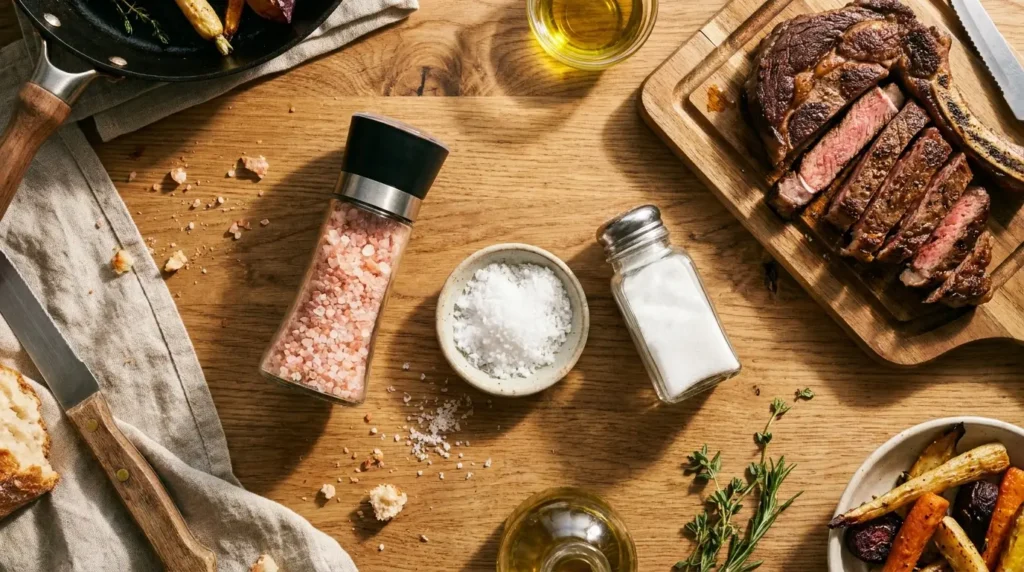
There’s no single best salt for cooking every dish — the right pick depends on the job:
| Use Case | Better Choice | Why |
|---|---|---|
| Baking | Table salt | Fine, consistent grain measures accurately by the teaspoon |
| Soups and sauces | Either | Both dissolve fully; table salt is the cheaper default |
| Seasoning meat | Coarse pink salt | Easier to pinch and spread evenly over a large cut |
| Pasta water | Either | Both dissolve completely in boiling water |
| Finishing food | Coarse or flaked pink salt | Adds visible texture and crunch right before serving |
| Salt grinders | Coarse pink salt | Sized for grinder mechanisms; fine salt tends to clog them |
| Everyday table use | Either | Iodized table salt is the more reliable iodine source |
For more detailed techniques, see our guide to cooking with pink salt.
Is Pink Salt Healthier Than Table Salt?
Not in any way that’s been demonstrated. Its sodium content is essentially the same as table salt by weight, and the trace minerals it carries are present in amounts too small to matter nutritionally. The peer-reviewed analysis of retail pink salt found that someone would need to eat more than 30 grams — about six teaspoons — a day to get a nutritionally meaningful amount of those minerals, a quantity that would deliver far more sodium than any adult should consume in a day. Any potential mineral benefit is effectively canceled out by the sodium that comes with it.
If anything, pink salt comes out slightly behind normal table salt on one point: iodine, since it isn’t fortified and table salt often is. For a full rundown of the claims made about pink salt and what the evidence actually supports, see Himalayan pink salt benefits.
Which Salt Should You Choose?
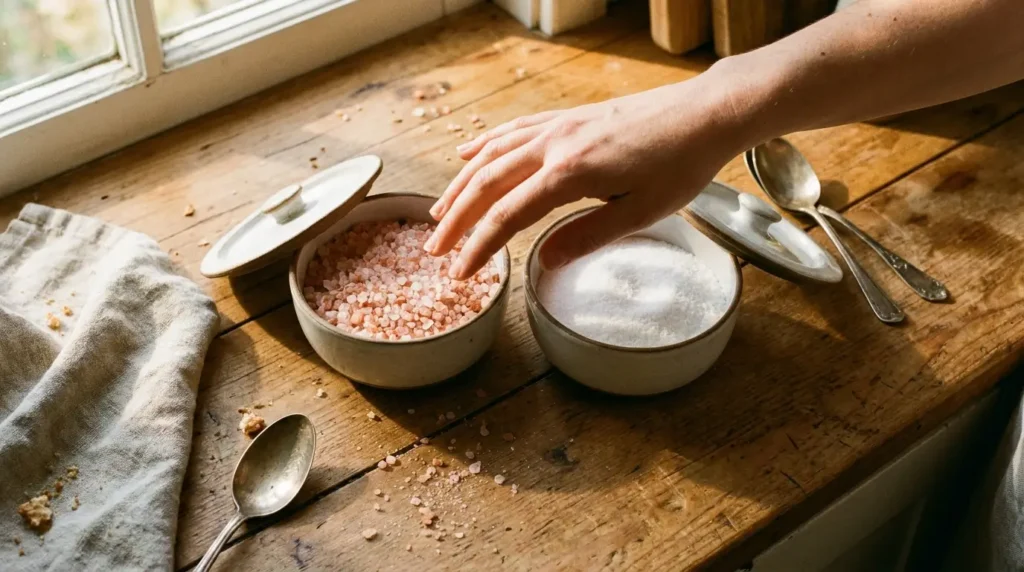
There’s no universally correct answer — only the salt that fits your kitchen and your diet.
Choose iodized table salt when: you bake often and need precise measurements, you want the least expensive option, or iodized salt makes up a meaningful part of your iodine intake.
Choose Himalayan pink salt when: you want a coarse or flaked salt for finishing and serving, you’d like the option of a salt grinder, or you simply prefer its look and texture — as long as you’re getting iodine from other foods.
Use either when: you’re seasoning soups, sauces, pasta water, or everyday meals, where the two perform almost identically.
If you’re weighing other specialty options, see our comparisons of pink salt vs sea salt and pink salt vs kosher salt.
Himalayan Pink Salt vs Table Salt: The Bottom Line
When it comes down to Himalayan pink salt vs table salt, the decision is more about kitchen preference than health. Both are safe, sensible ways to season food in moderation, and neither is meaningfully “healthier” once you account for how much sodium travels along with the minerals. Whether you reach for Himalayan salt or table salt tonight comes down to what you’re cooking: table salt for baking, budget, and iodine; pink salt for texture, finishing, and presentation. Plenty of home cooks simply keep both on hand and use whichever the recipe calls for.
Frequently Asked Questions
By weight, only marginally — both are around 96–99% sodium chloride. By teaspoon, coarse pink salt can measure out to less sodium simply because larger crystals leave more air in the spoon, not because the salt itself is “lighter” in sodium. Check the Nutrition Facts label for the exact number on whatever product you’re using.
Yes, for cooking and seasoning. The main thing you lose is iodine, since pink salt isn’t typically fortified. If table salt has been your main iodine source, make sure you’re getting it elsewhere — dairy, seafood, eggs, or a supplement — before switching over completely.
Not naturally, and most commercial pink salt isn’t fortified with iodine the way many table salts are. Always check the label if this matters for your diet, since formulations vary by brand.
Neither. Sodium raises blood pressure the same way regardless of a salt’s color or mineral content, so anyone managing blood pressure should focus on total sodium intake rather than switching salt types. Talk to your doctor or a registered dietitian about the right daily sodium target for you.
Fine table salt. Its small, uniform crystals measure consistently by volume, which matters when a recipe depends on an exact ratio of salt to flour or sugar. Coarse pink salt can work if it’s ground fine first.
Only subtly, and mostly due to texture rather than chemistry. Coarser crystals dissolve more slowly and add a bit of crunch, which can make pink salt taste sharper or more noticeable when used as a finishing salt, even though the underlying sodium chloride is the same.
By weight, yes. By volume — teaspoons or cups — not always, especially with coarse pink salt, which can measure lighter than fine table salt. When a recipe is sensitive to salt levels, weigh the salt if you can, or add pink salt gradually and taste as you go.