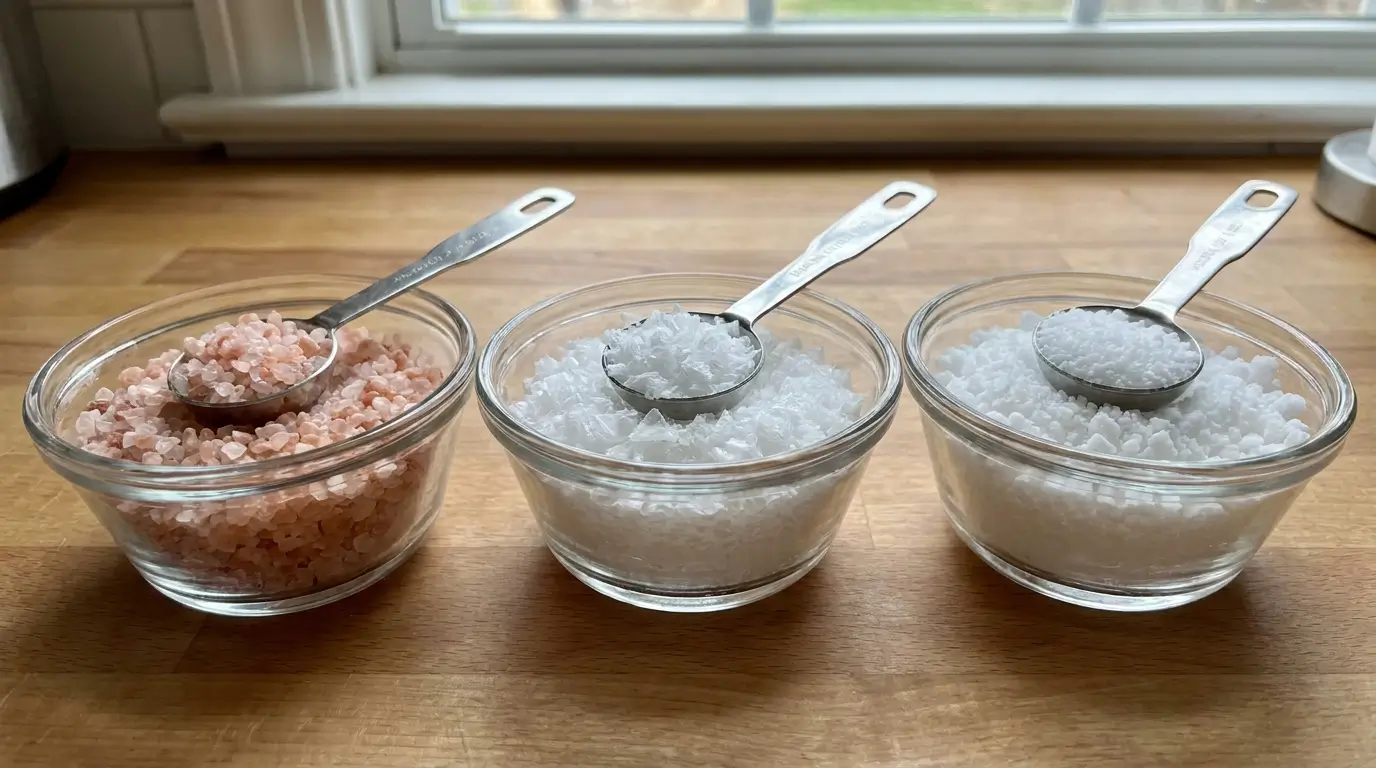
Pink salt and kosher salt are probably the two most commonly interchanged specialty salts in home kitchens. Both are coarse, additive-free (in most cases), and widely recommended as upgrades from iodized table salt. Both work across a broad range of cooking applications. Neither is iodized. On the surface, they look like near-equivalents.
They are not. The differences between them — in crystal density, texture, the critical Diamond Crystal vs Morton distinction, mineral character, and the specific applications where each genuinely excels — are concrete enough to affect real results in the kitchen. This article covers every one of them.
What Each Salt Actually Is
Himalayan pink salt is a rock salt — a mined mineral deposit from the Khewra Salt Mine in Punjab, Pakistan, formed approximately 600 million years ago when an ancient inland sea evaporated and left thick layers of sodium chloride and trace minerals underground. It is extracted, minimally processed, and sold in the crystalline form it was found in. Its pink color comes from trace iron oxide within the crystals. It is available in fine grain, coarse grain, finishing flakes, and solid blocks.
Kosher salt is not a single product — it is a category defined by crystal structure rather than origin or production method. The name comes from its traditional use in the koshering process: the large, flat crystals adhere to the surface of meat and draw out blood effectively, which is what the Jewish dietary preparation requires. Today kosher salt is used far beyond that application and is the workhorse salt of professional kitchens in North America, prized for its ease of hand-application and clean flavor rather than any religious significance.
Kosher salt can be either mined rock salt or evaporated salt, depending on the manufacturer. What defines it is the crystal shape: large, flat, irregular flakes with a high surface area relative to their weight.
The Diamond Crystal vs Morton Problem
Before any comparison between pink salt and kosher salt is useful, the kosher salt side of the equation needs to be pinned down — because the two dominant kosher salt brands in the US market behave so differently that treating them as the same ingredient is a significant cooking error.
Diamond Crystal kosher salt is made by a flake evaporation process that produces hollow, three-layered crystals — exceptionally light and airy in structure. One teaspoon weighs approximately 2.8 grams. The crystals are delicate, adhere well to food surfaces, and dissolve quickly relative to their size.
Morton kosher salt is produced by a compression process that yields denser, more solid flakes. One teaspoon weighs approximately 4.8 grams — roughly 70% more sodium per teaspoon than Diamond Crystal, by volume.
This density gap is why recipes that specify kosher salt by volume fail when the wrong brand is used. A recipe calibrated for Diamond Crystal will be noticeably over-salted with Morton at the same teaspoon measurement. The difference is large enough to ruin a dish, and professional recipes often specify which brand they were tested with for exactly this reason.
How coarse pink salt fits into this:
Coarse Himalayan pink salt is a rock salt with dense, three-dimensional crystals. One teaspoon weighs approximately 3.5–4.5 grams — sitting between Diamond Crystal and Morton on the density scale. It is denser than Diamond Crystal and roughly equivalent to or slightly lighter than Morton.
| Salt | Approx. weight per tsp | Approx. sodium per tsp |
|---|---|---|
| Fine table salt | ~6g | ~2,360mg |
| Morton kosher salt | ~4.8g | ~1,880mg |
| Coarse pink salt | ~3.5–4.5g | ~1,380–1,770mg |
| Diamond Crystal kosher salt | ~2.8g | ~1,100mg |
| Pink finishing flakes | ~3–4g | ~1,180–1,570mg |
The practical takeaway: when substituting coarse pink salt for Diamond Crystal kosher salt in a recipe measured by volume, use slightly less pink salt than called for, or — better — measure both by weight and the substitution becomes exact and reliable. For a full measurement conversion reference, the cooking with pink salt guide has the complete table.
Crystal Structure and Texture: The Most Practical Difference
Crystal structure is where pink salt and kosher salt diverge most usefully in the kitchen — not in flavor or mineral content, but in how the crystals physically behave when you apply them to food.
Kosher salt crystals — especially Diamond Crystal — are flat, rough-edged, and high in surface area. This geometry does two things particularly well:
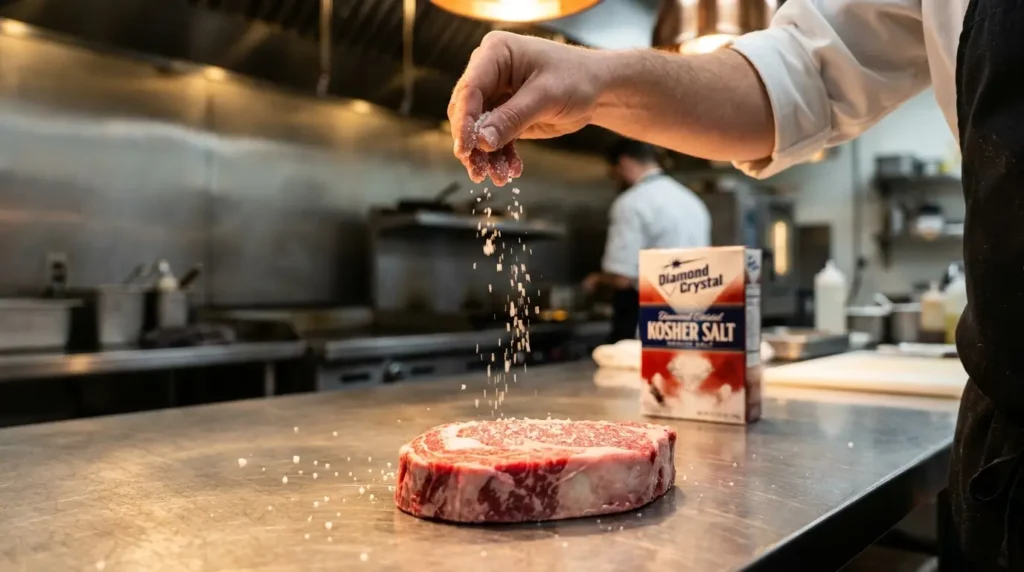
First, the flat surfaces adhere to food. When you press kosher salt onto a raw chicken breast or sprinkle it over a steak, the flakes grip the surface rather than rolling off. This makes application by hand exceptionally controllable — you can see exactly where salt has landed, feel the coverage, and adjust in the moment. This is why professional chefs season almost exclusively by hand with kosher salt rather than pouring from a shaker.
Second, the large surface area means kosher salt crystals dissolve more quickly than their size suggests. A flat crystal exposes more of its surface to moisture than a cubic or chunky crystal of equivalent weight, which accelerates dissolution. Diamond Crystal in particular dissolves remarkably quickly for its crystal size.
Pink salt crystals are denser, chunkier, and more three-dimensional — faceted rock formations rather than flat flakes. They are harder (Mohs ~7 vs ~2.5 for most evaporated salts), less adherent, and dissolve more slowly relative to their volume. The density means they do not adhere to food surfaces as naturally as kosher salt when applied by hand. They feel grittier between the fingers.
The result: kosher salt is easier to control in hand-seasoning applications. Pink salt, applied by hand in large quantities to a raw protein surface, is more likely to roll off than stick. For the pinching-and-scattering technique that defines professional seasoning, Diamond Crystal kosher salt is the more ergonomic tool.
Flavor: Honest Assessment
Both pink salt and kosher salt are overwhelmingly sodium chloride. In controlled blind taste tests where either salt is dissolved into a cooked dish, most people cannot reliably distinguish them. The flavor difference when salt is dissolved during cooking is real but not large enough for consistent identification.
Where there is a perceptible difference:
Kosher salt — both Diamond Crystal and Morton — has a very clean, neutral salinity. It was designed to season food without adding its own character. There are essentially no trace minerals contributing off-notes. The salinity is direct and immediate.
Pink salt, used as a finishing salt or ground fresh at the table, has a mild but perceptible mineral softness. The low magnesium content (lower than most sea salts) means it lacks the faint bitter edge that assertive mineral salts have, giving it a rounder finish. This is subtle — detectable in a focused side-by-side tasting, less reliably detected on a busy plate.
The honest summary: For dissolved-during-cooking applications, the flavor difference is negligible. For direct-on-palate applications — finishing salt, table grinding, crust on roasted meat — pink salt’s mild mineral character is marginally more complex than kosher salt’s intentional neutrality. Whether that complexity is desirable depends on the dish and the cook’s preference.
Where Kosher Salt Has a Genuine Advantage
There are specific applications where kosher salt’s crystal geometry gives it a real, functional edge over pink salt — not a matter of preference, but of how the physics of salt application works.
Hand-seasoning meat and fish. The flat, adherent crystals of Diamond Crystal kosher salt are purpose-built for this. When seasoning a steak by hand, the crystals stay where you put them, creating an even coat that you can see and feel. Coarse pink salt crystals, denser and more spherical, are harder to apply evenly and less likely to stick to vertical or angled surfaces. Professional kitchens use kosher salt for this reason almost universally.
Seasoning by feel. The light, airy structure of Diamond Crystal means a pinch between the fingers delivers a known and consistent quantity that experienced cooks calibrate to intuitively over time. It behaves predictably. Coarse pink salt in the same pinch delivers more sodium per volume — so the “seasoning by feel” calibration built around kosher salt does not transfer directly.
Pasta water in volume. Pasta water should be salted substantially. Using Diamond Crystal kosher salt by the palmful is standard restaurant practice because the large, light crystals are easy to gauge in large quantities. The density difference means if you switch to coarse pink salt and estimate the same volume, you will be adding more sodium than intended.
Cost for high-volume use. Diamond Crystal and Morton kosher salt are both priced significantly below premium pink salt products. In applications where large quantities are needed — brining a turkey, salting a large pot of blanching water, making a salt crust — the economics of kosher salt make it the more rational choice.
Where Pink Salt Has a Genuine Advantage
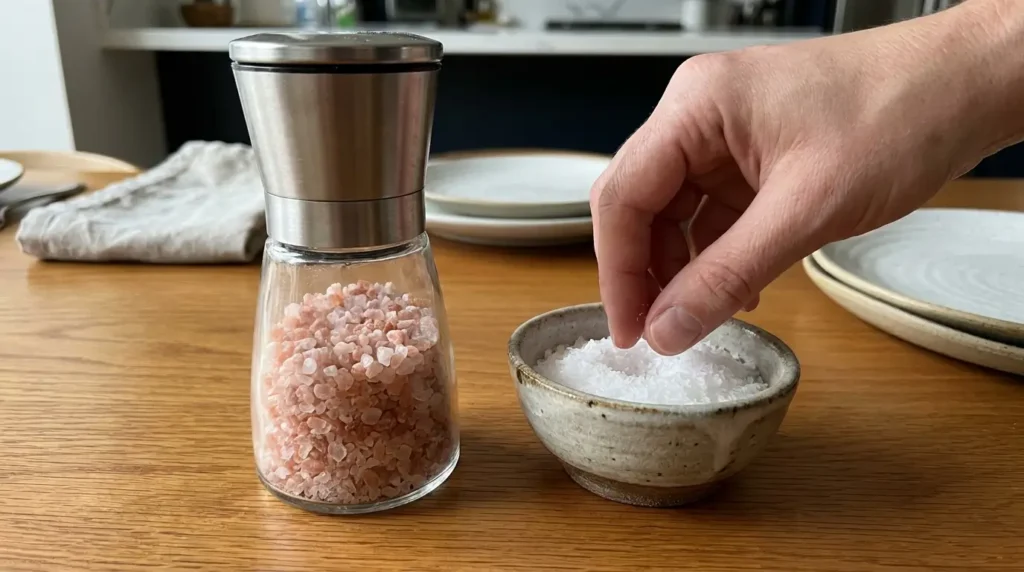
Finishing at the table. Pink salt’s visual impact — rose crystals against a dark sear, on a pale egg, across a chocolate dessert — is an aesthetic that kosher salt’s white crystals do not offer. Beyond appearance, the mild mineral complexity of freshly ground or applied pink salt adds a dimension that neutral kosher salt does not. For any application where the salt is seen and tasted directly, pink salt provides a more complete experience.
Table grinding. Coarse pink salt in a quality grinder is an excellent table condiment. The hard, dense crystals grind cleanly into irregular pieces that dissolve brightly on the tongue. Kosher salt crystals are too flat and soft to behave well in most standard grinder mechanisms — they tend to compact and jam rather than feed through the grinding burrs properly.
Salt block cooking. Himalayan salt blocks — solid slabs used as a cooking or serving surface — have no kosher salt equivalent. The application is unique to rock salt. For a complete guide to technique, see salt block grilling.
Fermentation and preservation. Both pink salt and non-iodized kosher salt work well in lacto-fermentation. Some kosher salt brands include anti-caking agents (check the label — Diamond Crystal does not; Morton’s some products do), which can cloud brine and potentially interfere with fermentation. Himalayan pink salt has no additives in any commercial form and is completely clean for fermentation use.
Dry brining for visual confirmation. When dry brining with pink salt, the pink crystals on a pale protein surface (chicken, fish, pork) are visually trackable in a way white kosher salt is not. You can see where coverage is even and where it is missing, and adjust accordingly. This is a minor advantage, but a real one.
Grinder Compatibility: A Critical Technical Point
One comparison point that almost never appears in pink salt vs kosher salt articles: these two salts require entirely different grinder mechanisms, and mixing them up destroys equipment.
Himalayan pink salt rates approximately 7 on the Mohs hardness scale — equivalent to quartz. It requires a grinder with a hardened ceramic or stainless steel mechanism explicitly designed for hard minerals. Standard pepper mill mechanisms and most budget grinders are not designed for this hardness and will fail quickly.
Kosher salt, as a flat, relatively soft crystal (Mohs ~2.5), does not grind well in most mechanisms at all — the flat flakes compact rather than fracture. Kosher salt is not typically used in grinders; it is applied by hand from a bowl or box.
If you are choosing a salt specifically for tabletop grinding, coarse pink salt in a hardened-mechanism grinder is the correct choice. Kosher salt at the table is best kept in a pinch bowl. The full guide to selecting a grinder that handles pink salt correctly is in the pink salt grinder guide.
Side-by-Side Comparison
| Himalayan Pink Salt (coarse) | Diamond Crystal Kosher | Morton Kosher | |
|---|---|---|---|
| Origin | Mined rock salt, Pakistan | Evaporated salt, USA | Compressed salt, USA |
| Crystal form | Dense, chunky, 3D | Hollow, flat, layered | Solid, flat, dense |
| Mohs hardness | ~7 | ~2.5 | ~2.5 |
| Weight per tsp | ~3.5–4.5g | ~2.8g | ~4.8g |
| Iodized? | No | No | No (most varieties) |
| Anti-caking agents? | No | No | No (coarse) |
| Adheres to food surfaces | ⚠️ Moderately | ✅ Excellent | ✅ Good |
| Works in grinder | ✅ Yes (hardened mechanism) | ❌ No | ❌ No |
| Visual impact as finishing | ✅ High (pink color) | ❌ White only | ❌ White only |
| Dry brining | ✅ Excellent | ✅ Excellent (standard) | ✅ Good |
| Wet brining | ✅ Yes (fine grain) | ✅ Yes | ✅ Yes |
| Baking | ✅ Fine grain only | ✅ Yes | ✅ Yes |
| Salt block cooking | ✅ Unique capability | ❌ N/A | ❌ N/A |
| Fermentation | ✅ No additives | ✅ No additives | ⚠️ Check label |
| Relative price | Mid–high | Low | Low |
Which Should You Keep in Your Kitchen?
The most practical answer: keep both, and use each for what it does best.
Diamond Crystal kosher salt for high-volume applications — pasta water, large brines, seasoning by hand during cooking, any situation where you are adding salt in substantial quantities and calibrating by feel and eye. It is inexpensive, reliable, and the professional standard for a reason.
Coarse pink salt for the table — in a quality grinder, as finishing flakes for the pass, and in a small pinch bowl for dishes you want to finish with visible, visually striking crystals. Add fine pink salt to the rotation if you want an additive-free option for baking and fermentation.
The two salts are not competitors for the same job. They are complementary tools with different strengths — understanding that distinction is what separates a well-stocked kitchen from one that has four varieties of the same thing.
For the full landscape of how pink salt compares to every major salt type — table salt, sea salt, Celtic grey, kala namak, and Fleur de Sel — see the pink salt vs other salts guide.
Frequently Asked Questions
By volume: not reliably. Coarse pink salt is denser than Diamond Crystal kosher salt — the same teaspoon measure contains roughly 25–60% more sodium. If a recipe specifies Diamond Crystal, use about 75% of the volume in coarse pink salt, then taste. If it specifies Morton, the densities are closer and a near-1:1 substitution works better. By weight: always reliable — weigh the quantity specified in grams and use that weight in whichever salt you are substituting.
Both work well. Kosher salt — particularly Diamond Crystal — is the professional standard because the flat crystals adhere exceptionally well to meat surfaces and are easy to distribute by hand. Coarse pink salt produces excellent dry brine results too, though the denser crystals are marginally less adherent. The visual benefit of pink crystals on a pale protein makes coverage easy to verify. Either is a sound choice; the execution matters more than the salt type.
Detectably, yes — but only in specific contexts. Dissolved into a cooked dish, the difference is below the threshold of reliable perception in blind taste tests. Applied directly as a finishing salt, pink salt has a mild mineral roundness that kosher salt’s neutral profile does not. The difference is real but subtle.
Diamond Crystal is the professional and culinary writer consensus recommendation for most applications, primarily because its lower density makes it more forgiving in hand-seasoning (it is harder to dramatically over-salt). If your grocery store only stocks Morton, it works perfectly well — just be aware of the density difference when following recipes that specify Diamond Crystal by volume.
Technically, coarse pink salt can perform the koshering function of drawing blood from meat surfaces — the process requires coarse salt crystals that adhere to and draw moisture from the surface, which coarse pink salt does. However, for koshering to meet religious dietary standards, the salt should be used under rabbinical guidance, and the process has specific requirements beyond simply the salt type. The common kitchen use of “kosher salt” as a cooking salt category has no religious requirement and pink salt substitutes freely