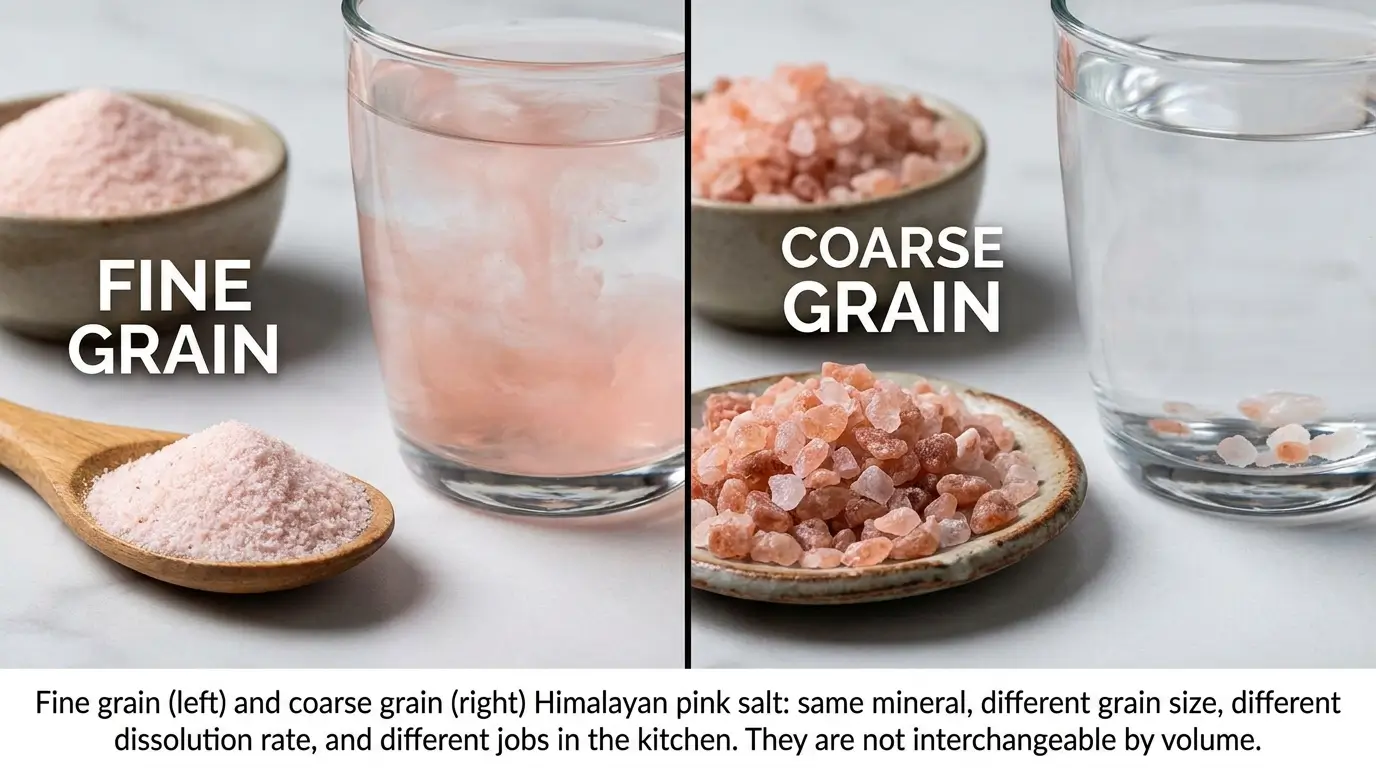
Fine pink salt and coarse pink salt are the same mineral — the same origin, the same composition, the same trace iron oxide that makes them pink. The only physical difference is grain size. But grain size changes how salt dissolves, how it measures, how it adheres to food, and what jobs it is suited for. Using the wrong one in the wrong place produces real, noticeable results: under-seasoned baking, a bitter dissolved crust, wasted finishing salt ground into a sauce.
Here is a complete guide to which form belongs where — and why.
What “Fine” and “Coarse” Actually Mean
Neither term is standardized. There is no regulated grain size that must be called “fine” or “coarse” — manufacturers use the terms differently, and grain sizes within each category vary meaningfully between brands. The useful working definitions for this article are:
Fine pink salt: Crystals small enough to dissolve in a few seconds in warm liquid and distribute evenly when mixed into dough or batter. Visually similar to standard table salt or fine sea salt. Grain size typically 0.5–1mm.
Coarse pink salt: Crystals large enough to see individually and feel between your fingers, that take noticeably longer to dissolve and remain visually distinct when applied to a food surface. Grain size typically 2–4mm or larger. The form typically sold in grinder jars.
There is also a middle category — medium grain pink salt — offered by some brands. It sits between these two extremes and is genuinely useful in some applications (particularly dry brining), but most buyers are choosing between fine and coarse, so that is the comparison this article focuses on.
And then there are finishing flakes — large, flat, irregular crystals designed for surface application at the table. These are a distinct product from coarse crystals and are covered separately in the pink salt finishing flakes guide. They are not the same as coarse salt and are not suited to grinders or brines.
The Critical Difference: Dissolution Rate
The most practically important difference between fine and coarse pink salt is how quickly each dissolves — and what that means for flavor delivery.
Fine salt dissolves almost instantly in warm or hot liquid, and within seconds when it contacts a moist food surface. When you add fine salt to a simmering soup or a marinade, it disperses evenly and integrates completely with the dish. When you season a raw chicken breast with fine salt and let it rest, the salt dissolves into surface moisture and begins drawing into the meat almost immediately.
Coarse salt dissolves slowly. A large pink salt crystal sitting on the surface of a piece of steak will still be partially intact several minutes later. On a cold food surface, large crystals can remain essentially undissolved for the duration of a meal if used as a finishing application. This slow dissolution is a liability in some contexts (coarse salt added to cold pasta water at the last second will not distribute evenly) and a significant asset in others (coarse salt applied to a steak just before serving delivers a burst of intense, localized saltiness as each crystal dissolves on the tongue).
Understanding this single difference — fast vs slow dissolution — explains every use case decision that follows.
When to Use Fine Pink Salt
General Cooking
Fine pink salt belongs in any application where salt is dissolved into the final dish during cooking. This covers the majority of everyday kitchen use:
- Pasta water, blanching water, stock: Dissolves fully and distributes evenly throughout the liquid. The quantity needed for pasta water is substantial — around 10g per liter is a reasonable target — so use an economical fine-grain bulk pink salt rather than a specialty product here.
- Soups, stews, braises: Add fine salt in stages throughout cooking, tasting as you go. It integrates immediately, so you can assess and adjust in real time.
- Sauces and reductions: Fine salt dissolves instantly into hot liquids, avoiding the uneven seasoning that can result from partially dissolved coarse crystals in a glossy pan sauce.
- Marinades: Fine salt in a marinade distributes evenly across the protein surface and begins drawing into the meat quickly, which is the goal.
Seasoning Meat Before Cooking (Short Rest)
When seasoning a steak, chicken piece, or fish fillet 15–30 minutes before cooking — a common technique to season the surface and draw out a small amount of moisture for better browning — fine salt is the correct choice. It dissolves into the surface moisture quickly and starts the osmotic process that pulls it back into the meat. Coarse salt in the same timeframe will still be sitting on the surface as undissolved crystals when the protein hits the pan, leading to uneven seasoning and potential burning of exposed salt crystals on high heat.
The exception: if you are seasoning 45 minutes to several hours in advance (a short dry brine), coarse salt becomes appropriate — it dissolves gradually as it draws out and reabsorbs moisture over the longer window.
Baking
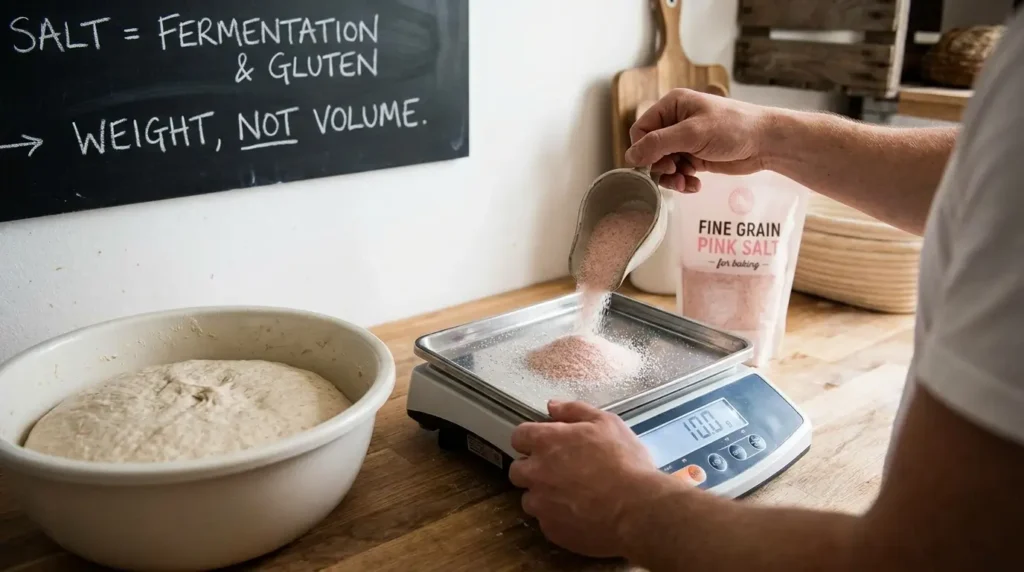
Fine pink salt only. There is no reasonable baking application for coarse pink salt except as a visible topping (focaccia, rolls, pretzels), and even there it competes with dedicated finishing products.
The reasons are functional, not aesthetic. Salt in bread dough affects yeast activity and fermentation rate, gluten network development, and final crumb structure. Salt in cake batter suppresses bitterness and enhances sweetness. Both effects require salt distributed evenly through the entire mixture. Coarse salt crystals in dough or batter create pockets — areas of intense salinity surrounded by under-seasoned material — that do not distribute evenly even after mixing.
Use fine pink salt for baking, and measure it by weight, not volume. Grain size varies enough between brands that a teaspoon of one fine pink salt can weigh meaningfully more or less than a teaspoon of another. Baking is a formula; measure to the formula. The full measurement reference with cross-salt conversion weights is in the cooking with pink salt guide.
Fermentation
Fine pink salt is ideal for lacto-fermentation — sauerkraut, kimchi, fermented pickles, brine ferments. The reason for using pink salt at all here (rather than table salt) is its absence of additives: no iodine (which can inhibit lactic acid bacteria at higher concentrations) and no anti-caking agents (which can cloud brine). Fine grain ensures the salt dissolves fully into the brine, creating a consistent salt concentration throughout the vessel rather than settling as undissolved crystals at the bottom.
Standard lacto-fermentation brine: 20–30g of fine pink salt per liter of filtered water (2–3% by weight).
When to Use Coarse Pink Salt
Dry Brining
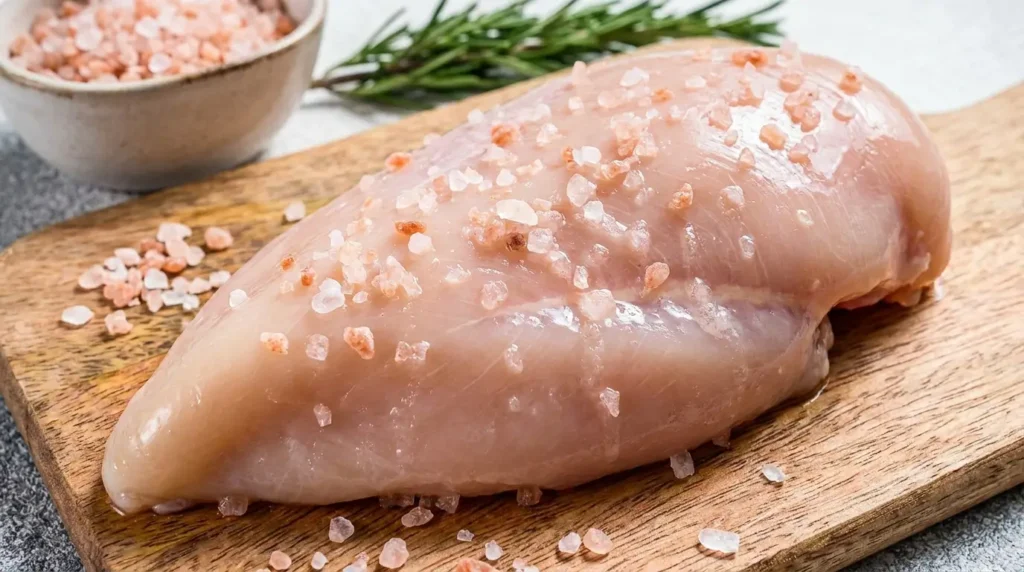
Dry brining — applying salt to the surface of meat and leaving it to rest, uncovered, in the refrigerator before cooking — is where coarse pink salt genuinely excels.
The technique works in two phases: the salt first draws moisture to the meat’s surface (osmosis), then that moisture dissolves the salt and is slowly reabsorbed into the meat (diffusion), carrying seasoning deep into the muscle rather than just coating the exterior. This process takes time — ideally 1–24 hours depending on the cut — and coarse salt is optimized for it.
The large crystals apply easily by hand, adhere to the meat surface without sliding off, and dissolve gradually at the rate the brine-draw-and-reabsorption process requires. Fine salt in a long dry brine over many hours can draw out more moisture than is reabsorbed, potentially drying the surface. For dry brines of one hour or more, coarse is the right choice.
Typical application rate: 0.5–0.75% of the meat’s weight in salt. For a 1kg piece of beef, that is 5–7.5g — roughly 1–1.5 teaspoons of coarse pink salt. Apply to all surfaces evenly, place on a rack (so air can circulate underneath), and refrigerate uncovered.
Salt Crusts
Coarse pink salt is the right choice for encrusting whole fish, beets, or other vegetables in a salt shell before roasting. The large crystals pack together to form a solid crust that traps steam and creates a gentle, even cooking environment while preventing the food from becoming overly salty. Fine salt would form too dense a crust, increasing surface area contact and salt penetration; coarse crystals create a more porous shell that insulates and seasons in the right ratio.
Grinders
Coarse pink salt is the standard form loaded into tabletop salt grinders. When you grind it fresh, the crystals fracture into irregular pieces with a larger surface area than pre-ground salt — they dissolve quickly on the tongue and deliver a noticeably brighter, more immediate mineral character than pre-ground fine salt applied from a shaker.
The important technical note: pink salt at Mohs hardness approximately 7 will damage grinder mechanisms that are not designed for hard minerals. Standard ceramic burrs rated for pepper (Mohs hardness 5–6) and most sea salts (Mohs hardness ~2.5) are not appropriate for pink salt. Use a grinder with a hardened ceramic or stainless steel mechanism rated explicitly for rock salt. This is covered fully in the pink salt grinder guide.
Visible Surface Applications in Baking
Coarse pink salt crystals as a topping on focaccia, soft pretzels, bagels, dinner rolls, or seeded bread serve a different function from salt mixed into the dough — they provide visual texture, a satisfying crunch, and a localized burst of salinity in each bite. This is an aesthetic-plus-textural application, not a seasoning-the-dough application, and large visible crystals are the point. A small pinch of coarse crystals applied before the oven also stays largely intact on the surface through baking, remaining visible after the crust forms.
The Measurement Problem, Stated Plainly
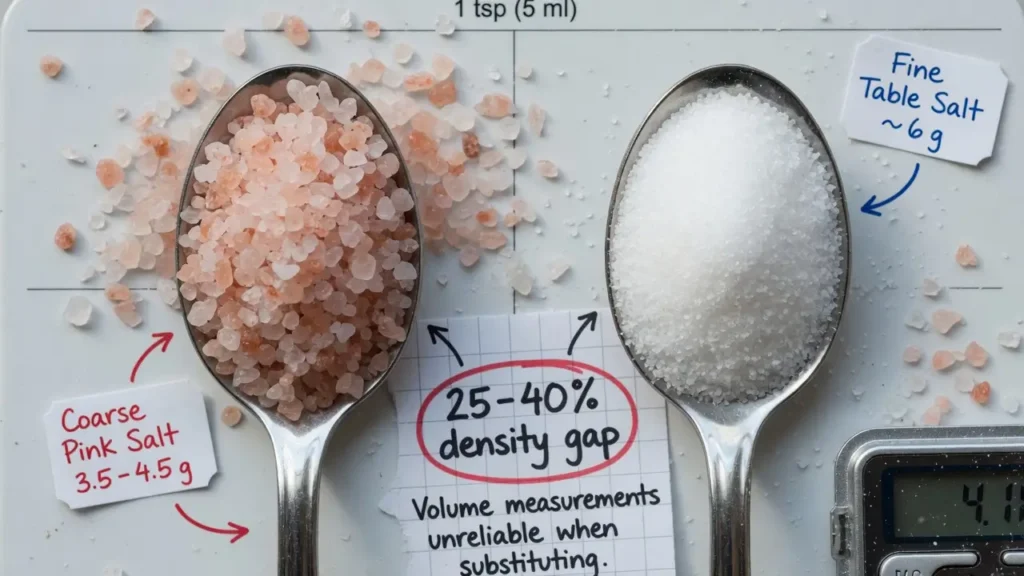
This deserves its own section because it causes real cooking failures.
Coarse pink salt is significantly less dense than fine table salt or fine pink salt. The same volume — one teaspoon — contains meaningfully less sodium in coarse form than in fine form.
| Format | Approx. weight per tsp | Sodium per tsp (approx.) |
|---|---|---|
| Fine table salt (iodized) | ~6g | ~2,360mg |
| Fine pink salt | ~5.5–6g | ~2,100–2,360mg |
| Coarse pink salt | ~3.5–4.5g | ~1,380–1,770mg |
| Finishing flakes | ~3–4g | ~1,180–1,570mg |
What this means in practice:
A baking recipe calling for 1 tsp of table salt expects approximately 6g of salt. If you measure 1 tsp of coarse pink salt instead, you are adding roughly 3.5–4.5g — 25–40% less than the recipe requires. In a loaf of bread or a batch of cookies, that is a noticeable under-seasoning. In a bread dough, it also affects fermentation rate and gluten development.
The fix: measure salt by weight whenever a recipe depends on a specific salt quantity. The grain size variable disappears entirely. One gram of sodium chloride is one gram regardless of what form it was in before you put it on the scale.
Side-by-Side Decision Guide
| Application | Fine | Coarse | Notes |
|---|---|---|---|
| Pasta water, blanching | ✅ | ❌ | Coarse dissolves too slowly for large volumes of water |
| Soups, sauces, braises | ✅ | ❌ | Needs even distribution during cooking |
| Marinades | ✅ | ⚠️ | Fine preferred; coarse acceptable if marinating 2+ hours |
| Seasoning meat 15–30 min before cooking | ✅ | ❌ | Fine dissolves and begins working quickly |
| Dry brining (1 hour to overnight) | ⚠️ | ✅ | Coarse adheres and dissolves at the right rate |
| Dry brining (24–72 hours, large cuts) | ❌ | ✅ | Coarse only for extended dry brines |
| Wet brining | ✅ | ⚠️ | Fine dissolves fully; coarse works if stirred thoroughly |
| Baking (mixed into dough/batter) | ✅ | ❌ | Coarse creates uneven pockets |
| Baking (surface topping) | ❌ | ✅ | Visible crystals are the point |
| Fermentation / lacto-fermentation | ✅ | ⚠️ | Fine ensures even brine concentration |
| Salt crust for whole fish / vegetables | ❌ | ✅ | Coarse crystals form the right crust density |
| Grinder (table use) | ❌ | ✅ | Coarse is what grinders are designed for |
| Finishing at the table | ⚠️ | ✅ | Coarse works; finishing flakes are better |
Which Should You Buy First?
If you are buying pink salt for the first time and want one product that covers most use cases: start with fine grain. It substitutes cleanly for table salt in everyday cooking, measures reliably, bakes without problems, and can be used in a pinch as a finishing salt. It is the most versatile single format.
Once you are cooking regularly with fine pink salt, add coarse grain for dry brining, your grinder, and surface applications in baking. At that point, if finishing dishes at the table is something you do regularly, the finishing flakes are worth the addition as a third distinct product.
All three together cover every cooking application pink salt is suited for. None of them, it bears repeating, should be confused with pink curing salt — which is a sodium nitrite compound used in meat curing, not a kitchen seasoning. If you are curing meat, that requires an entirely separate product covered in the pink curing salt guide.
Frequently Asked Questions
No — fine salt is already ground. You grind coarse salt to produce fine salt at the table. Loading a grinder with pre-ground fine salt will produce dust rather than useful ground seasoning.
No. Clumping means the salt has absorbed ambient moisture (salt is hygroscopic — it draws water from the air). Transfer it to an airtight container in a dry location. If the clumps are hard, break them up. The salt is chemically unchanged. Storing near a stovetop or in a humid kitchen accelerates clumping; a sealed ceramic or glass container solves it.
Yes, with adjustment. Diamond Crystal kosher salt weighs approximately 2.8g per teaspoon; coarse pink salt weighs approximately 3.5–4.5g per teaspoon. Start with the volume the recipe calls for and taste — coarse pink salt is denser than Diamond Crystal so the same volume delivers more sodium. Or simply measure both by weight and the substitution becomes exact.
No. Fine and coarse pink salt from the same deposit have the same mineral composition. Milling only changes the size of the crystals, not what is inside them. Color variation between fine and coarse salt from the same source is normal — fine-milled salt often appears lighter because it refracts light differently than larger crystals.