Himalayan pink salt is the most widely sold specialty salt in the world. You will find it in supermarkets, restaurant supply stores, wellness shops, and home goods retailers in a dozen different forms — fine grains, coarse crystals, finishing flakes, solid cooking slabs, and decorative lamps. It is used in professional kitchens and home pantries on every continent.
It is also one of the most heavily marketed food ingredients available, surrounded by claims that range from accurate to exaggerated to flatly wrong. This guide separates the two. It covers the geology, the mining, the culinary applications, the nutrition, and the buying process — all without the hype.
What Himalayan Pink Salt Is
Himalayan pink salt is a rock salt — a mineral form of sodium chloride that was once a seabed, became buried underground over geological time, and is now mined and sold as a food product. Its distinctive pink color comes from trace amounts of iron oxide naturally present in the deposit.
It is not a sea salt (which is produced by evaporating modern seawater), not a processed salt (it undergoes minimal refinement), and not a supplement or health product, despite widespread marketing that implies otherwise. It is salt — ancient, minimally processed, visually striking, and genuinely useful in the kitchen.
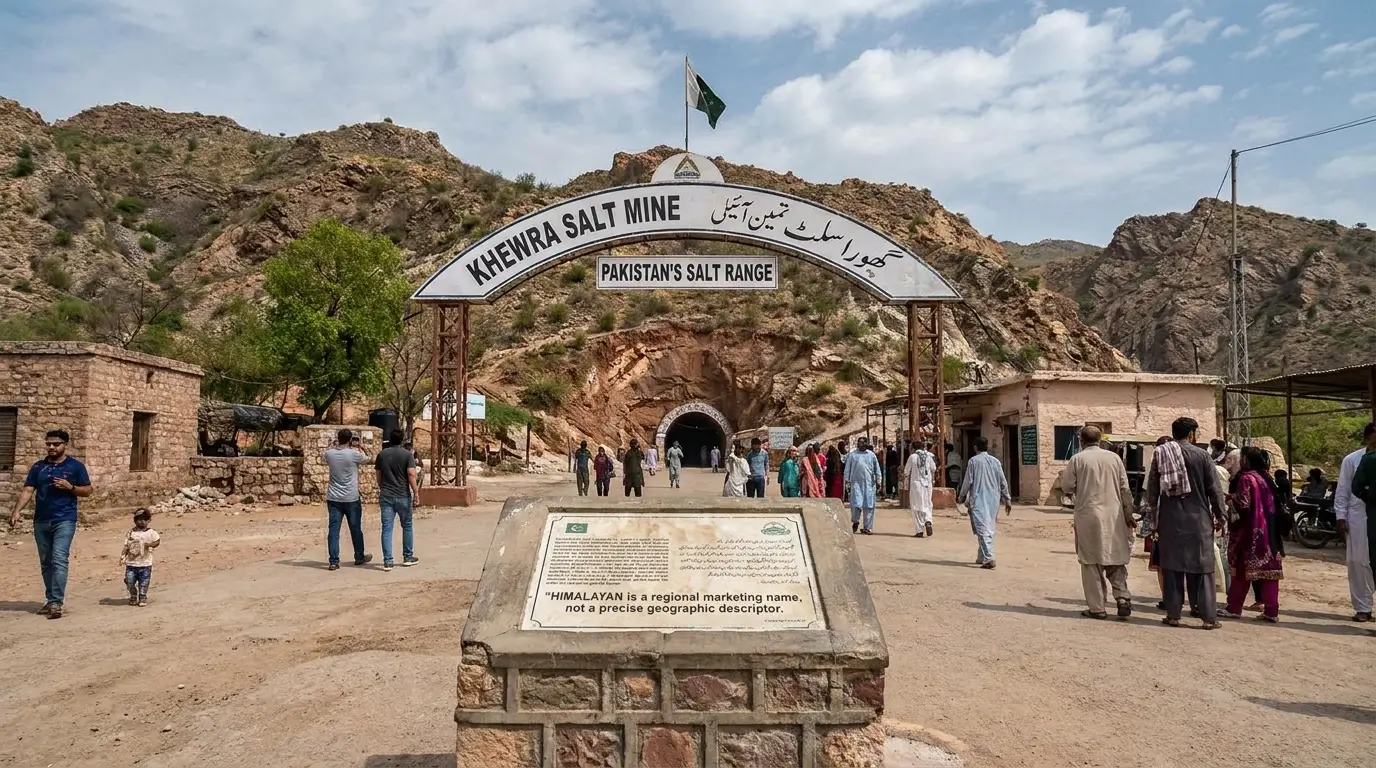
The term “Himalayan pink salt” refers almost exclusively to salt from one source: the Khewra Salt Mine in Punjab, Pakistan. Virtually all Himalayan pink salt sold globally — regardless of brand, country of retail sale, or packaging — originates from this single deposit.
It belongs to the broader category of pink salt, which also includes pink curing salt (a sodium nitrite compound used in meat curing, not a food seasoning), Hawaiian Alaea salt, and Peruvian Maras salt. When a recipe calls for “pink salt” without further specification, Himalayan pink salt is what it means.
Where It Actually Comes From
The Khewra Salt Mine sits in the Salt Range — a series of hills and ridges in the Punjab province of Pakistan, roughly 160 kilometers south of Islamabad. The mine is not in the Himalayan mountain range. The nearest edge of the Himalayas is approximately 300 kilometers to the northeast.
The name “Himalayan” is a marketing convention, not a geographic designation. It reflects the salt’s origin in the broader Himalayan region and the strong purity associations that the Himalayan brand carries in Western markets. The name has been in use for decades and is now the standard commercial term for the product. It does not indicate fraud or mislabeling — it is simply an imprecise geographic shorthand that the industry settled on.
The deposit itself formed approximately 600 million years ago, during the Precambrian era, when a shallow inland sea occupied the region. As that sea evaporated over geological time, it left thick salt deposits on what was then the seafloor. Subsequent tectonic activity — including the slow collision of the Indian subcontinent with the Eurasian plate that eventually pushed up the Himalayas — buried those deposits under layers of sediment and rock, compressing and preserving them underground.
The result is a salt deposit that has been sealed from surface contamination for hundreds of millions of years. No modern ocean pollutants. No microplastics. No industrial runoff. This geological isolation is the legitimate basis for Himalayan salt’s reputation for purity — not its color or mineral count.
For the full geographic and geological story, including how to read a map of the Salt Range and understand what the deposit actually looks like underground, see our detailed guide on where Himalayan pink salt comes from.
How It Is Mined
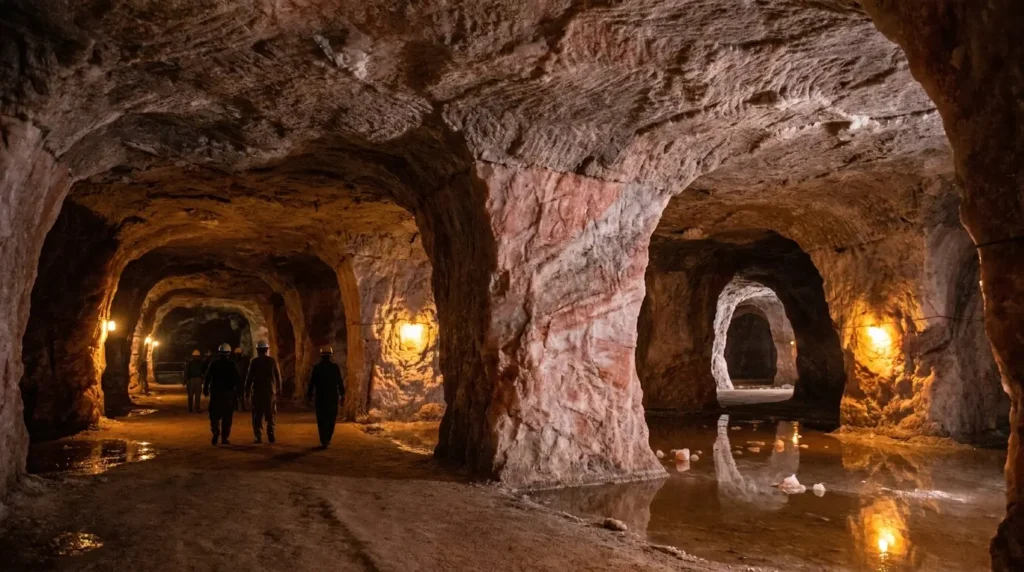
Khewra is one of the largest and oldest working salt mines in the world. Mining activity at the site is documented back to at least the 13th century CE, though local accounts and archaeological evidence suggest salt was collected from the deposit even earlier. Today the mine extends across 19 levels — 11 above ground level, 8 below — and produces hundreds of thousands of tonnes of salt annually.
The primary extraction method used at Khewra is room-and-pillar mining: tunnels are carved through the salt deposit, and large pillars of salt are deliberately left in place to support the ceiling and prevent collapse. Approximately 50% of the salt in any given section is left as structural support — meaning roughly half of the deposit is never extracted. This is the same method used in salt mines globally and is responsible for the cathedral-like chambers that make Khewra one of Pakistan’s most-visited tourist attractions.
Extraction itself is a combination of controlled blasting and hand-cutting. The salt is loosened from the rock face, collected, and transported to surface facilities where it is sorted by color and grain, washed with saturated brine (which removes surface impurities without dissolving the salt), dried, and milled or cut to the grain sizes sold commercially.
Importantly, the salt is not chemically refined. Unlike table salt, which is processed to remove trace minerals, anti-caking agents are added, and iodine is supplemented, Himalayan pink salt goes from the mine to your table with minimal intervention. This is what “minimally processed” means in the context of this product.
The full mining process — including the room-and-pillar technique, the labor practices at Khewra, and the environmental considerations around large-scale salt extraction — is covered in the article on how Himalayan pink salt is mined.
Is It Really From the Himalayas?
Technically, no — and yes, depending on how you define “from the Himalayas.”
The strict geographic answer: the Khewra Salt Mine is in the Salt Range, not in the Himalayan mountain range. The two are distinct geological formations, separated by several hundred kilometers. If “Himalayan” means “from the Himalayan mountains specifically,” then the name is inaccurate.
The broader answer: Khewra is located in the greater Himalayan region of South Asia, formed by the same tectonic forces that built the Himalayas, and the salt deposit is connected to the geological history of that mountain-building event. By that looser but widely accepted geographic framing, “Himalayan” is defensible as a regional designation.
What matters practically: the name does not affect the quality or authenticity of the product. Genuine Khewra salt is what it says it is — an ancient Pakistani rock salt with a traceable provenance and a well-documented mineral profile. The geographic imprecision in the name is a marketing artifact, not an indicator of anything wrong with the product.
The dedicated article on whether Himalayan salt is really from the Himalayas goes further into the geography, the tectonic history, and why this question matters (and doesn’t matter) from a sourcing perspective.
Mineral Composition and Color
Himalayan pink salt is 95–98% sodium chloride by weight. The remainder is trace minerals: potassium, magnesium, calcium, iron, sulfate, and roughly 80 other elements in very small concentrations.
The pink color comes specifically from iron oxide (Fe₂O₃) — the same compound responsible for the color of rust. The concentration is typically less than 0.1% by weight, but iron oxide is intensely pigmented. Even at trace levels, it shifts the color of sodium chloride from white toward pink, rose, or deep salmon depending on local concentration.
Color variation within a bag of pink salt — some crystals nearly white, others deeply colored — is normal and expected. It reflects the natural variation in iron concentration across different parts of the deposit. Salt that is a perfectly uniform pink throughout is more likely to be dyed than authentic; real Himalayan salt is variable.
A note on the mineral marketing: Pink salt is frequently marketed as containing “84 trace minerals” that provide significant nutritional benefits. The mineral presence is real; the nutritional significance is overstated. The quantities of these minerals in a typical daily serving of salt — perhaps 5–10 grams total — are too small to contribute meaningfully to nutritional needs. The minerals are there. They do not make pink salt a supplement.
One genuinely important mineral point: Himalayan pink salt contains no added iodine. Standard iodized table salt includes potassium iodide as a public health measure to prevent iodine deficiency. If pink salt replaces iodized salt as your household’s primary salt, and you do not regularly consume seafood, dairy, or eggs, iodine intake is worth monitoring.
How to Cook With It
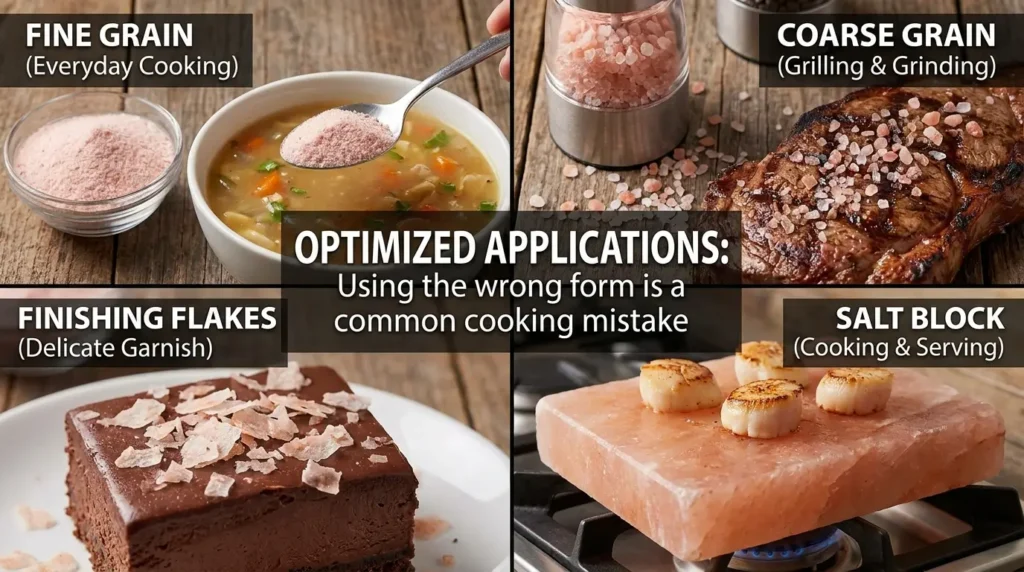
Himalayan pink salt works in every application that calls for salt. The most useful thing to understand is that different grain sizes are optimized for different uses — and using the wrong one is the most common mistake home cooks make.
Fine-grain pink salt dissolves quickly and measures consistently. It is the right choice for cooking — adding to pasta water, seasoning meat before cooking, incorporating into dough, mixing into sauces, and any application where the salt will be dissolved into the dish. For cooking purposes, fine Himalayan salt and iodized table salt are functionally interchangeable, with one exception: the measurement conversion. Coarse Himalayan salt is less dense than fine table salt, so one teaspoon of coarse pink salt contains less sodium than one teaspoon of table salt. Always taste and adjust when substituting by volume.
Coarse-grain pink salt is best used in a grinder or mill, as a dry brine for large cuts of meat, or as a cooking crust for proteins. If you are loading it into a grinder, the grinder’s mechanism matters: Himalayan salt rates approximately 7 on the Mohs hardness scale, compared to about 2.5 for table salt. It destroys cheap ceramic or plastic grinder mechanisms within weeks. Use only a grinder with a hardened ceramic or steel burr. The full guide to how to grind pink salt covers this in detail, including specific grinder recommendations.
Finishing flakes are large, flat crystals designed for applying to food at the table, immediately before eating. They provide visual contrast, a satisfying crunch, and a concentrated burst of mineral salinity that you simply cannot get from salt dissolved during cooking. A pinch of finishing flakes over a sliced steak, roasted vegetables, or a chocolate dessert is where Himalayan pink salt earns its premium reputation. For the technique and best uses, see pink salt finishing flakes.
Salt blocks (also called salt slabs or salt plates) are solid slabs of Himalayan pink salt, typically 8–12 inches across and 1.5–2 inches thick, used as a cooking surface. They can be heated on a grill or gas burner to high temperatures and used to sear proteins directly on the salt surface, which imparts a light mineral salinity to the food. They can also be chilled and used to serve food cold — sushi, cheese, fruit. Salt block cooking has specific requirements, particularly a very gradual heating protocol to avoid cracking. The full technique is in our Himalayan salt block cooking guide.
For a complete overview of all cooking applications — including measurement conversions, pairing suggestions, and the situations where Himalayan salt genuinely outperforms cheaper alternatives — see our guide to cooking with pink salt.
Salt Lamps and Salt Caves
Himalayan pink salt has two major non-culinary applications that deserve honest treatment.
Salt lamps are hollowed-out pieces of pink salt rock, fitted with a bulb or candle, that emit a warm amber glow. They are sold widely in home goods stores and online. The aesthetic appeal is real — the light is warm, the material is natural, and the lamps are genuinely attractive as ambient lighting.
The health and air-purification claims attached to salt lamps are a different matter. The most common claim — that heated salt emits negative ions that purify air and improve mood — is not well supported by controlled research. The amount of negative ion emission from a salt lamp is not sufficient to measurably affect indoor air quality in a normally sized room. Salt lamps are beautiful decorative objects. They are not air purifiers. The full, research-based breakdown is in our article on Himalayan salt lamps.
Salt caves and halotherapy are another wellness application of Himalayan pink salt that is growing rapidly — searches for “pink salt cave” have increased significantly in recent years. Halotherapy involves breathing dry salt aerosol in a controlled environment, either a natural salt cave or a purpose-built salt room. Some studies suggest potential benefits for respiratory conditions, but the evidence base is not robust enough to make strong clinical claims. The full picture — what the research shows, what to expect from a session, and how to find reputable providers — is in our article on pink salt cave halotherapy.
How to Buy It — and What to Avoid
The Himalayan pink salt market has a meaningful counterfeiting and mislabeling problem. Investigations and laboratory analyses have found that a significant percentage of pink salt sold under the “Himalayan” label either does not originate from Khewra, has been mixed with lower-grade salt from other sources, or in the most egregious cases is dyed regular rock salt.
The most reliable indicators when buying:
Provenance declaration: The label should state “Product of Pakistan” or specifically name the Khewra mine. “Packaged in [country]” is not origin information — it tells you where it was processed or bagged, not where the salt was mined.
Color variation: Authentic Himalayan salt from Khewra shows natural variation in color — white to pink to rose within the same bag or container. Uniformly perfect pink coloration throughout suggests either heavy processing or dye.
Price relative to market: Genuine Himalayan pink salt has a cost floor set by mining, processing, and export. Products priced dramatically below comparable salts — especially in large quantities — should be treated with skepticism.
Brand transparency: Reputable suppliers disclose their sourcing and, ideally, provide third-party lab testing results. Vague claims about origin (“from the Himalayas”) without specific mine or region information are a yellow flag.
For a comprehensive review of tested brands across price tiers — including fine, coarse, and finishing flake formats — see our best Himalayan pink salt buying guide. For the complete checklist of authentication tests, including at-home methods that can help identify dyed counterfeits, see how to spot fake Himalayan pink salt.
Storage and Shelf Life
Himalayan pink salt does not spoil. Salt is chemically stable and antimicrobial — the same properties that made it valuable as a food preservative for thousands of years mean that properly stored pink salt has an effectively indefinite shelf life.
The main enemy of stored pink salt is moisture. Salt is hygroscopic — it absorbs water from the surrounding air. In high-humidity environments, coarse salt crystals can absorb enough moisture to clump together, and fine salt can form hard blocks. The solution is straightforward:
- Store in an airtight container, not in an open dish or loosely covered bowl
- Keep away from the stovetop, where steam from cooking increases ambient humidity
- A ceramic, glass, or stainless steel container with a tight-fitting lid is ideal
- If clumping occurs, the salt is not ruined — break it up and transfer to a drier container
Do not store pink salt in a metal container that can corrode. Salt’s corrosive properties mean that prolonged contact with reactive metals will both degrade the container and potentially alter the taste of the salt.
Salt blocks require slightly different care. They should be stored in a cool, dry location, wrapped in plastic or in a sealed bag when not in use, and kept away from humidity sources. Never wash a salt block with water — the surface will dissolve. Wipe it down with a barely damp cloth and dry thoroughly immediately.
Frequently Asked Questions
For culinary use, Himalayan pink salt is better in specific applications — particularly as a finishing salt or for use in a grinder at the table — where the crystal size, texture, and mild mineral character add something that fine table salt cannot. For cooking applications where salt is dissolved into a dish, the difference is minimal and most people cannot detect it in a blind taste test. “Better” depends on what you are using it for.
No. Himalayan pink salt is sodium chloride — it has the same sodium content as table salt by weight. A gram of Himalayan pink salt contains approximately the same sodium as a gram of table salt. Because coarse pink salt crystals are larger and less dense than fine table salt, a teaspoon of coarse pink salt may contain less sodium than a teaspoon of fine table salt by volume — but that is a measurement artifact, not a chemical difference.
Color variation reflects the natural variation in iron oxide concentration within the Khewra deposit. Salt from different depths and locations within the mine contains different amounts of iron. Paler salt has less iron oxide; darker salt has more. Both are authentic Himalayan salt. The color is not a quality indicator.
No, and confusing them is genuinely dangerous. Pink curing salt (Prague Powder, Instacure) is a sodium nitrite compound used to cure meat. It is deliberately dyed pink to distinguish it from edible salt, but it is not a food seasoning — it is toxic in the quantities used if consumed directly. Never substitute one for the other. See the pink curing salt guide for the full explanation.
Indefinitely, when stored properly in a sealed container away from moisture. Salt does not expire or go bad. The “best before” dates on some packages are regulatory requirements in certain markets, not an indication that the salt degrades.
Yes, and it produces excellent results for proteins like steak, shrimp, and scallops. The salt block must be heated very gradually — starting at low heat and incrementally increasing over 45–60 minutes — to avoid thermal shock and cracking. Full technique details are in the salt block cooking guide.
The Khewra mine is open to visitors and is one of Pakistan’s most-visited tourist attractions. It contains a salt mosque, crystal chambers, and illuminated interior rooms. Travel logistics, what to expect, and how to book are covered in our Khewra Salt Mine visitor guide.