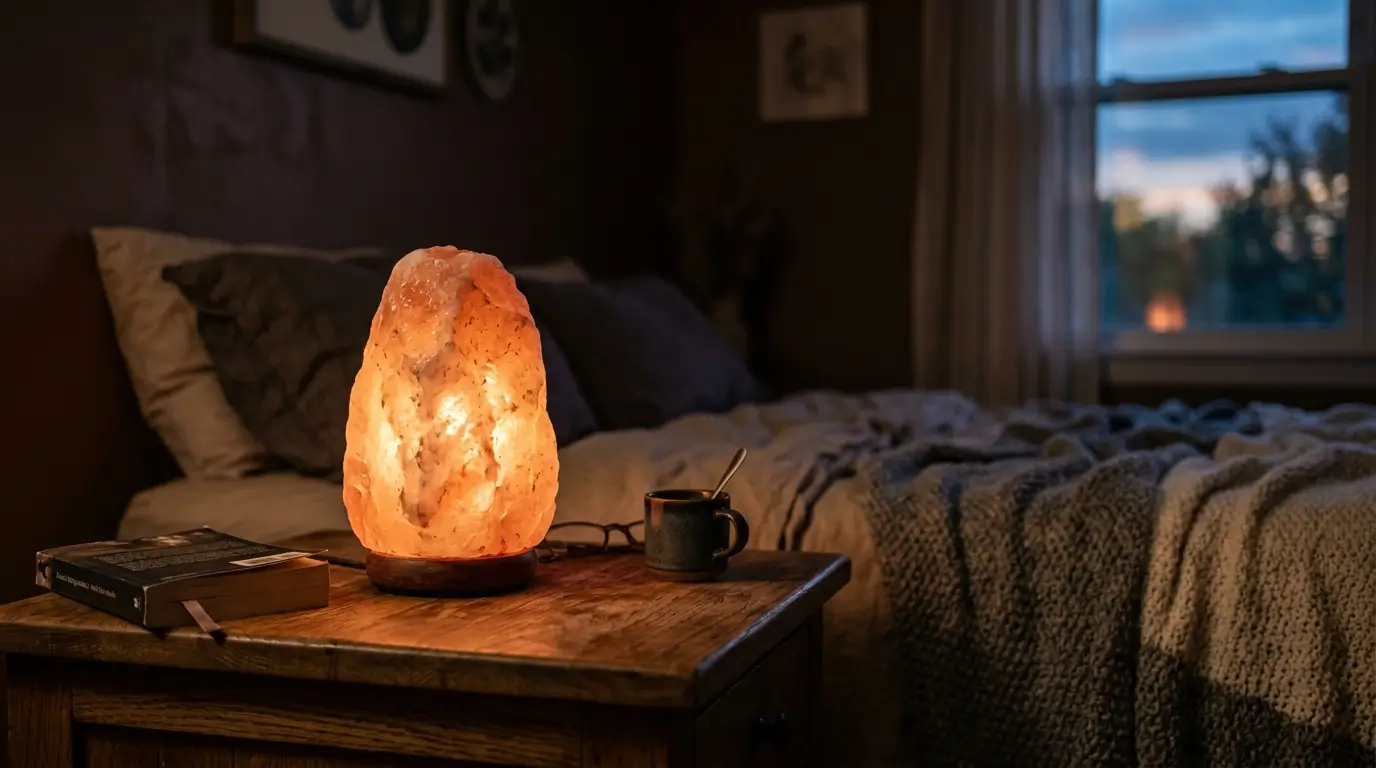
Search for a himalayan salt lamp and you land in the middle of an argument. One side insists the glowing pink rock on your nightstand is quietly scrubbing your air and calming your nervous system. The other dismisses it as a nightlight with a good marketing department. The real answer sits closer to the second camp, but it’s more specific than that: a Himalayan salt lamp is a genuinely pleasant piece of natural lighting, and nearly every claim beyond that hasn’t held up under testing.
What Is a Himalayan Salt Lamp, Exactly?
A Himalayan salt lamp is a solid chunk of pink rock salt, hollowed out to hold a small light bulb. Nearly all of that salt comes from a single source: the Khewra Salt Mine in Pakistan’s Punjab province. Lit from inside, the salt filters the bulb’s light into a warm, uneven glow ranging from pale peach to deep amber — a color that comes from trace iron oxide trapped in the crystal, the same compound that rusts iron and tints canyon rock red.
You’ll also see the same product sold as a pink salt lamp or a himalayan rock salt lamp. All three names describe the same thing: halite (the geological name for rock salt), shaped, hollowed, wired for a bulb, and set on a small base. For the full picture of this salt and how it compares to what’s in your shaker, see our guide to Himalayan pink salt.
How Himalayan Salt Lamps Are Made

The process starts underground, where miners use a “room and pillar” method — cutting out roughly half the salt in a given area and leaving the rest standing as structural support, which is part of how Khewra has stayed the world’s second-largest salt mine without collapsing in on itself. Lamp-grade blocks are set aside by color and clarity, then shaped by hand or machine: chiseled or sawed into rough form, drilled at the base for the bulb cavity, and smoothed or left natural depending on the style. No two lamps come out identical, since the mineral veining varies block to block.
One geography note worth clearing up: despite the name, Khewra sits in the Salt Range of the Punjab plains, a separate hill system south of the Himalayas rather than inside them. The deposit itself formed roughly 600 million years ago, when an ancient inland sea evaporated and left thick salt beds that were later folded upward by the same tectonic collision that raised the Himalayas. We go deeper on that naming question in whether Himalayan salt is really from the Himalayas.
Why People Actually Buy a Himalayan Salt Lamp
Strip away the marketing and one benefit survives every round of scrutiny: the light itself. A salt lamp throws a soft, irregular glow that reads as warmer and calmer than a regular bulb — closer to candlelight than to a reading lamp. It isn’t bright enough to work a room the way a floor lamp does, and that’s the point. Most owners run it as a night light, a bedside glow, or an accent on a desk or reading chair.
That aesthetic pull is also why sales spike every autumn: a salt lamp is a reliable holiday gift and a popular pick for anyone softening a bedroom or meditation corner for the darker months. If ambiance is why you’re shopping for one, that’s a complete and sufficient reason — the lamp doesn’t need to pass the claims below to be worth owning.
Do Himalayan Salt Lamps Release Negative Ions?
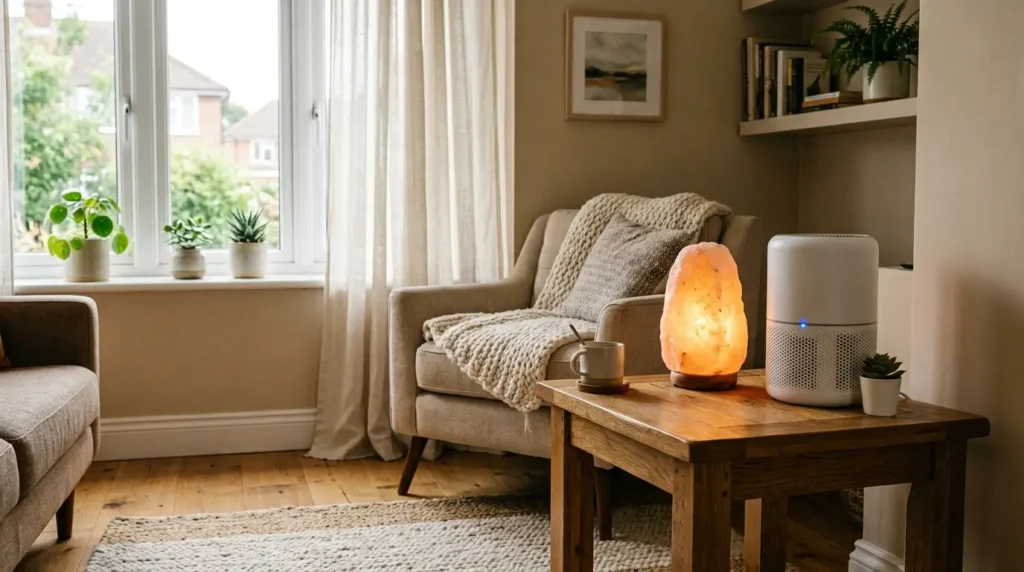
Ask a seller what a salt lamp does for you, and two claimed salt lamp benefits come up almost every time: negative ions and cleaner air. Start with the ions, since it’s the more specific and more testable claim. The pitch goes like this: salt is hygroscopic, meaning it pulls moisture out of the surrounding air; heat from the bulb evaporates that moisture back off the surface; and this exchange is said to release negative ions into the room.
The chemistry doesn’t support the mechanism. An ion is an atom or molecule carrying an electrical charge, gained or lost when an electron changes hands — and prying sodium apart from chloride that way takes real heat, somewhere near sodium chloride’s melting point of about 1,474°F (801°C). A chemist consulted on the claim put it plainly: a lamp anywhere near that temperature would be melting, not glowing. A standard 15-watt bulb, the fitting most salt lamps ship with, keeps the surface only slightly warm to the touch — nowhere close to hot enough to start that reaction.
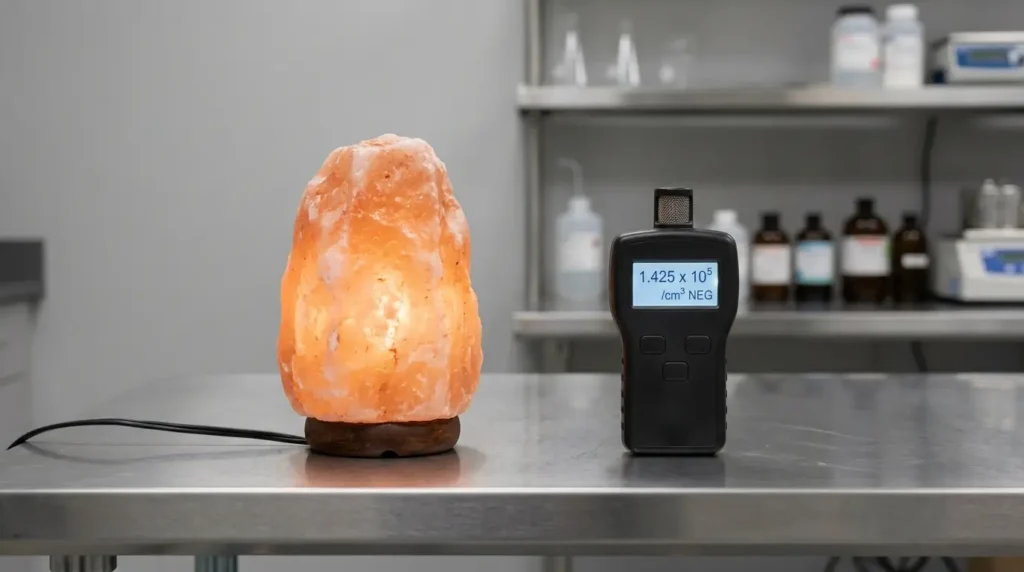
Independent measurements back this up: testers who’ve pointed ion counters at lit salt lamps have recorded output too small to distinguish from ordinary background levels in a room, and no peer-reviewed study has measured meaningful ion production from a household lamp specifically. Even the broader science on air ions doesn’t rescue the claim. A comprehensive review of 23 studies on air ions and respiratory function, conducted with purpose-built, high-output ion generators far stronger than anything a warmed rock could produce, found inconsistent and often contradictory results. If dedicated ionizing equipment can’t produce a reliable effect, a decorative lamp warmed by a night-light bulb isn’t a plausible source of it either.
Do Salt Lamps Actually Purify the Air?
The air-purifying claim leans on that same hygroscopic property: humidity riding on dust, pollen, or smoke supposedly gets trapped on the crystal’s damp surface. It’s a reasonable-sounding mechanism. It’s just never been shown to work at a scale that matters.
The clearest evidence comes from a far more powerful category of device: plug-in ionizers built specifically to charge particles in a room. The U.S. Environmental Protection Agency notes that even these purpose-built devices are relatively ineffective against larger particles like pollen and house dust, don’t touch gases or odors at all, and have never had the underlying “ion imbalance” theory confirmed in a controlled study. A salt lamp produces a small fraction of a dedicated ionizer’s output. If the stronger technology can’t reliably clean a room, a warmed rock isn’t doing it either.
None of this makes a salt lamp harmful — it’s simply decorative. For genuine allergy or asthma triggers, a mechanical HEPA filter, which physically traps particles through fine mesh rather than static charge, is the tool with real evidence behind it. Salt lamps also get confused with halotherapy — sitting in a room or cave deliberately filled with aerosolized salt particles. That’s a separate practice with its own evidence base, covered in our guide to pink salt caves and halotherapy.
How to Spot a Fake Himalayan Salt Lamp
Genuine lamps require mining and hand-carving, so they cost more than a lump of dyed rock salt should — which is exactly what makes counterfeits, often carved from cheap white halite or molded from resin and glass, profitable to sell. A few physical checks catch nearly all of them.
| Trait | Genuine salt lamp | Likely fake |
|---|---|---|
| Color | Uneven pink, orange, or amber tones, often with darker veining | Uniform white or an unnaturally bright, even pink |
| Weight | Dense and heavy for its size | Noticeably light for its size |
| Glow | Dim, warm, and irregular | Bright and perfectly even |
| Durability | Brittle — chips or cracks if dropped | Nearly indestructible |
| Humidity response | Develops surface moisture (“sweats”) in a humid room | Stays dry no matter the humidity |
| Price | Priced per pound, reflecting mining and hand-carving labor | Suspiciously cheap for its size |
Handle a few in person and the weight gives it away before anything else does — a genuine 5- or 6-pound lamp feels like a small dumbbell, not a hollow shell. On the sweating point specifically: that surface moisture is just the hygroscopic reaction described above, not evidence the lamp is releasing anything beneficial into the air. It’s a useful authenticity test and nothing more.
The same counterfeit problem shows up in the kitchen, not just the lamp aisle — dyed rock salt gets passed off as the real thing in cooking salt too, which we cover in spotting fake Himalayan pink salt.
How to Buy a Himalayan Salt Lamp
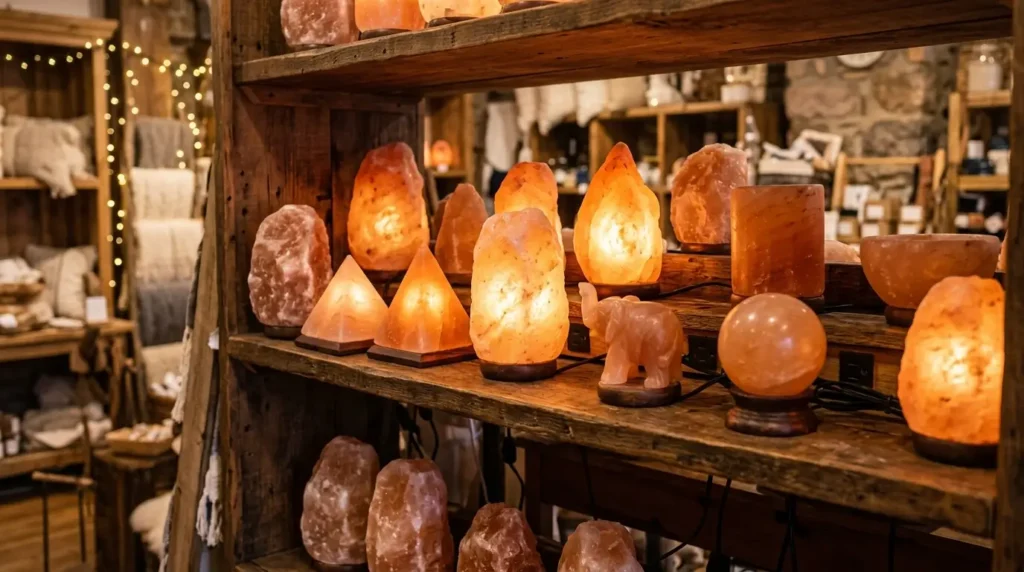
Once you’ve decided you want one for what it actually offers — the light — a few practical details matter more than the copy on the box.
- Match size to the room. A small lamp, roughly 2 to 3 pounds, suits a nightstand or desk; a piece meant to anchor a living room typically runs 7 pounds or more. Bigger only means more light and presence, not more air-cleaning coverage.
- Check the wattage. Most lamps ship with a 15-watt bulb; larger lamps or humid climates sometimes call for 20 to 25 watts. Don’t exceed the wattage printed on the base — an oversized bulb overheats the socket and can crack the salt.
- Look for a rated cord. A UL-listed or equivalent safety certification matters more here than on most lamps, since the fixture stays in constant contact with a material that occasionally gets damp.
- Confirm the source. Reputable sellers state that the salt is quarried at Khewra, in Pakistan. A listing with no origin information at all is a weaker bet.
- Plan its spot before it arrives. Keep it off surfaces that can’t handle occasional moisture, away from bathrooms and kitchens, and out of reach of pets — cats and dogs are drawn to the salty surface, and repeated licking can cause sodium poisoning, according to veterinary poison control specialists.
For lamps, grinders, and other Himalayan salt products we’ve tested side by side, our buying guides hub is the place to start.
Caring for a Salt Lamp That Sweats
Most owners discover the hygroscopic property the hard way: a ring of moisture on the nightstand. That isn’t a defect — it means the lamp is doing exactly what rock salt does, pulling humidity out of the air. It happens more in a bathroom-adjacent bedroom or a humid coastal climate than in a dry, climate-controlled office; we’ve watched the same lamp behave completely differently in those two settings within a single week.
The fix is almost always the same: leave the lamp switched on. The bulb’s low heat evaporates surface moisture faster than the salt can reabsorb it, which is why lamps left on most of the day rarely sweat, while ones switched off in a damp room often do. Run continuously, a standard 15-watt bulb draws around 11 kilowatt-hours a month — at a typical U.S. residential rate, that’s roughly $1.50 to $2.50, depending on your utility.
- Set it on a coaster or small plate rather than directly on wood or fabric.
- Dust or wipe it with a barely damp cloth only — never rinse it or hold it under running water, since salt dissolves.
- Storing it for a while? Remove the bulb, seal the lamp in an airtight bag, and keep it somewhere dry and cool.
- Expect to replace the bulb every year or two with regular use. The salt itself, hundreds of millions of years in the making, isn’t going anywhere.
Should You Buy One?
A Himalayan salt lamp is honest about one thing and oversold on the rest. The light is real, and for a lot of people, genuinely worth having in a bedroom or reading corner. The negative ions, the air purification, the allergy relief — none of that has survived actual scrutiny, and the chemistry explains why: a 15-watt bulb simply isn’t hot enough to do what the marketing claims.
Buy one for the glow, not the health claims. Check the weight and color before you pay, keep it running rather than switching it on and off, set it on something that can handle a little moisture, and keep it away from pets. Do that, and a genuine lamp will light a room for decades without asking for much in return.