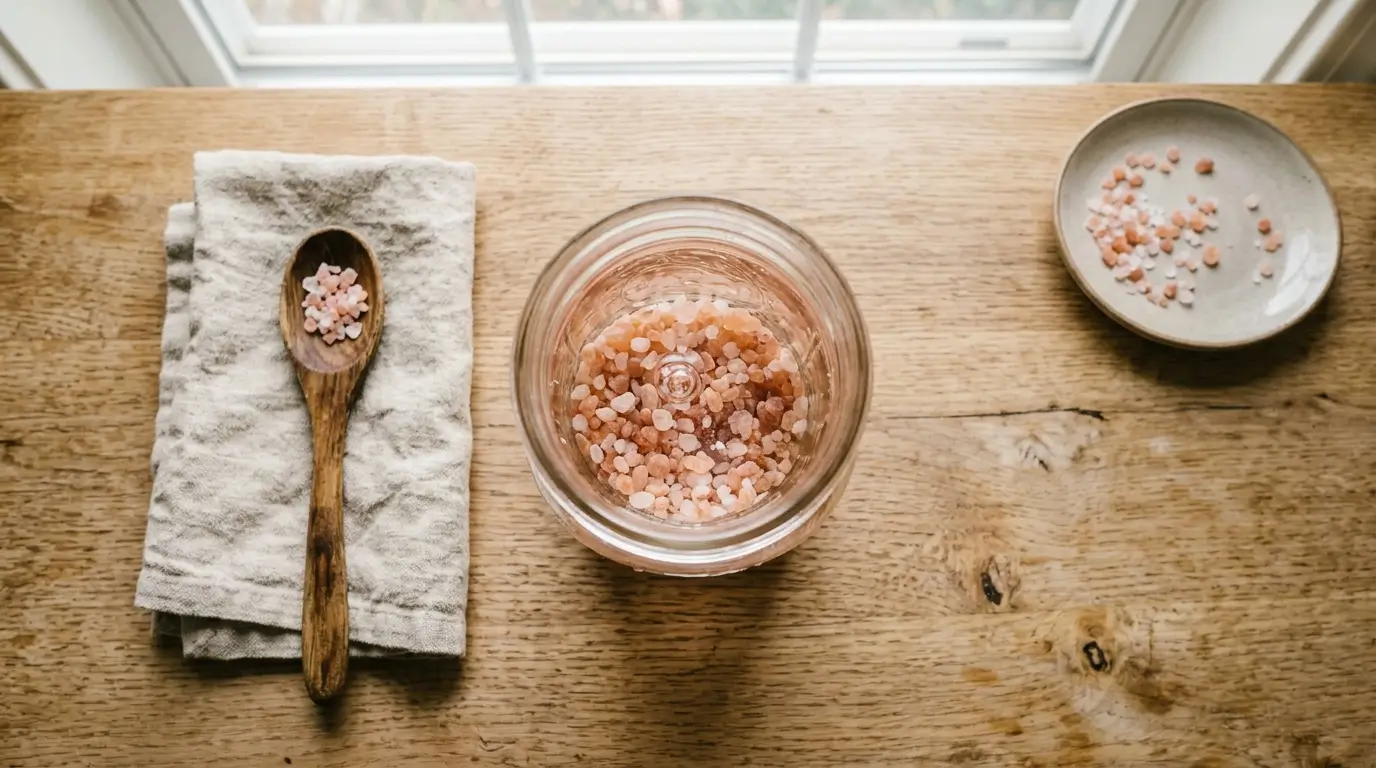
Walk into enough wellness-minded kitchens and you’ll spot the same cloudy pink jar on the counter: coarse salt crystals sitting at the bottom of filtered water, with a teaspoon stirred into a glass each morning. That mixture is what happens when you dissolve Himalayan salt in water past the point where it can absorb any more — a preparation called sole (pronounced so-lay). It’s cheap, it’s simple, and it comes attached to some fairly bold claims about hydration, energy, and detoxification.
Here’s what actually happens when salt meets water, what a typical serving delivers in sodium, and where the line sits between a genuinely old European brine tradition and a much newer wellness story.
What Is Himalayan Salt in Water (Sole)?
Himalayan salt in water — usually called sole — is water that has been fully saturated with pink Himalayan salt. You add salt until the water can’t dissolve any more of it, which happens once the mixture reaches roughly 26 percent salt by weight. What you’re left with is a concentrate, not a finished drink: people dilute a small spoonful of it into a full glass of water before they ever taste it.
That 26 percent ceiling is just chemistry. Sodium chloride stops dissolving in room-temperature water at that saturation point regardless of the salt’s color or where it was mined. If a few grains sit undissolved at the bottom of the jar after a day, that’s your signal the water is fully saturated and the sole is ready.
How to Make Himalayan Salt in Water at Home
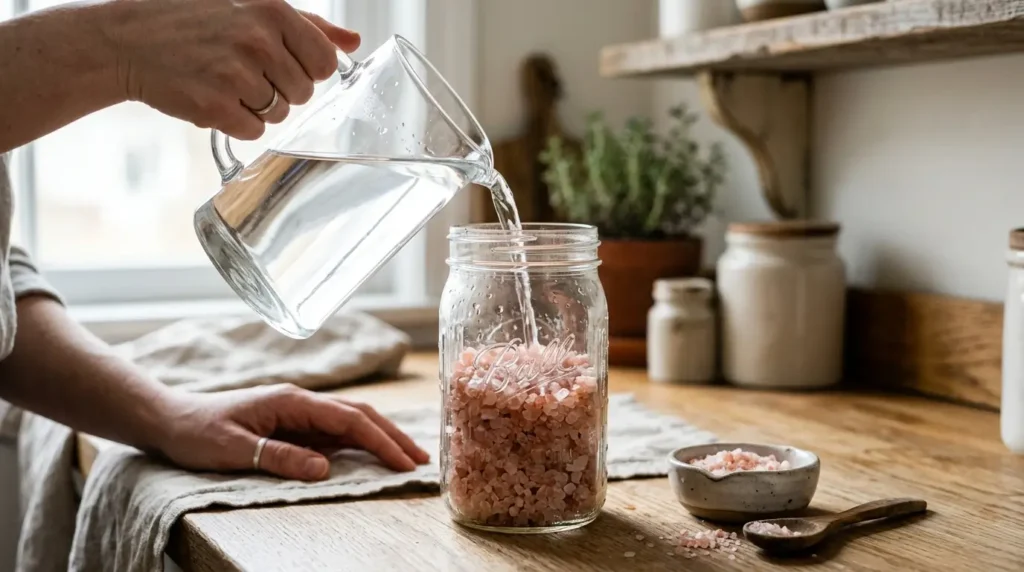
The Himalayan salt water recipe hasn’t changed much since it entered wellness culture: salt, water, time, and a container that won’t react with either.
- Fill a clean glass jar about a quarter full with coarse pink Himalayan salt crystals.
- Pour filtered or spring water over the salt until the jar is nearly full, leaving about an inch of headspace.
- Seal the jar with a plastic, cork, or glass lid — never metal, which corrodes on contact with concentrated brine.
- Let the jar sit undisturbed at room temperature for 12 to 24 hours.
- Check the bottom of the jar. If a small amount of salt remains undissolved, the water is fully saturated and the sole is ready to use. If every crystal dissolved, add more salt and wait another day.
- Keep topping up the jar with salt and water as you use the concentrate. Salt inhibits bacterial growth, so a properly maintained jar keeps at room temperature indefinitely, though many people refresh the whole batch every few weeks out of habit.
To drink it, the standard serving is about a teaspoon of concentrate stirred into a full glass of room-temperature water, usually first thing in the morning. Buy your crystals from a source you trust — a surprising share of “Himalayan” salt on shelves isn’t what the label claims, and origin is harder to verify once the salt is already dissolved.
What Sole Tastes Like (and How People Actually Drink It)
Straight sole tastes like exactly what it is: an intensely salty brine, closer to seawater at its strongest than to a mineral water. Nobody drinks it undiluted. The pink salt water drink most people actually consume — a teaspoon of concentrate in eight ounces of water — tastes like lightly salted water, mild enough that many people notice little more than a faint mineral edge. Some stir in a squeeze of lemon or lime, which cuts the salinity and is the most common variation you’ll find in any recipe for it.
What’s Really Inside a Glass of Himalayan Salt Water
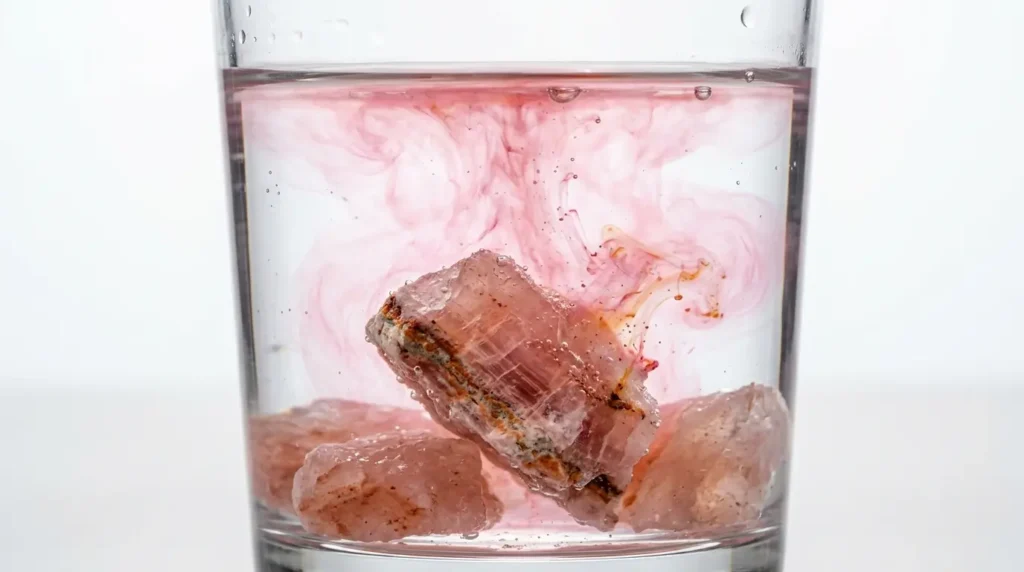
The marketing around Himalayan salt leans hard on one number: 84 trace minerals. That claim is technically defensible — spectrometry can detect dozens of elements in any rock salt — but it skips the part that actually matters, which is quantity. A peer-reviewed mineral analysis of commercial pink salt found that it runs 96 to 99 percent sodium chloride by weight, with calcium, magnesium, potassium, and iron oxide, which also gives the salt its color, making up the remaining 1 to 4 percent. That same analysis found Himalayan-sourced and darker-colored samples generally tested higher in trace minerals than paler, non-Himalayan pink salts — so if mineral content genuinely matters to you, origin and color are the more useful signals, not the marketing copy.
The same study calculated what it would actually take to get a nutritionally meaningful dose of those minerals from pink salt alone: more than 30 grams a day, or roughly six teaspoons. At that volume, the sodium load would blow past every major health guideline long before the minerals contributed anything useful. The analysis also flagged one commercial sample that exceeded the legal lead limit for salt — a reminder that “natural” and “tested” aren’t the same thing, and that sourcing matters more than the color of the crystal. Ordinary table salt runs about 97 to 99 percent sodium chloride too, so a sole made with iodized table salt would deliver a nearly identical sodium load — the trace minerals and the color are really the only meaningful differences between the two.
Run the math on a normal serving instead of the whole jar, and the picture sharpens further. A registered dietitian interviewed by the Cleveland Clinic estimated that a typical glass of sole water — one teaspoon of concentrate diluted into eight ounces of water — delivers upwards of 500 milligrams of sodium. Set that next to the numbers regulators actually publish and the “just a splash of salt” framing stops holding up: CDC guidance caps sodium at less than 2,300 milligrams a day, and the American Heart Association puts the ideal ceiling for most adults at 1,500 milligrams. One morning glass can already claim a fifth to a third of an entire day’s sodium budget before breakfast is on the table.
Himalayan Salt in Water: Claims vs. What the Evidence Shows
Search around and the same handful of benefits come up again and again. Here’s how each one holds up against what’s actually been studied.
| Claim | What’s Said | What the Evidence Shows |
|---|---|---|
| Better hydration | Ionic minerals help water absorb into cells faster | Dissolved salt does separate into ions, but that’s equally true of ordinary table salt stirred into water — it isn’t unique to Himalayan salt |
| Mineral supplementation | 84 trace minerals nourish the body | The minerals are real but minor; reaching a meaningful dose would require a sodium intake far beyond any safe daily limit |
| Detoxification | Draws toxins out of the body | No peer-reviewed research supports a distinct detox mechanism; the liver and kidneys handle that job regardless of what you drink |
| Lower blood pressure | Balances electrolytes and blood pressure | The opposite is far better supported: excess sodium is one of the most consistent dietary drivers of high blood pressure |
| More energy, less fatigue | Corrects a mineral deficiency causing tiredness | Any lift is more plausibly explained by correcting mild dehydration than by a property specific to pink salt |
None of this makes a modest serving dangerous for a healthy adult. It makes sole water ordinary salt water with noticeably better marketing than the shaker on your table.
Where This Practice Actually Comes From
The word sole didn’t arrive with a specific ancient lineage attached to drinking a morning teaspoon of it, and that detail matters, because a lot of marketing implies otherwise. Sole is simply the German word for brine, tied to a genuinely old tradition: German spa towns built graduation towers — timber walls that trickle concentrated brine into a fine mist — so visitors could sit nearby and breathe salt-laden air for their skin and lungs. That’s documented practice going back centuries, and it’s still running today in towns like Bad Reichenhall and Bad Kissingen. It’s a tradition built around bathing in and inhaling brine, not drinking it by the spoonful.
Salt water has its own separate, legitimate folk roots elsewhere, too. Saline nasal irrigation — the neti pot — comes out of a yogic and Ayurvedic lineage that’s centuries old, and gargling salt water for a sore throat shows up across cultures with real modern research behind those two specific, narrow uses. Drinking a saturated brine solution each morning is a related idea wearing older clothes, but it isn’t the same practice, and it doesn’t automatically inherit the same evidence.
The version sold today — a jar of sole on the counter, a teaspoon in the morning water — traces more directly to wellness publishing and social media over the last two decades than to any single historical source, riding alongside broader interest in salt-based wellness trends like halotherapy.
Who Should Be Cautious With Himalayan Salt in Water
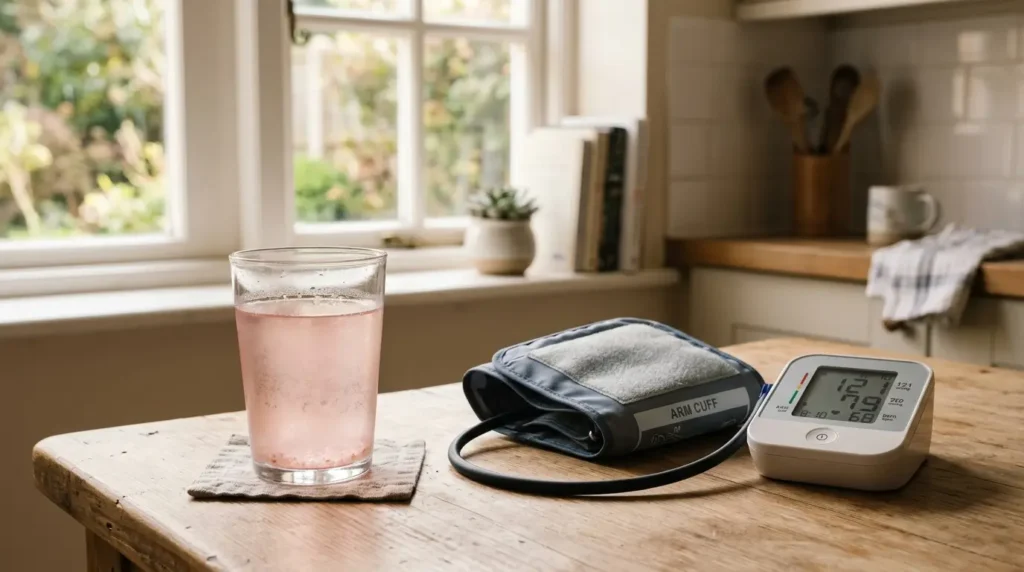
For a healthy adult with no sodium-related conditions, one modest serving is unlikely to cause harm on its own — sodium only becomes a problem in the context of a whole day’s intake, and this is one contributor among many. A few groups have real reasons to skip it or check with a doctor first:
- Anyone with high blood pressure. Extra sodium is one of the most well-established dietary factors in elevated blood pressure, and a daily habit adds up fast.
- Anyone with kidney disease. The kidneys manage sodium balance, and impaired kidney function changes how much sodium the body can safely process.
- Anyone with heart failure or on a doctor-prescribed low-sodium diet. These diets are often built around a strict daily sodium ceiling, and 500-plus milligrams from one glass is a significant share of it.
- Pregnant or breastfeeding people. Sodium needs shift during pregnancy, and it’s worth running any new daily habit past an OB or midwife rather than guessing.
- Infants and young children. Concentrated salt water should never be given to infants or toddlers; their kidneys can’t process a sudden sodium load the way an adult’s can.
None of this is a reason to panic over a single glass. It’s a reason to treat sole water like what it actually is — a sodium source — and weigh it against everything else salty already sitting in your day.
The Bottom Line
Himalayan salt in water is neither a miracle mineral tonic nor a hidden danger. It’s salt water, made slightly more concentrated and considerably more photogenic than what comes out of your kitchen tap. If you enjoy the ritual or the taste, keep the serving small — a teaspoon of concentrate in a full glass, not a splash of the concentrate itself — count it against your daily sodium intake the way you would a handful of chips or a slice of deli meat, and skip it entirely if you fall into one of the higher-risk groups above.
For a closer look at where this salt actually comes from and how it reaches a kitchen jar in the first place, the full guide to Himalayan pink salt covers the rest of what’s worth knowing before you buy a bag.