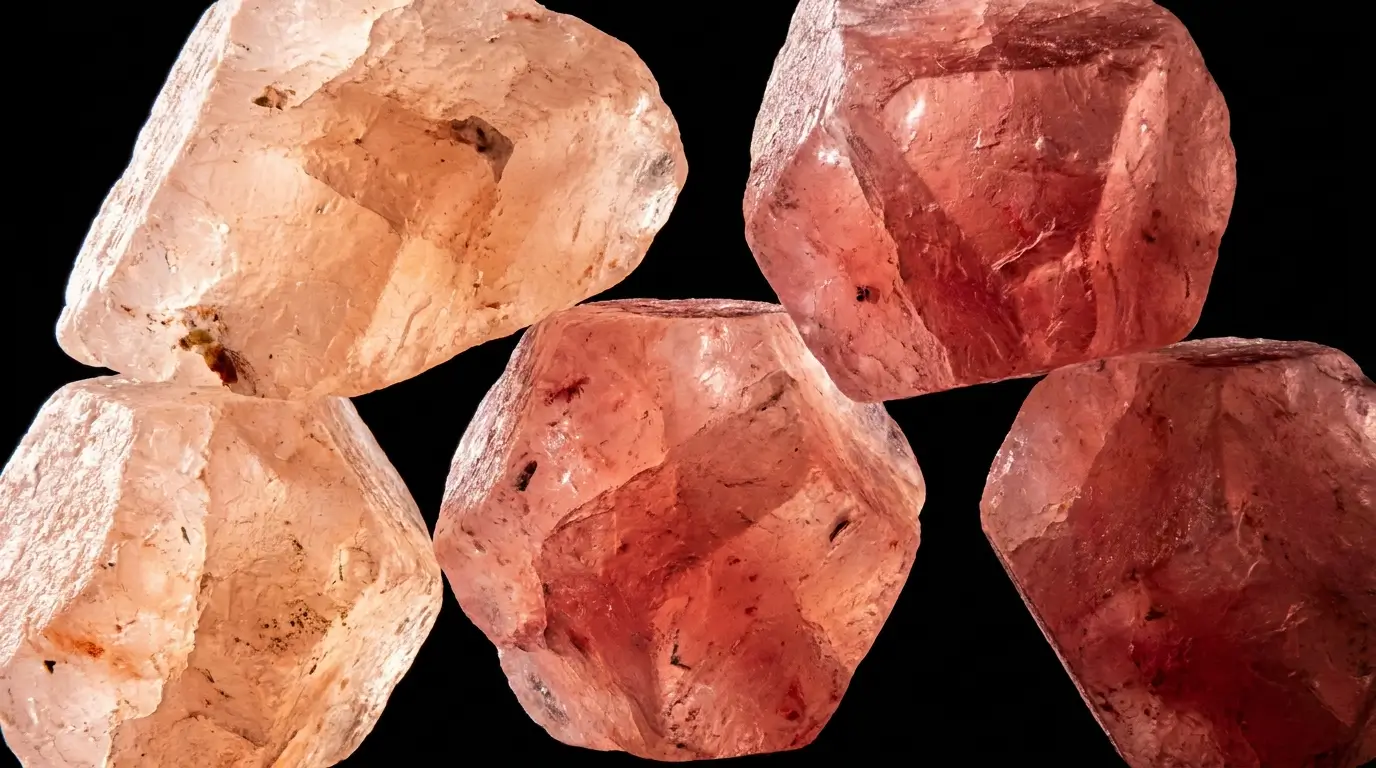
Pink salt is pink because it contains trace amounts of iron oxide — the same compound that makes rust red, desert sandstone orange, and the soil of the American Southwest that distinctive terracotta color. The concentration in Himalayan pink salt is tiny, typically less than 0.1% by weight, but iron oxide is intensely pigmented. Even in minute quantities, it is enough to shift the color of sodium chloride from white to pale blush, dusty rose, or deep salmon depending on how much is present.
That is the complete answer to the question. What follows is the geology, the mineralogy, and the practical implications — because understanding why the iron got there in the first place, and what else came along with it, is genuinely interesting and useful for anyone who cooks with or buys pink salt.
The Geology: How a 600-Million-Year-Old Ocean Made Pink Salt
Himalayan pink salt did not start out pink. It started as a shallow inland sea.
Approximately 600 million years ago, during the Precambrian era, what is now the Salt Range region of northern Pakistan was covered by a warm, shallow body of seawater. Over geological time, that sea evaporated — not quickly, but over immense spans of time — leaving behind thick deposits of sodium chloride and other minerals on what was then the seafloor.
As tectonic activity reshaped the planet’s crust, those salt deposits were buried under layers of sediment, then compressed and heated as the Indian subcontinent collided with the Eurasian plate — the same collision that built the Himalayan mountain range over tens of millions of years. The salt, now deep underground, was protected from dissolution and contamination by the surrounding rock. It was also slowly infused with minerals leaching from those surrounding rocks over hundreds of millions of years.
Iron was one of those minerals. Iron compounds are among the most abundant minerals in the Earth’s crust, and as iron-bearing water moved through the salt deposit over geological time, iron oxide precipitated out and became incorporated into the salt crystals. The result is what you grind into your food today.
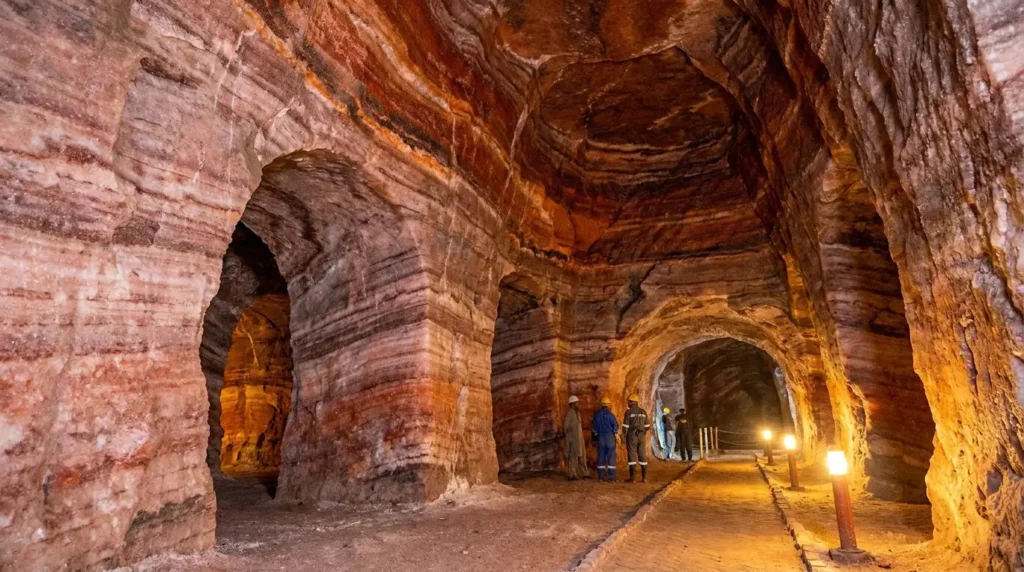
The Khewra Salt Mine in Punjab, Pakistan — the source of virtually all Himalayan pink salt sold globally — is the surface expression of this deposit. The mine descends through multiple levels of salt, and the color of the salt varies considerably depending on depth and location within the deposit. Some chambers yield nearly white salt; others produce salt so deeply colored it approaches orange-red. All of it is chemically the same mineral: sodium chloride with varying concentrations of trace iron oxide and other minerals.
What Trace Minerals Are Actually in Pink Salt
Iron oxide is the color agent, but it is not the only mineral present in Himalayan pink salt beyond sodium chloride. Multiple independent laboratory analyses of Khewra salt have been published over the years, and while exact figures vary depending on the specific sample tested and the analytical method used, the general profile is consistent.
A representative mineral analysis of Himalayan pink salt looks approximately like this:
| Compound / Element | Typical concentration |
|---|---|
| Sodium chloride (NaCl) | 95–98% by weight |
| Calcium | 400–600 mg/kg |
| Potassium | 3,000–4,000 mg/kg |
| Magnesium | 100–200 mg/kg |
| Iron | 30–50 mg/kg |
| Sulfate | ~1,200 mg/kg |
| Fluoride | trace |
| Other trace elements | < combined 1% |
The iron figure — roughly 30–50 mg per kilogram of salt — is low in absolute terms, but iron oxide’s pigmenting power is disproportionate to its mass. You do not need much of it to change the color of a white crystal noticeably.
One peer-reviewed study worth citing here is the analysis published by Bhatti and colleagues (2016) in the Pakistan Journal of Pharmaceutical Sciences, which tested multiple samples from the Khewra mine and found significant color variation between samples while confirming the predominance of NaCl and the presence of trace minerals consistent with iron oxide pigmentation. The finding of color variation across samples from the same mine is particularly important for understanding why not all pink salt looks the same.
How the Color Varies — and What That Actually Tells You
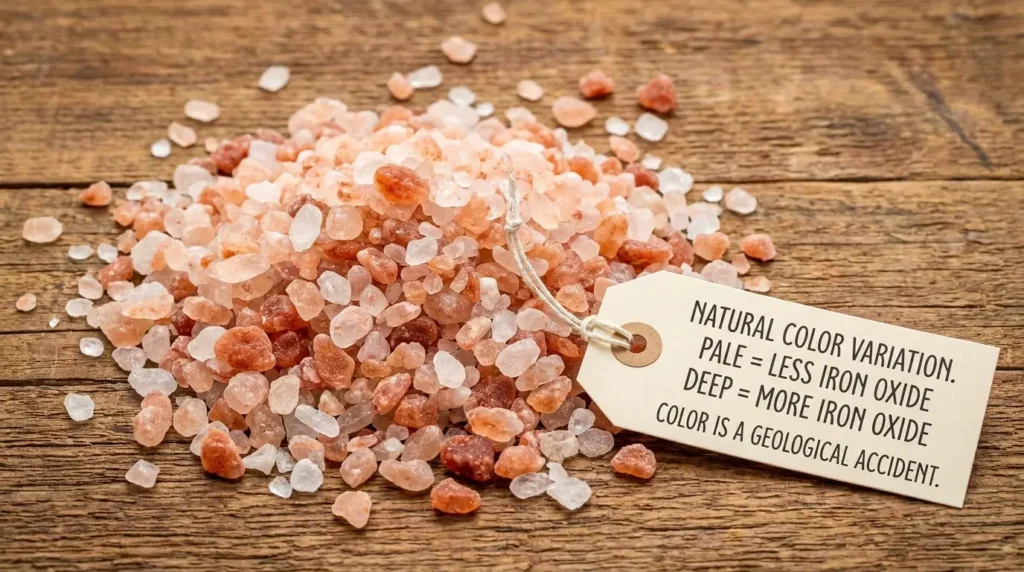
Not all Himalayan pink salt is the same shade. The range runs from almost pure white, through pale blush and soft pink, to rose, salmon, and in some pieces a deep brick red. This variation is not a quality difference — it is a geological one.
The deeper and more iron-rich the section of the deposit, the darker the salt extracted from it. Salt from different levels of the Khewra mine, or from different lateral positions within the same level, can look quite different even though it came out of the ground on the same day.
This has a practical implication for buyers: color uniformity in pink salt is a warning sign, not a quality indicator. Real Himalayan salt from Khewra shows natural variation — lighter pieces mixed with darker ones, gradient variation within a single crystal, and differences between batches. Salt that is a perfectly consistent shade of uniform rose throughout is likely either heavily processed (fine-milled salt loses some of the color variation apparent in coarse crystals) or, in the worst case, dyed regular rock salt.
The “deeper pink = more minerals = healthier” logic that appears in some marketing is not supported by the mineral analysis data. The relationship between iron oxide concentration and the concentration of other beneficial trace minerals is not linear or reliable enough to use color as a nutritional proxy. You cannot assess the magnesium or potassium content of a salt crystal by looking at its color.
Does the Pink Color Affect the Taste?
Marginally, and not in the way most people expect.
Iron itself is not strongly taste-active in the concentrations present in pink salt. The faint metallic character that comes from iron compounds in water is detectable at much higher concentrations than what is present in a typical serving of pink salt. In double-blind taste tests comparing Himalayan pink salt to high-quality sea salt when dissolved into cooked food, subjects consistently fail to identify the pink salt reliably — the mineral profile, while real, is below the perceptual threshold when salt is dissolved into a dish.
Where a difference is more perceptible is in direct contact on the palate — using coarse pink salt as a finishing salt on a dish rather than dissolving it during cooking. The irregular crystal structure delivers a burst of concentrated salinity that dissolves on the tongue, and some people detect a very slight mineral softness compared to the sharper bite of pure table salt. Whether that difference is from the trace minerals or from the crystal structure and dissolution rate is difficult to separate in practice.
The honest answer: the pink color does not mean the salt tastes dramatically different. If you are using pink salt primarily because you prefer the flavor, the most perceptible difference will come from using it as a finishing salt, not from cooking with it.
Is the Color “Proof” of Purity? No — Here’s Why
This claim appears constantly in pink salt marketing and it needs a direct rebuttal, because it contains a logical error.
The argument usually goes: “The pink color comes from the 84 trace minerals naturally present in Himalayan salt, which proves it is pure and unrefined.”
The first part is partially true — the color does come from trace minerals, and the salt is minimally processed. But color is not proof of purity in any analytically useful sense. Here is why:
Purity in chemistry means a high concentration of a single compound. By that standard, whiter salt is actually “purer” — it contains a higher percentage of sodium chloride. Heavily pink salt contains more iron oxide, which is technically an impurity (a departure from pure NaCl), not a marker of purity.
Dyes can replicate the color perfectly. Regular rock salt from other deposits can be treated with iron oxide dye to produce a product visually indistinguishable from Khewra salt. Color alone cannot confirm authenticity. Provenance, sourcing transparency, and — where it matters — independent lab testing are the actual indicators.
“84 trace minerals” is a marketing number, not an analytical one. The figure circulates widely in pink salt marketing but is not derived from peer-reviewed analysis. Actual independent laboratory analyses typically identify 10–15 minerals present in quantities above trace detection limits, not 84 distinct nutritionally meaningful minerals. The number conflates the detection of any element in any quantity with the presence of meaningful mineral content.
None of this makes Himalayan pink salt a bad product. It is genuinely ancient, genuinely minimally processed, and genuinely contains trace minerals that refined table salt does not. But color is not the evidence for any of that — the geology and the sourcing are.
What the Research Actually Shows
A handful of peer-reviewed studies have analyzed the mineral content of Himalayan pink salt, and their findings are consistent: the salt is predominantly sodium chloride, contains measurable trace minerals, shows color variation corresponding to iron oxide concentration, and does not contain the nutritionally transformative mineral profile that some marketing implies.
The most directly relevant for this question — why is pink salt pink — is the straightforward mineralogical answer: iron(III) oxide (Fe₂O₃) is the primary chromophore. This is not disputed in the scientific literature. The debate, such as it is, concerns the nutritional significance of the trace minerals, not their presence.
For anyone interested in the full mineral composition picture, the what is pink salt article covers the composition data in more detail, and the types of pink salt guide explains how other pink salts — Hawaiian Alaea and Peruvian Maras, for example — get their color from different sources entirely. Alaea’s color comes from volcanic red clay mixed into the salt, not from iron oxide within the crystals themselves.
The Short Answer, One More Time
Pink salt is pink because trace iron oxide is embedded in its crystals as a result of 600 million years of geological activity at the Khewra Salt Mine in Pakistan. The color varies naturally within and between bags because iron concentration varies within the deposit. It is not a marker of purity, not a reliable indicator of mineral richness, and it has a marginal effect on flavor — most noticeable when used as a finishing salt rather than a cooking ingredient.
The color is real, the geology behind it is fascinating, and the salt is genuinely excellent in the kitchen. It just does not need to be more than that.