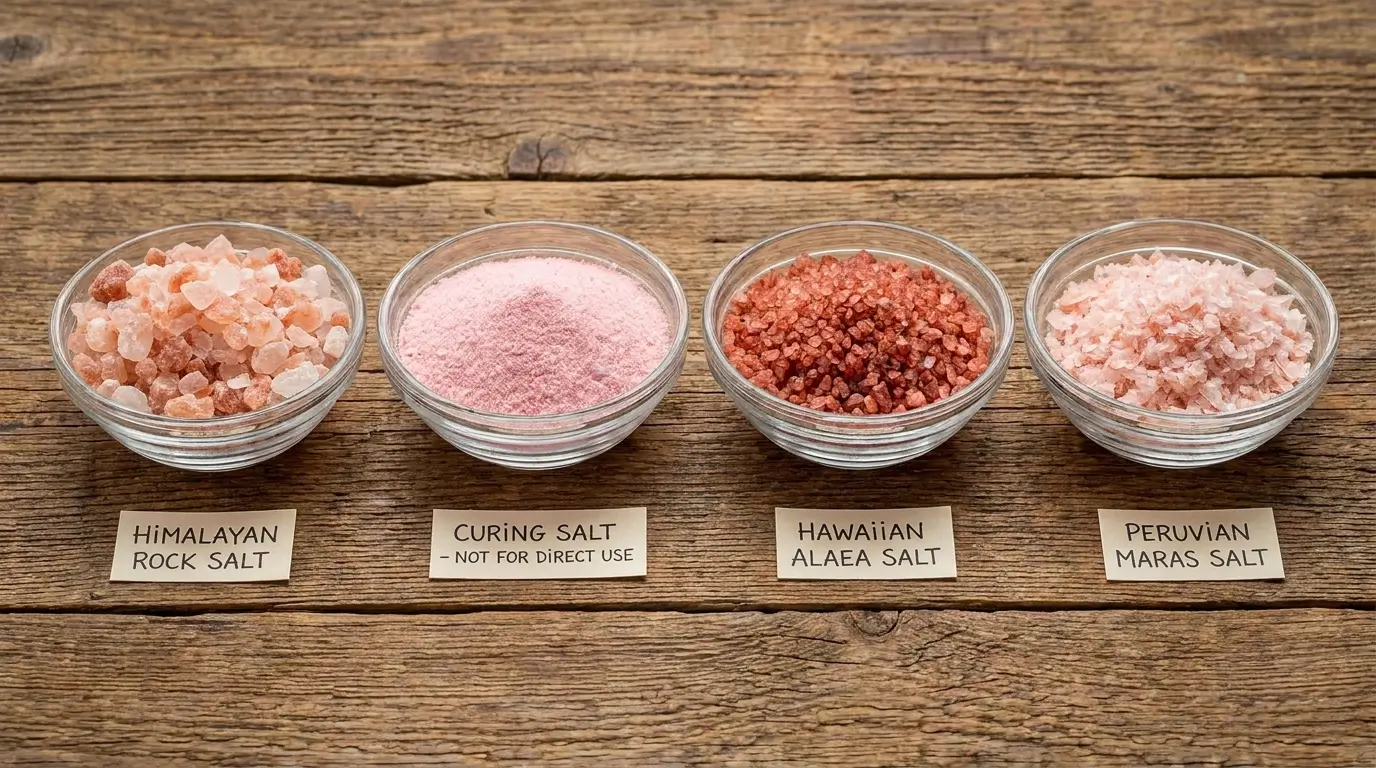
“Pink salt” is not a single product. It is a color description applied to at least four distinct types of salt — each with different origins, different chemical compositions, and in one case, very different safety profiles. Knowing which type a recipe, product label, or recommendation refers to is not just a culinary detail. In the case of pink curing salt, it is a matter of food safety.
Here is a complete map of every major type of pink salt, what each one actually is, and which one belongs in your kitchen.
⚠️ Critical safety note before you read further:
Pink curing salt (Prague Powder / Instacure) is not a food seasoning. It contains sodium nitrite, is toxic in raw quantities, and is deliberately dyed pink to prevent confusion with edible salt. It must never be used as a substitute for Himalayan pink salt, table salt, or any other cooking salt. If a recipe calls for “pink salt” as a seasoning, it means Himalayan pink salt — not curing salt. This distinction is covered fully in its own section below.
Type 1: Himalayan Pink Salt
What it is: A rock salt mined from the Khewra Salt Mine in Punjab, Pakistan. It is the dominant product in the “pink salt” category and the one that most recipes, restaurants, and retailers mean when they say “pink salt” without further qualification.
Where it comes from: A single underground deposit in Pakistan’s Salt Range mountains, formed approximately 600 million years ago when an ancient inland sea evaporated and left thick mineral deposits that were subsequently buried and preserved by tectonic activity. The geological isolation of the deposit — sealed from surface contamination for hundreds of millions of years — is the basis for its reputation for purity.
Why it is pink: Trace iron oxide (Fe₂O₃) embedded in the salt crystals during the deposit’s formation. The concentration varies across the deposit, which is why individual crystals range from nearly white to deep rose within the same bag. Uniform color throughout is a sign of processing or dye, not quality.
Chemical composition: 95–98% sodium chloride, with trace amounts of potassium, magnesium, calcium, iron, and roughly 80 other elements in very small concentrations. The trace minerals are real. Their nutritional significance at typical serving sizes is minimal.
Forms available:
- Fine grain — for general cooking, dissolves quickly, measures consistently
- Coarse grain — for grinders and dry brines; requires a hardened ceramic or steel grinder mechanism because pink salt is significantly harder than table salt
- Finishing flakes — large flat crystals for topping dishes at the table
- Salt blocks / slabs — solid pieces used as cooking surfaces or serving platters
Best used for: General kitchen seasoning, finishing dishes at the table, grinding at the table, salt block cooking, and any application where visual appeal and mild mineral character matter.
Important limitation: Unlike iodized table salt, Himalayan pink salt contains no added iodine. If it is your primary household salt and your diet does not include regular seafood, dairy, or eggs, iodine intake is worth monitoring.
For a complete guide to this salt — its geology, mineral profile, culinary applications, and how to buy it without getting a counterfeit — see the Himalayan pink salt guide.
Type 2: Pink Curing Salt (Prague Powder / Instacure)
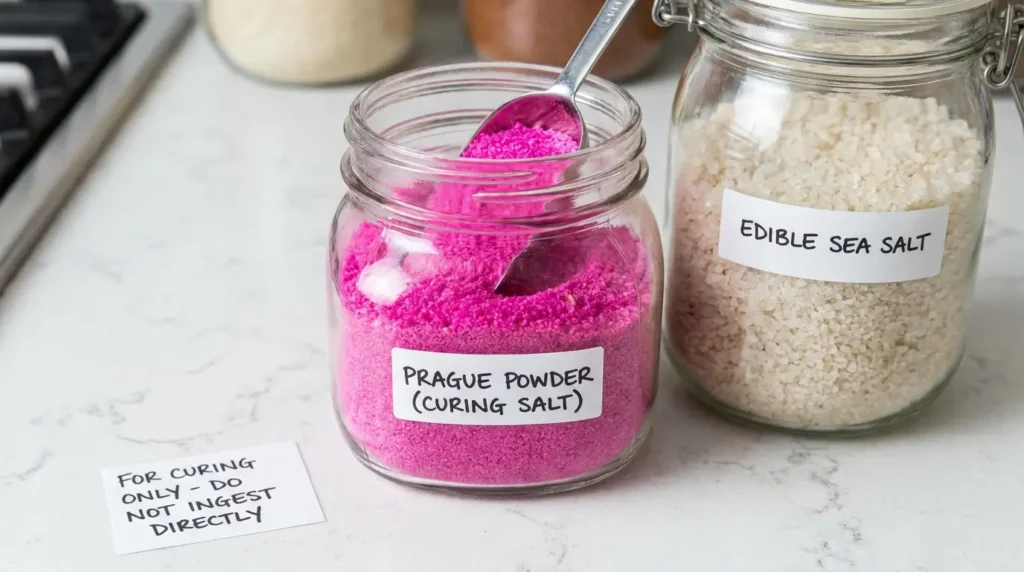
⚠️ Safety callout: Pink curing salt is not a food seasoning. It contains sodium nitrite — a compound that is effective and safe in the precise small quantities used in meat curing, but toxic if consumed in the concentrations found in the curing salt itself. It is dyed bright pink specifically so it cannot be mistaken for ordinary salt. Treat it as a controlled ingredient, not a pantry staple.
What it is: A precise blend of regular table salt (93–94%) and sodium nitrite (6–6.25%), dyed pink as a safety measure. It is sold under several commercial names — Prague Powder #1, Instacure #1, DQ Curing Salt, and pink curing salt among them. A second formulation, Prague Powder #2, contains sodium nitrate in addition to sodium nitrite and is used for different applications.
Where it comes from: This is a manufactured product, not a mined mineral. It is produced industrially by blending food-grade sodium chloride with sodium nitrite, adding a pink or red food-safe dye, and packaging in precise concentrations. There is no geographic origin in the sense that Himalayan salt has one.
Why it is pink: Intentional food-safe dye, added specifically to make it visually distinct from ordinary salt and prevent accidental use as a seasoning.
What it does: Sodium nitrite inhibits the growth of Clostridium botulinum — the bacterium responsible for botulism — in cured and smoked meats. It also contributes to the characteristic pink color of cured products like bacon, ham, and corned beef, and extends shelf life. It is a functional food safety ingredient with a long history of regulated use.
Prague Powder #1 vs. Prague Powder #2:
| Prague Powder #1 | Prague Powder #2 | |
|---|---|---|
| Contains | Salt + sodium nitrite (6.25%) | Salt + sodium nitrite (6.25%) + sodium nitrate (4%) |
| Used for | Short-cure and cooked products | Long-cure, dried products |
| Examples | Bacon, corned beef, hot dogs, smoked sausage | Salami, prosciutto, country ham, dry-cured meats |
| Curing time | Hours to days | Weeks to months |
Best used for: Meat curing — specifically products that will be smoked, cooked, or fermented. Never for direct seasoning or table use.
Typical usage rate: Prague Powder #1 is used at approximately 1 teaspoon (about 5.7g) per 5 pounds of meat. Precision matters — this is not an ingredient to estimate.
For complete guidance on safe handling, measurement, and the legal and practical distinctions between #1 and #2, see the full pink curing salt guide.
Type 3: Hawaiian Alaea Salt
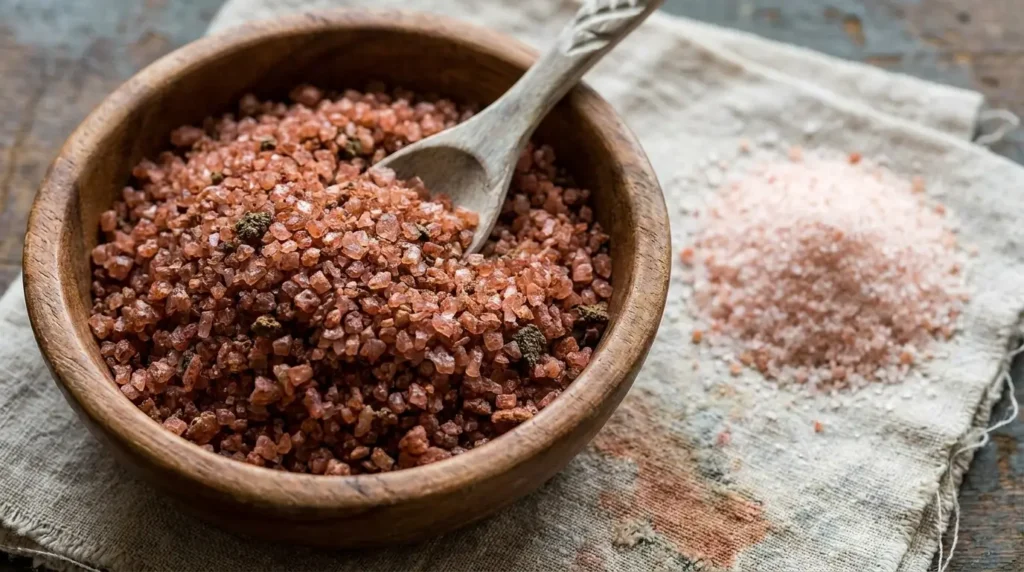
What it is: A traditional Hawaiian sea salt mixed with volcanic red clay (alaea), which gives it a distinctive pink-to-rust color and an earthy mineral flavor unlike any other salt in this category. It has been produced and used in Hawaiian cooking and ceremony for centuries.
Where it comes from: Hawaii, produced by evaporating Pacific Ocean seawater in traditional salt pans, then blending the resulting sea salt with alaea — a natural volcanic clay found only in certain locations in Hawaii. The red clay is rich in iron-bearing minerals, and its addition to the salt is both a flavoring technique and a cultural tradition.
Why it is pink: Volcanic red clay (alaea), not iron oxide within the salt crystals themselves. This is a meaningful distinction — in Himalayan salt, the color is intrinsic to the mineral; in Alaea salt, the color comes from an added ingredient. The resulting hue ranges from soft salmon to deep rust depending on the proportion of clay used.
Chemical composition: Sea salt (sodium chloride from Pacific Ocean water) plus naturally occurring minerals from the volcanic clay — particularly iron oxides, silica, and trace earth minerals. The mineral profile is genuinely different from Himalayan salt, and the flavor reflects it.
Flavor profile: Distinctly earthy and mineral, with a complexity that goes well beyond the mild neutrality of Himalayan pink salt. In a side-by-side comparison, Alaea is noticeably different — more assertive, with a clay-like earthiness that is either appealing or unusual depending on the dish and the cook’s preference.
Traditional uses: Kalua pig (slow-roasted whole pig, where Alaea is essential to the authentic preparation), poke, grilled fish, and Hawaiian ceremonial practices. It is also used in Hawaiian salt massage traditions.
Best used for: Hawaiian dishes where authenticity matters, grilled or roasted proteins where the earthy mineral note is an asset, and as a visually striking finishing salt. It is not a neutral-flavored all-purpose salt — its character is specific enough that substituting it for Himalayan salt in a recipe will change the dish perceptibly.
Where to buy: Not widely available in standard supermarkets outside Hawaii. Specialty food retailers, Hawaiian food importers, and online specialty salt vendors are the primary sources. Authentic Alaea salt should list Hawaiian origin and specify the inclusion of volcanic clay.
For a detailed comparison of Alaea and Himalayan salt — flavor, texture, mineral content, use cases, and which to buy — see pink salt vs Hawaiian Alaea.
Type 4: Peruvian Maras Salt
What it is: A mineral salt produced at the Maras salt pans (salineras) in Peru’s Sacred Valley, near Cusco, using evaporation methods that have been in continuous use since the Incan period. The salt ranges from white to pale pink to soft orange depending on the mineral content of the spring water fed into the terraced pools.
Where it comes from: A naturally salty underground spring in the Andes mountains of Peru, whose water has been channeled into hundreds of small terraced evaporation pools cut into the hillside above the Sacred Valley. Each pool is managed by a different family or community, following a cooperative system of traditional land use.
Why it is pink: Trace minerals — including iron and other compounds — naturally present in the spring water. The color is not uniform across the pans or across harvests; it varies with the season, the water’s mineral content at any given time, and how long the salt is left in the evaporation pool.
Flavor profile: Complex and mineral, with a softness and depth that reflects the spring water’s mineral richness. Generally regarded by specialty salt enthusiasts as one of the more interesting and nuanced salts available — not the same character as Himalayan or Alaea, but distinct in its own right.
Best used for: As a finishing salt, where its delicate color and complex mineral character are most perceptible. It is a specialty product — priced accordingly — and is best reserved for applications where a finishing salt genuinely adds something, rather than used as an everyday cooking salt.
Where to buy: Specialty food retailers, online gourmet salt vendors, and some high-end kitchen stores. Authentic Maras salt should specify Peruvian origin and ideally the Sacred Valley or Maras location.
Side-by-Side Comparison
| Himalayan Pink Salt | Pink Curing Salt | Hawaiian Alaea | Peruvian Maras | |
|---|---|---|---|---|
| Origin | Khewra Mine, Pakistan | Manufactured (industrial) | Hawaii, USA | Sacred Valley, Peru |
| Type | Rock salt | Manufactured compound | Sea salt + volcanic clay | Spring-fed evaporation salt |
| Color source | Iron oxide within crystals | Artificial dye | Volcanic red clay | Trace minerals in spring water |
| Primary compound | ~97% NaCl | 93% NaCl + 6.25% sodium nitrite | NaCl + clay minerals | NaCl + trace minerals |
| Safe to season with? | ✅ Yes | ❌ No — meat curing only | ✅ Yes | ✅ Yes |
| Iodized? | No | No | No | No |
| Flavor character | Mild, lightly mineral | N/A (not a seasoning) | Earthy, assertive | Complex, nuanced |
| Common forms | Fine, coarse, flakes, blocks | Fine powder (pre-blended) | Coarse, fine | Coarse, fine |
| Availability | Widely available everywhere | Specialty / butcher supply | Specialty retailers | Specialty retailers |
| Primary use | General cooking, finishing | Curing bacon, ham, charcuterie | Hawaiian cuisine, finishing | Finishing, gourmet cooking |
Which One Do You Actually Need?
If a recipe calls for “pink salt” as a seasoning — for cooking, finishing, or grinding at the table — it means Himalayan pink salt. This is the default meaning in virtually every consumer and culinary context.
If a recipe calls for “pink curing salt,” “Prague Powder,” or “Instacure” — you need pink curing salt, and only pink curing salt, measured precisely. Do not substitute any other salt. Do not improvise.
If you are cooking traditional Hawaiian dishes — particularly kalua pig or authentic poke — Hawaiian Alaea is the appropriate choice, and its distinct flavor is part of what makes those preparations authentic.
If you are looking for a premium finishing salt with genuine complexity and provenance — Peruvian Maras is worth seeking out and is genuinely different from Himalayan in character.
The broader landscape of how Himalayan pink salt compares to other salts — sea salt, kosher salt, Celtic salt, and kala namak — is covered in the pink salt vs other salts guide, which includes head-to-head comparisons across flavor, texture, mineral content, and best use cases.
And if you want the complete picture of everything that falls under the “pink salt” umbrella — the root definition, the geology, the marketing, and the misconceptions — the pink salt guide is the place to start.