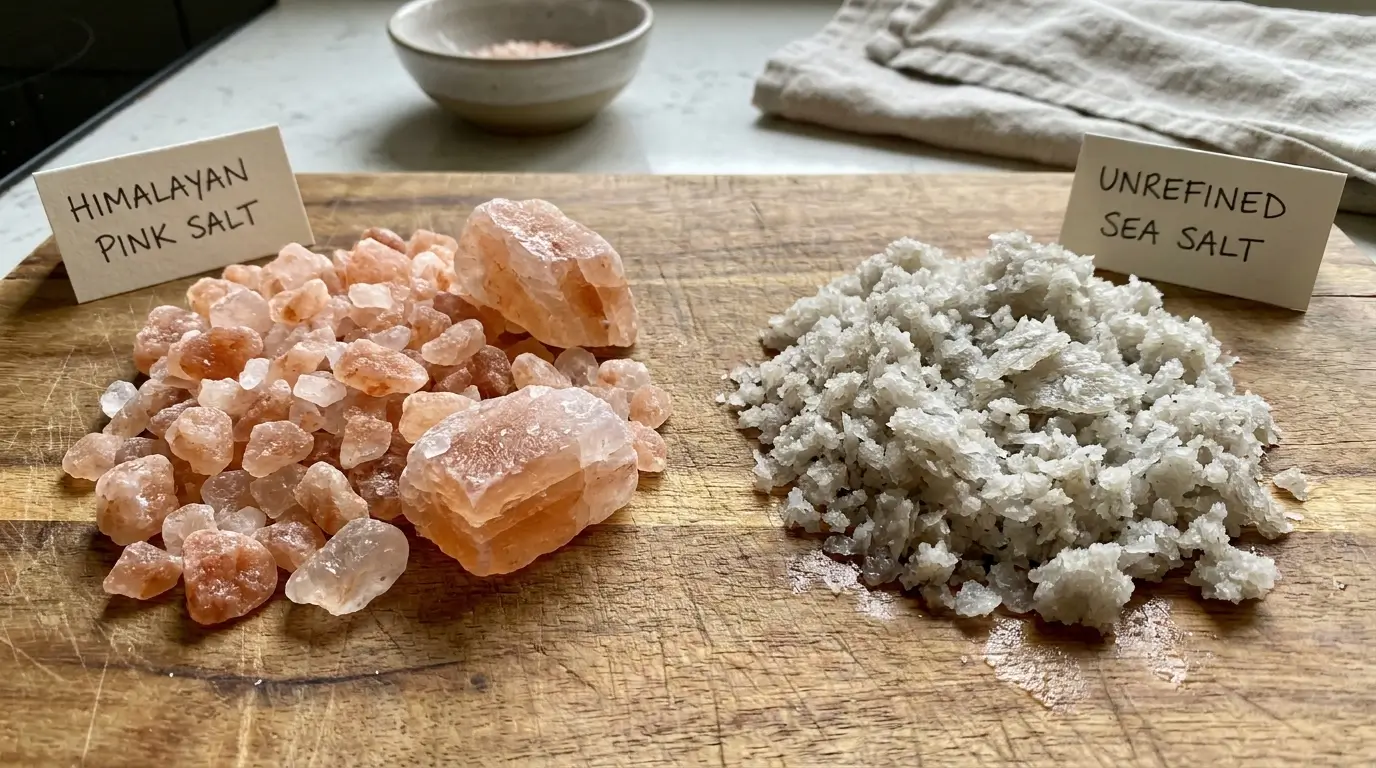
Pink salt and sea salt are not the same thing. They are both sodium chloride — the same fundamental compound — but they differ in how they formed, where they come from, what trace minerals they contain, and how they behave in the kitchen. For most everyday cooking purposes the differences are minor. For specific applications, they matter more than people expect.
Here is the complete comparison.
The Short Answer
Pink salt (Himalayan pink salt) is a rock salt — ancient sodium chloride mined from a landlocked underground deposit in Pakistan that was once a seabed 600 million years ago. Its pink color comes from trace iron oxide locked inside the crystals during the deposit’s formation.
Sea salt is produced by evaporating modern seawater — either in open-air coastal pans (traditional method) or through industrial processes. It comes in dozens of varieties from locations around the world: French Fleur de Sel, Maldon from England, Portuguese Atlantic salt, Hawaiian Alaea, Australian Murray River salt, and many others.
The key structural difference: pink salt is a mined mineral that formed hundreds of millions of years ago and has been sealed underground ever since. Sea salt is a contemporary product harvested from today’s ocean. Both are overwhelmingly sodium chloride. Both have trace mineral profiles. Both are used as food seasonings. But their origins, textures, and subtle flavor profiles are genuinely distinct.
How Each One Forms
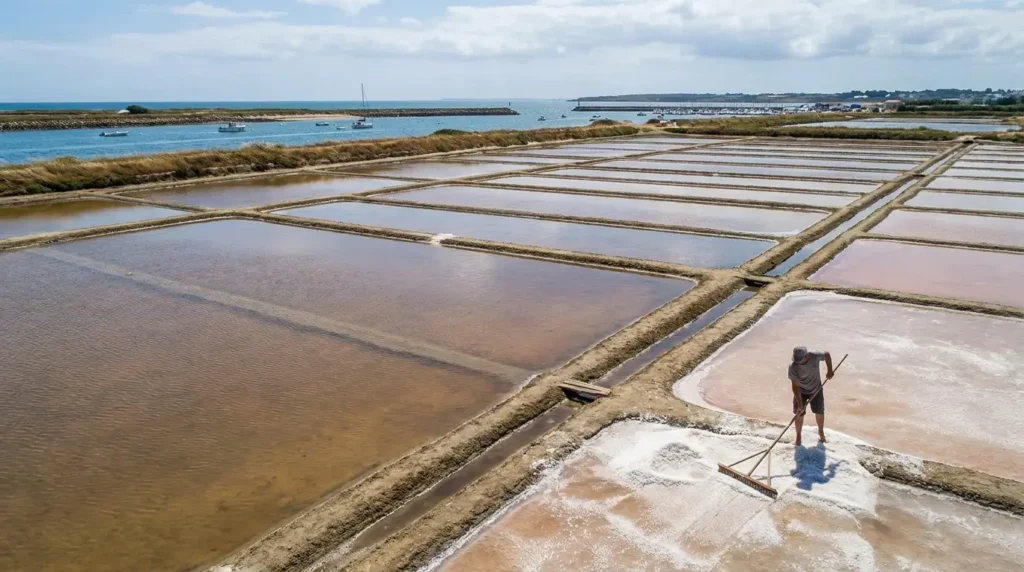
Understanding how pink salt and sea salt form makes every other difference between them easier to understand.
How Pink Salt Forms
Himalayan pink salt began as a shallow inland sea that evaporated approximately 600 million years ago during the late Precambrian era. As the water disappeared, the minerals it held — primarily sodium chloride, along with trace amounts of dozens of other compounds — crystallized out and settled on the seafloor in thick layers.
Over the following hundreds of millions of years, those layers were buried under sediment, compressed by the weight of overlying rock, and eventually folded and pushed upward by the tectonic forces that built the Himalayan mountain range. The result was a dense, hard mineral deposit — halite, the geological term for rock salt — locked underground in Pakistan’s Salt Range mountains.
Because the deposit has been sealed from the surface environment for so long, it has not been exposed to the contamination that affects modern ocean water. The trace minerals in the salt are ancient mineral inclusions from the original seawater and surrounding rock, not anything deposited recently.
For the full geological story of how this deposit formed and where it sits geographically, see where does Himalayan pink salt come from.
How Sea Salt Forms
Sea salt production begins with modern ocean water — the same water that covers 71% of the planet’s surface today. Seawater is about 3.5% dissolved minerals by weight, of which sodium chloride makes up approximately 85%. The rest is magnesium, sulfate, calcium, potassium, and dozens of other compounds in smaller quantities.
To produce sea salt, seawater is channeled into shallow pans or pools and allowed to evaporate — either by sun and wind in traditional pan salt production, or by industrial evaporation. As the water evaporates, the minerals concentrate until sodium chloride crystallizes out first (because it has a lower solubility threshold than most other salts). The crystals are raked, harvested, and dried.
The specific character of a sea salt — its crystal structure, mineral profile, and flavor — depends heavily on where it was produced, the local water chemistry, the evaporation method, and how it was harvested and processed. Fleur de Sel, hand-skimmed from the surface of French salt pans, has a completely different texture from industrially evaporated Mediterranean sea salt, even though both are sea salts.
Mineral Composition: What Is Actually Different
Both pink salt and sea salt are predominantly sodium chloride. The difference in mineral composition is real but modest, and its practical significance depends on what you are measuring it against.
Himalayan pink salt mineral profile (approximate):
| Component | Concentration |
|---|---|
| Sodium chloride | 95–98% |
| Calcium | ~400–600 mg/kg |
| Potassium | ~3,000–4,000 mg/kg |
| Magnesium | ~100–200 mg/kg |
| Iron (as iron oxide) | ~30–50 mg/kg |
| Other trace elements | < 1% combined |
Typical sea salt mineral profile (approximate, unrefined):
| Component | Concentration |
|---|---|
| Sodium chloride | 94–98% |
| Magnesium | ~400–1,000 mg/kg |
| Sulfate | ~2,000–4,000 mg/kg |
| Calcium | ~200–500 mg/kg |
| Potassium | ~400–700 mg/kg |
| Other trace elements | < 1% combined |
The most notable difference: sea salt tends to be higher in magnesium and sulfate (because modern seawater is rich in both), while Himalayan pink salt is notably higher in potassium and iron. The iron content is what produces the pink color; there is no pink color in most sea salts because they do not contain significant iron oxide.
One important caveat: sea salt mineral profiles vary considerably depending on the source. A French Atlantic sea salt harvested from the Guérande region has a different mineral profile from a Mediterranean evaporated sea salt, which differs again from Hawaiian Alaea (a sea salt blended with volcanic clay). “Sea salt” is a broad category, not a single product with a fixed composition.
Neither pink salt nor sea salt is iodized in their natural forms. Iodized table salt has potassium iodide added as a public health supplement. If you use specialty salts as your primary seasoning and do not eat much seafood or dairy, iodine intake is worth being aware of regardless of which specialty salt you choose.
Texture and Crystal Structure
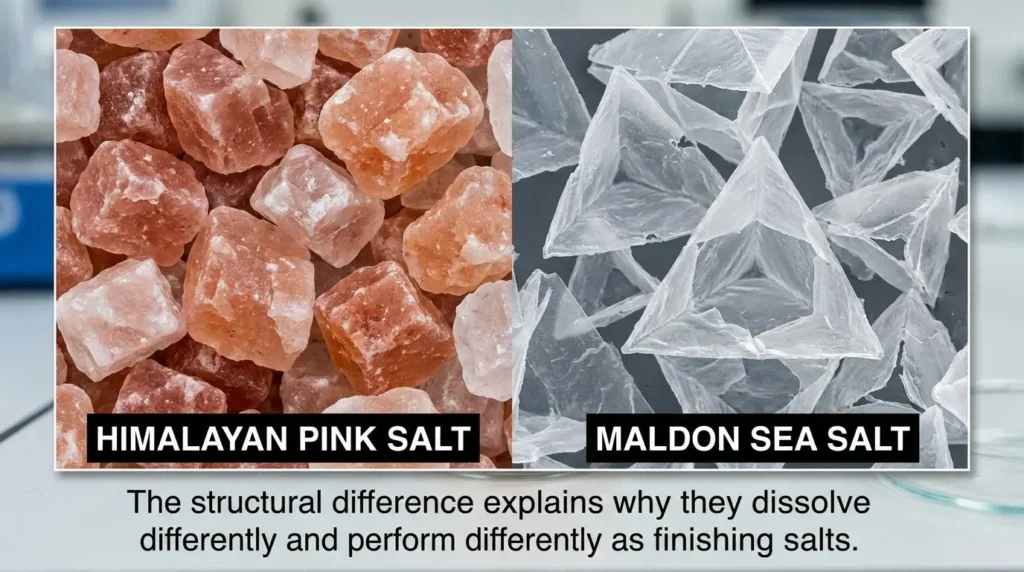
This is where the differences between pink salt and sea salt become most practically significant in the kitchen.
Pink salt is a rock salt — hard, dense, and irregularly shaped. Its crystals are chunky and three-dimensional, formed under geological pressure over millions of years. Fine-ground pink salt dissolves reasonably well, but coarse crystals take noticeably longer to dissolve than fine sea salt. The hardness (approximately 7 on the Mohs scale — harder than most ceramic grinders) means pink salt can damage cheap grinder mechanisms. It benefits from a high-quality hardened steel or ceramic burr grinder.
Sea salt crystals vary enormously by type. Industrial evaporated sea salt produces small, cuboid crystals similar in structure to table salt. Traditionally harvested sea salts produce larger, more irregular crystals. Fleur de Sel produces flat, delicate flakes. Maldon produces large, hollow pyramid-shaped crystals with a distinctive crunch.
The texture difference matters most for finishing applications. A large, flat Maldon crystal dissolves in layers on the tongue — first a crunch, then a gradual burst of salinity. A coarse pink salt crystal dissolves in a single concentrated burst. Both are excellent finishing salts; they just feel different in the mouth.
Flavor: Is There Actually a Difference?
This is the question that generates the most debate among cooks, and the honest answer is: it depends on how you use it.
When dissolved into cooked food: Most controlled blind taste tests find that people cannot reliably distinguish Himalayan pink salt from a quality unrefined sea salt when both are dissolved into a dish during cooking. At that point, the trace mineral differences are simply too small relative to the overall flavor profile of the dish to be perceptible. If you are cooking a soup, pasta, or sauce and adding salt during the process, the choice between pink salt and sea salt has minimal impact on the final flavor.
When used as a finishing salt: The difference becomes more detectable. The reason is that a finishing salt dissolves on the tongue directly, without dilution, so the mineral character of the salt itself is what you are tasting. Pink salt, dissolved this way, has a mild mineral softness compared to the sharper bite of pure table salt or heavily refined sea salt. Unrefined sea salts — particularly those with higher magnesium content — often have a slightly bitter mineral complexity. Neither is “better”; they suit different applications.
Magnesium and bitterness: Sea salts with relatively high magnesium content can have a faint bitter edge that is absent in pink salt. This is one practical reason some cooks prefer pink salt as a finishing salt — its magnesium content is lower, giving it a cleaner, rounder finish on the palate.
Iron and earthiness: The iron oxide in pink salt does not contribute a strongly metallic flavor at the concentrations present. The flavor difference attributed to pink salt in marketing (“84 minerals give it a superior taste”) is not consistently supported in blind testing. The texture, crystal size, and dissolution rate contribute more to the perceived flavor difference than the mineral content itself.
Practical Cooking Comparison
| Himalayan Pink Salt | Sea Salt (unrefined) | |
|---|---|---|
| Best for cooking into dishes | ✅ Yes (fine grain) | ✅ Yes |
| Best as a finishing salt | ✅ Yes (coarse/flakes) | ✅ Yes (Fleur de Sel, Maldon) |
| Grinding at the table | ✅ Yes — needs hardened grinder | ✅ Yes — easier on grinders |
| Salt block cooking | ✅ Yes (unique application) | ❌ Not available in block form |
| Baking | ⚠️ Use fine grain; measure by weight | ✅ Yes — measure by weight |
| Brining meat or vegetables | ✅ Yes | ✅ Yes |
| Visual impact on plating | ✅ High — distinctive pink color | ✅ Variable — Fleur de Sel and Maldon also striking |
| Dissolves quickly | ⚠️ Coarse is slow; fine is faster | ✅ Most forms dissolve readily |
| Iodized option available | ❌ No | ❌ Rarely — check label |
| Counterfeiting risk | ⚠️ Yes — significant market issue | Lower — fewer fakes |
What Genuine Sea Salts Offer That Pink Salt Does Not
It would be incomplete to write a comparison article that implied pink salt was simply the better option. There are specific applications and specific sea salts that outperform Himalayan pink salt on their own terms.
Fleur de Sel — hand-skimmed from the surface of salt pans in France’s Guérande and Camargue regions — has a moist, delicate texture and a complex mineral flavor that many chefs consider the finest finishing salt available. Its crystals dissolve in thin, layered flakes on the palate in a way that coarser pink salt cannot replicate.
Maldon sea salt from Essex, England, produces large hollow pyramid crystals with an exceptional crunch and a clean, sharp salinity. For finishing grilled meat or roasted vegetables, many professional cooks prefer Maldon’s texture to any rock salt, pink or otherwise.
Japanese Shio Koji salt and other traditional Far Eastern sea salts are produced by methods that produce specific mineral profiles not found in any rock salt.
High-magnesium sea salts from the Atlantic or Pacific coasts have a mineral complexity that suits certain applications — particularly with seafood — where that edge is an asset rather than a neutral characteristic.
The right finishing salt depends on what you are finishing and what character you want to add. Pink salt is excellent. It is not uniquely superior to the best sea salts for every application.
Microplastics: An Honest Update
One argument frequently made in favor of Himalayan pink salt over sea salt is the absence of microplastics. This argument has some validity.
Multiple published studies — including a widely cited 2018 analysis in Environmental Science & Technology and follow-up research from Korean researchers — have found detectable microplastic particles in commercially available sea salts from multiple countries. The contamination reflects the microplastic burden in modern ocean water.
Himalayan pink salt, mined from a deposit sealed underground since before synthetic plastics existed, does not carry this contamination. This is one of the legitimate purity claims for the product, not a marketing invention.
That said, the health implications of microplastics in food remain an active area of research, and the quantities found in sea salt — while measurable — are currently considered low enough that most food safety agencies have not issued dietary guidance. The microplastic issue is worth knowing about, but it should not drive salt purchasing decisions based on alarm. It is, however, a genuine and scientifically documented difference between the two.
The Bottom Line
Pink salt and sea salt are similar in composition — both are primarily sodium chloride, both have trace mineral profiles, both perform well across a wide range of culinary applications. They are not the same product.
The meaningful differences are in origin (ancient rock deposit vs. modern ocean), texture (hard dense rock crystals vs. varied sea salt crystal forms), specific mineral content (pink salt higher in iron and potassium; sea salt often higher in magnesium and sulfate), and contamination risk (pink salt has no microplastic exposure; sea salt varies by source).
For everyday cooking, both are excellent. For finishing dishes at the table, both produce outstanding results — the best choice depends on the character you want: pink salt’s mild mineral softness, or a premium sea salt’s distinct texture and flavor. For visual impact and salt block cooking, pink salt has no sea salt equivalent.
To see how Himalayan pink salt compares to the full range of other salt types — including kosher salt, table salt, Celtic grey salt, and black salt — see the complete pink salt vs other salts guide. For a deep dive into Hawaiian Alaea salt — a sea salt that also falls in the pink category — see pink salt vs Hawaiian Alaea.