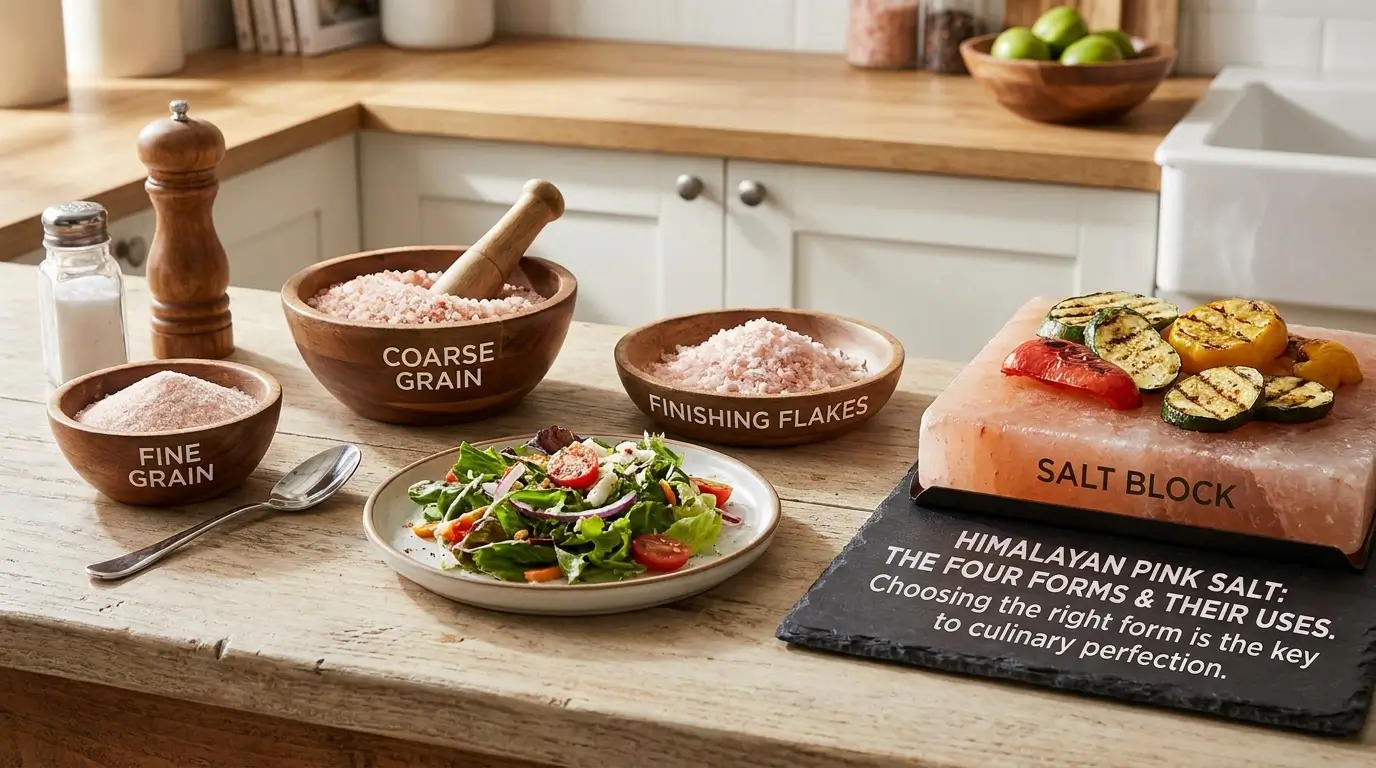
Pink salt is a genuine kitchen workhorse — versatile across essentially every cooking application, from pasta water to dry rubs to chocolate desserts. Most people who buy it use it correctly. Most people also underuse it, defaulting to one form when two or three would serve them better.
This guide covers every practical application: which grain size to use when, how to measure accurately across salt types, finishing technique, the full method for salt block cooking, what to look for in a grinder, and the specific mistakes that cause problems in the kitchen. No wellness claims, no mineral tallies — just cooking.
The Single Most Important Thing to Know
Before anything else: pink salt comes in multiple forms, and they are not interchangeable by volume.
Coarse pink salt crystals are larger and less dense than fine table salt. A teaspoon of coarse pink salt contains meaningfully less sodium than a teaspoon of fine table salt or fine sea salt. The exact difference depends on the specific crystal size, but it can be 25–40% less sodium per unit volume. In baking or any recipe where salt quantity matters precisely, measuring by volume and assuming 1:1 equivalence will under-salt your food.
The fix is simple: measure salt by weight, not by spoon, whenever precision matters. A kitchen scale removes the variable entirely. When a recipe specifies “1 tsp table salt” and you are using coarse pink salt, weigh it: 1 tsp of table salt is approximately 6g. Use 6g of pink salt regardless of how much space it takes in the spoon.
For casual seasoning — a pinch on a steak, a grind over vegetables — this does not matter. Trust your palate and adjust. For baking, brining at a specific concentration, or any recipe where the author has calibrated salt quantity carefully, weigh it.
Pink Salt Forms: Which One Does What
Himalayan pink salt is sold in four distinct forms. Each is optimized for different applications, and using the wrong form for the job is the most common cooking mistake with this ingredient.
Fine Grain
Fine pink salt is ground to a size comparable to standard table salt or fine sea salt — small, relatively uniform crystals that dissolve quickly and distribute evenly. This is the right form for:
- General cooking: adding to pasta water, soups, sauces, marinades, and any liquid-based application
- Mixing into dough or batter
- Seasoning raw meat before cooking when you want the salt to dissolve into the surface quickly
- Any recipe that specifies salt by volume (with the caveat about measuring by weight)
Fine grain is the most versatile form and the one that belongs in your everyday cooking rotation.
Coarse Grain
Coarse pink salt has large, chunky crystals — the form most commonly sold in grinder-top jars or in bulk bags for manual use. It dissolves more slowly than fine grain, which is sometimes a drawback and sometimes exactly what you want. Best applications:
- Loading a grinder for table use
- Dry brining (where large crystals are applied to meat surfaces and left to work over time)
- Salt crusts for whole fish or vegetables
- Layering on bread before baking where visible crystals and crunch are part of the result
Do not attempt to use coarse pink salt in a cheap grinder. Pink salt rates approximately 7 on the Mohs hardness scale — hard enough to destroy ceramic grinder mechanisms that were not designed for it. The grinder question is covered fully in the grinding section below.
Finishing Flakes
Finishing flakes are large, flat, irregular crystals — similar in concept to Maldon sea salt flakes, but with the visual character of pink salt. They are designed for one job: applied to food immediately before serving, where they provide texture, visual impact, and concentrated bursts of mineral salinity.
Finishing flakes should never be used in cooking. Their size and shape make them dissolve unevenly, they clump in humid environments, and their higher cost makes them an expensive choice for anything other than finishing. The full technique for getting the most from them is in the finishing flakes guide.
Salt Blocks and Slabs
Himalayan pink salt blocks are solid slabs of salt, typically 8–12 inches across and 1.5–2 inches thick, used as cooking surfaces or serving platters. They are an entirely different cooking tool from granular salt and require their own technique and care. This form is covered in detail in the salt block cooking section and the dedicated salt block grilling guide.
Measurement and Conversion
The reference conversions below are approximate — actual values depend on crystal size, which varies between brands and production batches. They are accurate enough for practical kitchen use; for anything requiring exact sodium control, weigh your salt.
| Salt type | 1 tsp approximate weight | Relative to table salt |
|---|---|---|
| Fine table salt (iodized) | ~6g | Baseline |
| Fine pink salt | ~5–6g | ~1:1 equivalent |
| Coarse pink salt | ~3.5–4.5g | Use ~1.25–1.5× volume |
| Kosher salt (Diamond Crystal) | ~2.8g | Use ~2× volume |
| Kosher salt (Morton) | ~4.8g | Use ~1.25× volume |
| Fleur de Sel | ~4g | Use ~1.5× volume |
Practical rule for recipe substitution:
- Substituting fine pink salt for table salt: use the same volume, taste and adjust.
- Substituting coarse pink salt for table salt: start with 1.25× the volume called for, then taste.
- Substituting coarse pink salt for Diamond Crystal kosher salt: they are closer in density than most people expect — start roughly 1:1 and adjust.
When in doubt, add less than you think you need, taste, and add more. Salt is the one seasoning you cannot remove from a dish.
Cooking Into Dishes: Soups, Sauces, Braises, Pasta Water
When pink salt is dissolved into a liquid during cooking — pasta water, stock, soup, sauce, brine — the cooking performance is functionally identical to any other quality unrefined salt. Controlled blind taste tests consistently find that people cannot reliably distinguish Himalayan pink salt from quality sea salt in cooked dishes. The trace mineral differences are too small relative to the overall flavor environment of a cooked dish to register on the palate.
This means one practical thing: use fine pink salt for dissolved-into-cooking applications, and do not pay finishing-salt prices for the privilege. Fine pink salt in bulk is modestly priced and entirely appropriate for pasta water and weeknight soups. Reserve your finishing flakes for the table.
Exception — pasta water: The quantities involved here are substantial. A liter of pasta water should be heavily salted — the oft-cited “salty as the sea” is an exaggeration, but 10g per liter is a reasonable target. Using finishing flakes or coarse pink salt for pasta water is wasteful. Use fine grain, or use kosher salt, which is equally effective and typically cheaper in large quantities.
Dry Brining with Pink Salt
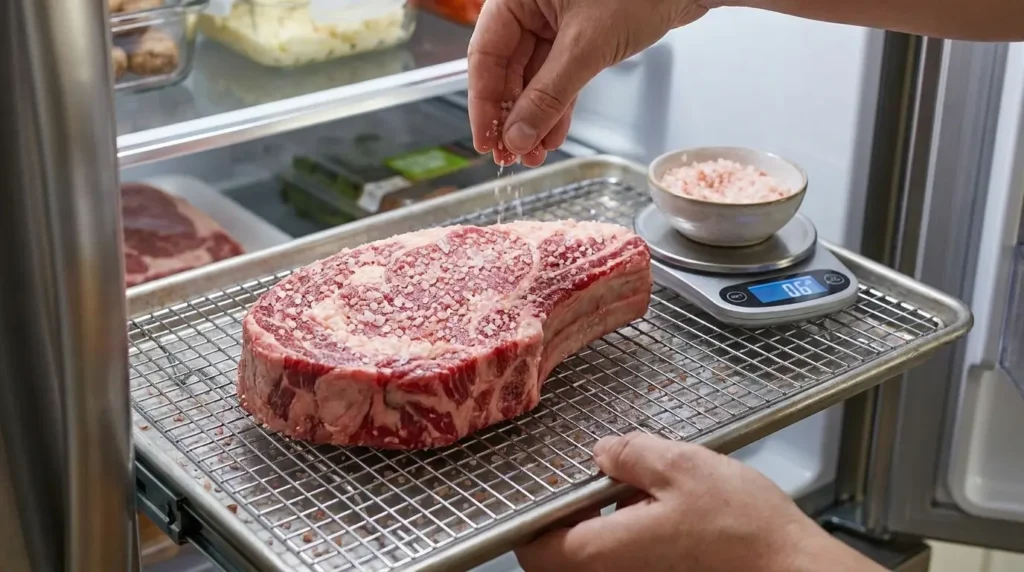
Dry brining — applying salt directly to the surface of meat and allowing it to rest before cooking — is one of the most effective techniques in home cooking, and pink salt performs very well in this application.
The process:
- Apply coarse pink salt generously to all surfaces of the meat — typically 0.5–0.75% of the meat’s weight in salt (about 1 tsp per pound as a starting point for thick cuts).
- Place the salted meat uncovered on a rack in the refrigerator. For steaks and chops: 45 minutes to 1 hour minimum; overnight is better. For large roasts and whole birds: 24–72 hours.
- The salt initially draws moisture to the surface, dissolves into it, and is then reabsorbed into the meat. The result is seasoning that penetrates deeply rather than sitting on the surface, and a drier exterior that browns more effectively.
Why coarse pink salt works well here: The large crystals are easy to distribute by hand, adhere to the meat surface rather than falling off, and dissolve gradually as they draw out and reabsorb moisture. The gradual dissolution rate that is a disadvantage in some applications is exactly right for a long dry brine.
The one adjustment: Because coarse pink salt is less dense than kosher salt, if you are following a recipe that specifies Diamond Crystal kosher salt by volume, use approximately the same volume of coarse pink salt to start. If the recipe specifies Morton kosher salt, use slightly less pink salt. Weighing is more reliable than converting.
Wet Brining with Pink Salt
Wet brining — submerging protein in a salt-water solution before cooking — is particularly useful for lean proteins prone to drying out (chicken breast, pork tenderloin, turkey) and for adding flavor to mild fish.
Basic wet brine ratio: 50–60g of fine pink salt per liter of water (approximately 5–6% by weight). This is appropriate for most poultry and pork. Adjust to 30–40g per liter for fish, which is more delicate.
Timing:
- Chicken pieces: 1–4 hours
- Whole chicken: 4–8 hours
- Turkey: 12–24 hours
- Pork chops: 2–4 hours
- Fish fillets: 30–60 minutes maximum
Use fine pink salt for wet brines — it dissolves completely and quickly, ensuring an even concentration throughout the solution. Always rinse brined proteins briefly before cooking to remove excess surface salt, and pat dry thoroughly before applying heat.
Finishing Salt: Where Pink Salt Earns Its Reputation
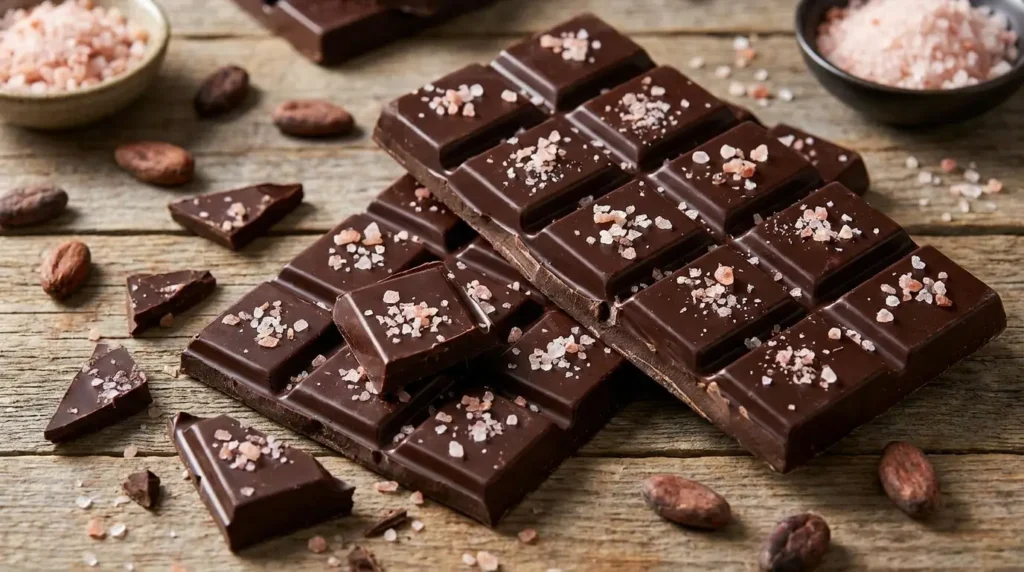
Finishing salt is applied to food at the last moment — just before serving, or at the table — rather than during cooking. This is the application where pink salt most clearly demonstrates its value, and where the choice between pink salt and other finishing salts is most consequential.
Why finishing salt is different from cooking salt:
A finishing salt dissolves on the tongue without dilution. The diner tastes the salt itself — its mineral character, its dissolution rate, and the textural contrast it provides — in a way that is impossible when salt is cooked into a dish. This is why high-end restaurants keep a separate finishing salt on the pass, often different from what they cook with.
What pink salt brings to finishing:
- Mild mineral softness. Pink salt’s low magnesium content gives it a cleaner, rounder finish than Celtic grey salt or some assertive Atlantic sea salts, which have a more pronounced bitter mineral edge. It adds salinity without dominating.
- Visual impact. Pink crystals against a dark sear, roasted vegetables, or a chocolate dessert are genuinely striking. No white salt provides the same contrast.
- Concentrated salinity. A pinch of coarse pink salt or finishing flakes on a just-sliced steak delivers an immediate burst of flavor that dissolved salt during cooking cannot replicate.
Best finishing applications:
- Steak and grilled meat: Apply immediately before serving, while the surface is still hot enough to barely start dissolving the crystals. The combination of crust heat and crystal texture is the point.
- Roasted or grilled vegetables: A light finishing of flakes on roasted cauliflower, asparagus, or root vegetables elevates a side dish noticeably.
- Chocolate and caramel: Pink salt finishing flakes on dark chocolate brownies, salted caramel sauce, or chocolate bark is one of the most effective flavor combinations in modern pastry. The mineral softness of pink salt suits sweet applications better than more assertive salts.
- Avocado, eggs, fresh cheese: Any mild, creamy food benefits from finishing salt contrast. Pink salt is ideal because it does not overpower subtle flavors.
- Fresh pasta, risotto, and polenta: These dishes often benefit from a finishing flourish that dissolved cooking salt cannot provide.
For the complete guide to finishing technique — how much to use, when to apply, which crystal size for which food — see the pink salt finishing flakes guide.
Grinding at the Table
A tabletop grinder filled with coarse pink salt is one of the most satisfying ways to use this ingredient — freshly cracked crystals have a more immediate mineral character than pre-ground salt, and the ritual of grinding at the table is a genuinely enjoyable part of service.
The technical requirement that almost no one mentions in salt purchasing guides: pink salt at Mohs hardness ~7 will destroy grinder mechanisms that were not designed for hard materials.
Most pepper mills and inexpensive salt grinders use a ceramic or plastic grinding mechanism rated for softer materials. Sodium chloride from a standard sea salt or table salt source rates approximately 2–2.5 on the Mohs scale — well within range of cheap ceramic burrs. Himalayan pink salt at hardness 7 wears through them quickly, sometimes within weeks of regular use.
What to look for in a grinder for pink salt:
- Hardened steel mechanism (stainless or carbon steel) rated explicitly for use with rock salt or high-hardness minerals
- Adjustable grind — coarser for finishing applications, finer for table seasoning
- Non-reactive materials — avoid mechanisms with parts that will corrode on contact with salt
- Easy refill — because you will be refilling it regularly
Specific grinder models and brands tested with Himalayan pink salt are covered in the dedicated pink salt grinder guide.
Salt Block Cooking
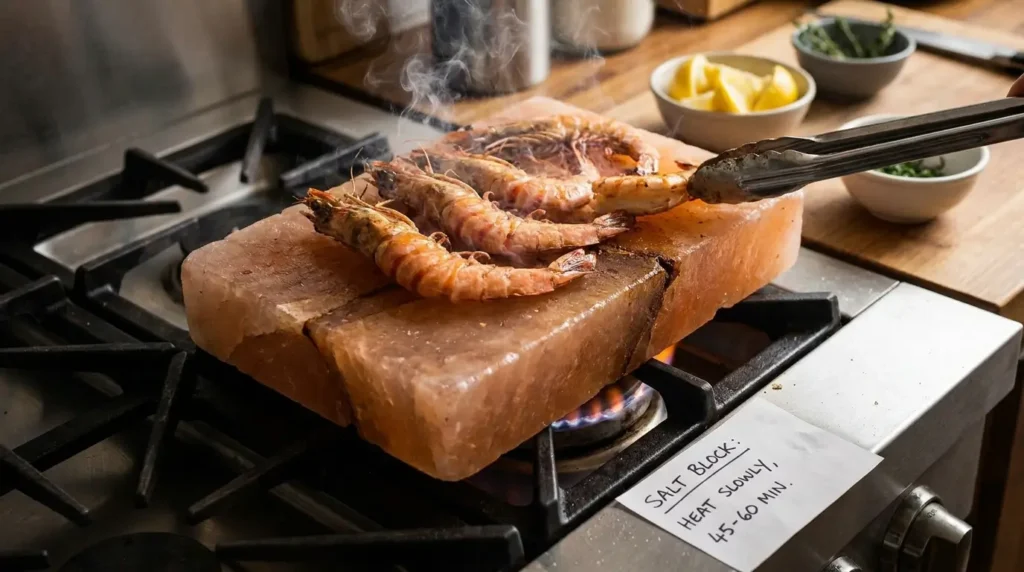
Himalayan salt blocks are solid slabs of pink salt — typically 8 × 12 inches, 1.5–2 inches thick, weighing 4–6 pounds — used as a cooking surface. When heated to high temperatures on a grill or gas burner, they hold and radiate heat intensely, searing proteins with a light mineral salinity imparted by direct contact with the salt surface. When chilled, they serve as a serving platter for cold foods, keeping them cold while lightly seasoning them.
Salt block cooking has one strict protocol that must be followed: the block must be heated gradually. Thermal shock from heating too quickly causes cracking. The correct process:
- Room temperature start. The block must be at room temperature before any heat is applied. Never heat a cold block.
- Low heat, 15 minutes. Place on a burner set to low or on a grill at low indirect heat. Let it sit undisturbed.
- Medium heat, 15 minutes. Increase to medium. The block will begin to discolor slightly as residual moisture escapes — this is normal.
- Medium-high to high, 15 minutes. Increase to cooking temperature. The full preheating process takes 45–60 minutes minimum.
- Test for readiness. A few drops of water dropped on the surface should vaporize immediately. The surface should be too hot to hold your hand near.
Best foods for salt block cooking: Thin proteins that cook quickly — prawns, scallops, thin steak cuts, sliced vegetables, calamari. Thick cuts need more contact time than a salt block surface easily provides.
Care and longevity: Never wash a salt block with water — it will dissolve the surface. After cooking, allow it to cool completely before handling (thermal shock can crack a hot block too). Wipe down with a barely damp cloth and dry immediately. Stored properly, a salt block lasts for many cooking sessions, though it will gradually change color and reduce in thickness over time.
The full method — including troubleshooting, food-specific temperatures, and storage — is in the salt block grilling guide.
Baking with Pink Salt
Pink salt works in baking, with two adjustments that matter.
Use fine grain only. Coarse crystals do not dissolve evenly in dough or batter and create inconsistent salinity — pockets of intense salt flavor surrounded by under-seasoned crumb. Fine pink salt dissolves like fine table salt and distributes evenly.
Measure by weight. Baking recipes are calibrated formulas. Salt quantity in a bread recipe affects fermentation rate, gluten development, and crust formation — not just flavor. When a recipe calls for 10g of fine table salt, use 10g of fine pink salt. Do not convert by teaspoon.
The iodine note for bread bakers specifically: Iodine in iodized table salt can slightly inhibit yeast activity in some fermentation contexts — a known variable in bread baking. Since pink salt is not iodized, this variable is removed. In practice, the effect of iodized vs non-iodized salt on home bread baking is small and inconsistent, but it is a real mechanism worth knowing about.
Fermentation and Preservation
Pink salt is an excellent choice for lacto-fermentation (sauerkraut, kimchi, fermented vegetables) and salt-preserved foods. The reason: it contains no additives.
Iodized table salt’s potassium iodide can inhibit the lactic acid bacteria responsible for lacto-fermentation at higher concentrations. Anti-caking agents in table salt can cloud brine and affect texture. Fine pink salt — pure sodium chloride with trace minerals and no additives — creates a clean brine that supports fermentation without interference.
Standard lacto-fermentation brine: 20–30g of fine pink salt per liter of filtered water (2–3% by weight). This is the range that suppresses pathogenic bacteria while allowing beneficial lactobacillus species to thrive.
One critical point: do not use pink curing salt for fermentation or preservation. Pink curing salt contains sodium nitrite and is formulated specifically for meat curing — it is not appropriate as a fermentation salt. If you are making cured meats like salami or dry-cured ham, that requires pink curing salt used at precise measured quantities, not Himalayan pink salt.
What Not to Do
Do not use finishing flakes in cooking. They are expensive, dissolve unevenly, and provide no advantage over fine grain once dissolved into a dish. Their value is entirely in the finished, surface application.
Do not load a cheap grinder with pink salt. The Mohs hardness incompatibility is not a minor inconvenience — it is a mechanism failure waiting to happen. Invest in a quality grinder with hardened mechanisms if you want to grind pink salt at the table.
Do not heat a salt block rapidly. The gradual heating protocol exists for structural reasons. A cracked salt block cannot be repaired and cannot be used safely.
Do not substitute pink salt for pink curing salt, or vice versa. This is the most safety-critical point in the entire category. Pink curing salt contains sodium nitrite. It is toxic if consumed as a table seasoning. It is dyed pink specifically to prevent this confusion. If a recipe says “pink curing salt” or “Prague Powder,” that is what it means — not Himalayan salt. The full explanation is in the pink curing salt guide.
Do not measure coarse pink salt 1:1 with fine table salt by volume in precise recipes. The density difference produces real under-salting. Weigh your salt.
Do not store pink salt in a reactive metal container. Salt is corrosive to many metals. Use ceramic, glass, or stainless steel storage.