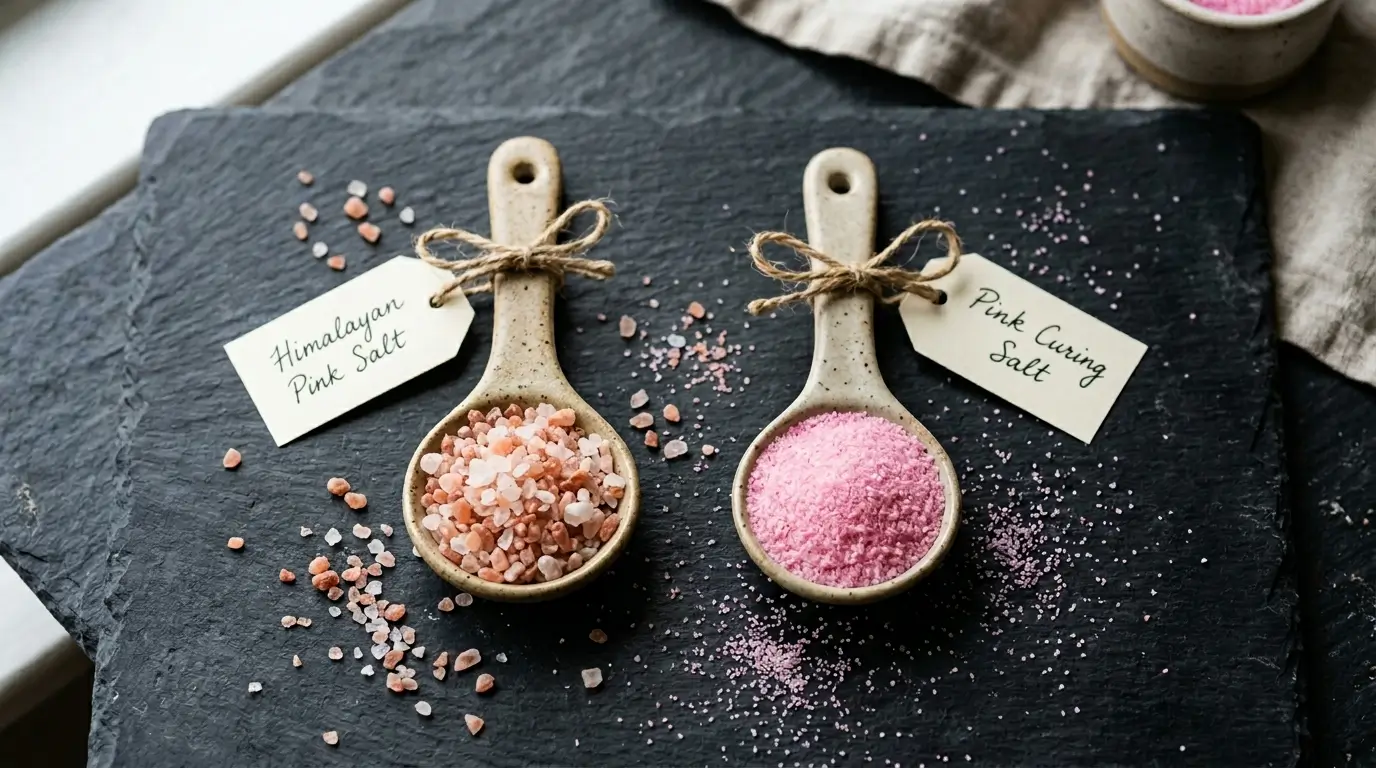
They share the same blush-pink color and are sold in bags that often look almost identical on a store shelf. But pink curing salt and Himalayan pink salt are not the same product, they do not serve the same purpose, and using one in place of the other can lead to real harm — either wasted food or a genuine food safety risk. If you’ve ever reached for a bag of pink salt and paused, wondering which one you’re holding, this guide gives you a definitive answer.
⚠️ Safety note: Pink curing salt contains sodium nitrite, a controlled preservative compound that is toxic in large quantities. It is not a table seasoning and should never be used as a substitute for Himalayan pink salt. If you are learning about pink curing salt for the first time, start with our complete guide before attempting to use it.
The One-Sentence Difference
Pink curing salt is a meat-preservation compound made of sodium chloride and sodium nitrite, dyed pink deliberately so it cannot be confused with regular salt — though, ironically, people still confuse it with Himalayan pink salt all the time. Himalayan pink salt is a naturally occurring mineral salt mined from ancient geological deposits and used as an everyday cooking and finishing seasoning.
Same color. Completely different chemistry. Completely different use.
Visual Comparison: They Do Look Similar
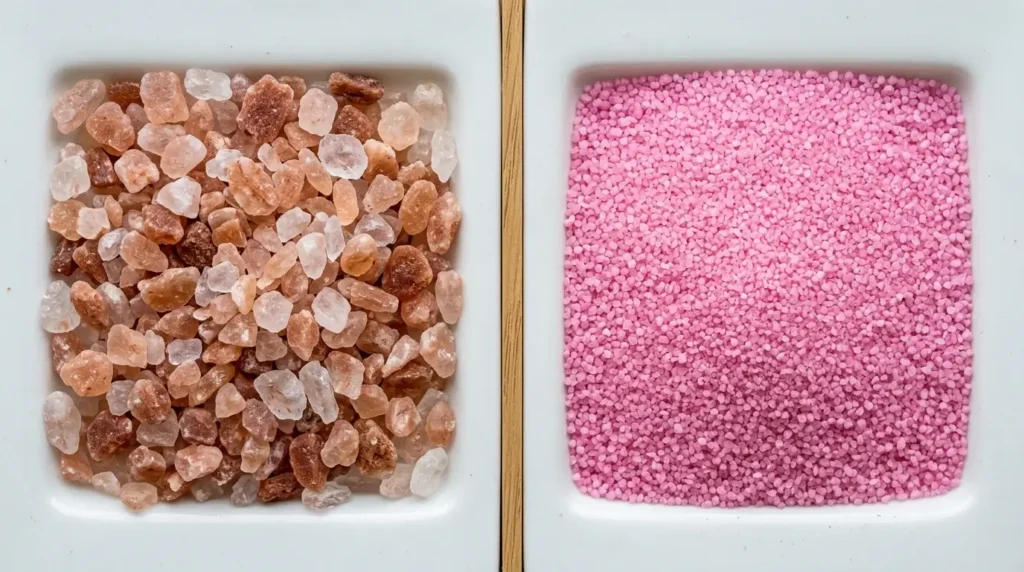
It is worth acknowledging that the visual similarity is real. Both products are pink. Both come in granular or crystal form. And because the salt industry does not enforce strict packaging standards, some brands package them in ways that could easily cause a mix-up in a busy kitchen or pantry.
That said, there are visual cues once you know what to look for:
Himalayan pink salt has a warm, rosy, sometimes almost terracotta hue that varies from crystal to crystal. If you hold a handful up to the light, you will see variation — pale pink, deep salmon, even occasional white or translucent grains mixed in. That inconsistency is the point. The color comes from trace iron oxide in the salt deposit, and it distributes unevenly, which is what makes authentic Himalayan pink salt look natural rather than manufactured.
Pink curing salt (sold under brand names including Prague Powder, Instacure, and DQ Curing Salt) has a more uniform, almost artificial-looking pink. That uniformity is intentional: the salt is dyed a consistent color during manufacturing so it is visually distinct from plain white table salt. The pink dye is a food-safe colorant — it does not affect the flavor or curing process — but its purpose is pure safety identification. If the color looks too consistent across every grain, that is a sign you may be looking at curing salt, not Himalayan.
Neither visual test is foolproof. Read the label.
Chemical Composition: This Is Where They Diverge Completely
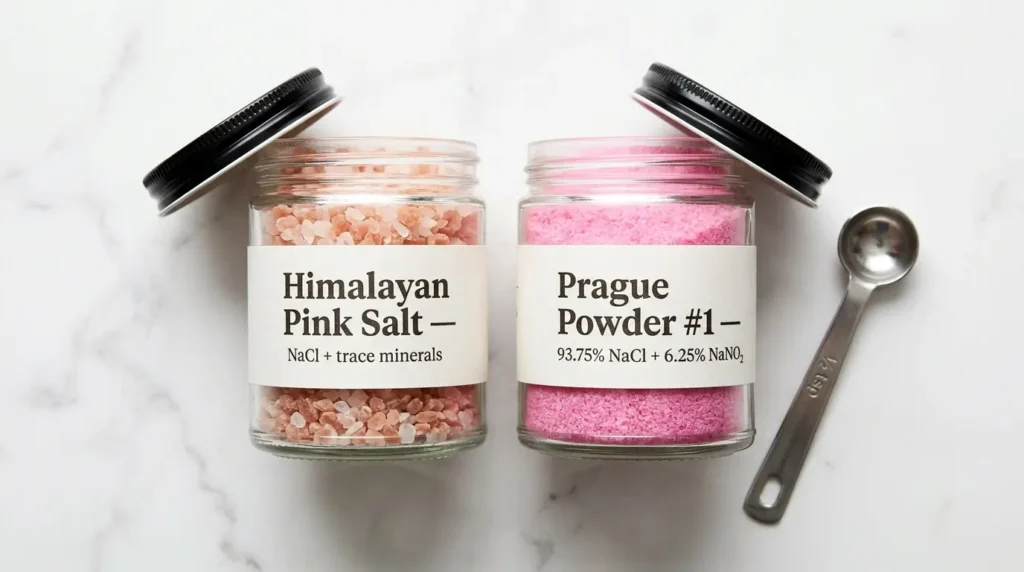
This is the most important part of the comparison, and the place where treating these products as interchangeable becomes dangerous.
Himalayan Pink Salt
Himalayan pink salt is almost entirely sodium chloride — roughly 97–98% by weight. The remaining 1–2% consists of trace minerals: iron oxide (which causes the pink color), magnesium, calcium, potassium, and a handful of other compounds in amounts measured in parts per million. These trace minerals are what give premium Himalayan salt a slightly more complex flavor than iodized table salt, but they do not change its fundamental nature. It is salt. You season food with it, finish dishes with it, and use it in cooking the way you would any other culinary salt.
There is no nitrite in Himalayan pink salt. None.
Pink Curing Salt (Prague Powder #1)
The most common variety of pink curing salt — Prague Powder #1, also sold as Instacure #1 or Curing Salt #1 — is composed of 93.75% sodium chloride and 6.25% sodium nitrite (NaNO₂). That sodium nitrite is the active agent. It inhibits the growth of Clostridium botulinum, the bacterium responsible for botulism, during the extended curing and smoking process that meats like bacon, corned beef, ham, and jerky undergo. It also contributes to the characteristic pink color of cured meats and, secondarily, to their flavor.
Prague Powder #2, used for long-cured products like salami and prosciutto, replaces some of the nitrite with sodium nitrate (NaNO₃), which converts to nitrite more slowly over months of curing.
The sodium nitrite content in curing salt is not incidental — it is the entire point of the product. And that same sodium nitrite, in concentrations that exceed safe usage levels, is acutely toxic. The USDA mandates that cured meats contain no more than 200 parts per million of residual nitrite; professional charcutiers typically target 100–150 ppm. Precision matters.
What Happens If You Substitute One for the Other
Using Himalayan Salt When a Recipe Calls for Curing Salt
This is the scenario that creates a food safety hazard. If a recipe calls for pink curing salt — for bacon, pastrami, homemade jerky, or any other cured meat — and you substitute Himalayan pink salt, you are removing the compound that prevents botulism growth. The finished product may look and taste fine. It will not be safe. Botulinum toxin is colorless, odorless, and tasteless, and it is among the most potent toxins known. Cured meats that skip the nitrite step must be consumed immediately, not stored — and even then, low-temperature, low-oxygen environments (like a vacuum-sealed bag in the refrigerator) remain risk zones.
Do not substitute Himalayan salt for curing salt in any recipe that specifies curing salt. If you want to cure meat without nitrites, that requires a different process entirely with different timing, temperature, and pH controls. It is not a simple swap.
Using Curing Salt When a Recipe Calls for Himalayan Salt
This is the scenario that creates a toxicity risk. Pink curing salt is used at approximately 1 teaspoon per 5 pounds of meat — a very small quantity designed to achieve a specific nitrite concentration in the final product. If someone mistakes curing salt for Himalayan salt and uses it to season food at normal culinary quantities — a pinch in a soup, a tablespoon on a steak, a teaspoon in cookie dough — they are consuming sodium nitrite at levels far exceeding what is safe.
Acute sodium nitrite poisoning causes methemoglobinemia, a condition in which the blood loses its ability to carry oxygen. Symptoms include rapid heartbeat, fatigue, shortness of breath, and blue discoloration of the skin. It is a medical emergency.
Curing salt is never a seasoning. It is a measured preservative that is safe when diluted into a proper curing recipe and dangerous when used at volume.
How to Tell Them Apart at the Store
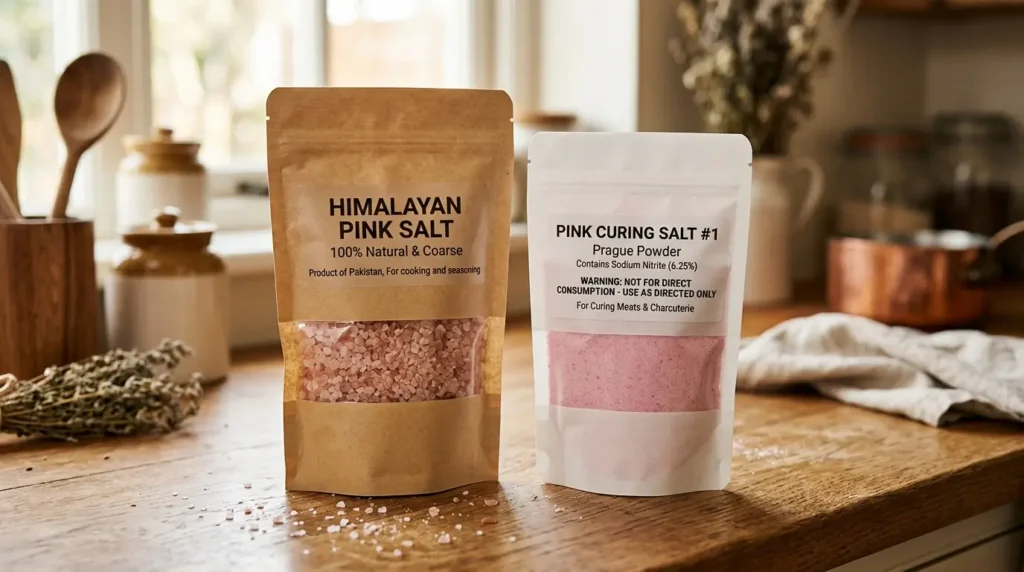
The fastest and most reliable method is reading the label. Specifically, look for these signals:
It is pink curing salt if the label says any of the following:
- “Prague Powder” (with a number: #1 or #2)
- “Instacure” or “Insta Cure”
- “Curing salt” or “Curing mix”
- “Contains sodium nitrite” or lists NaNO₂ or E250 in the ingredients
- “Not for direct consumption” or “Use as directed”
- A warning against use as a table salt substitute
It is Himalayan pink salt if the label says:
- “Himalayan” or “Pink Himalayan”
- “Mined in Pakistan” or “Khewra” or “Punjab”
- Ingredients list: “100% Himalayan pink salt” or “Himalayan rock salt”
- Uses like “cooking,” “finishing,” “seasoning,” or “table use”
If a label is unclear or damaged, treat the product as curing salt until confirmed otherwise. That is the safer default.
Safe Storage Protocols
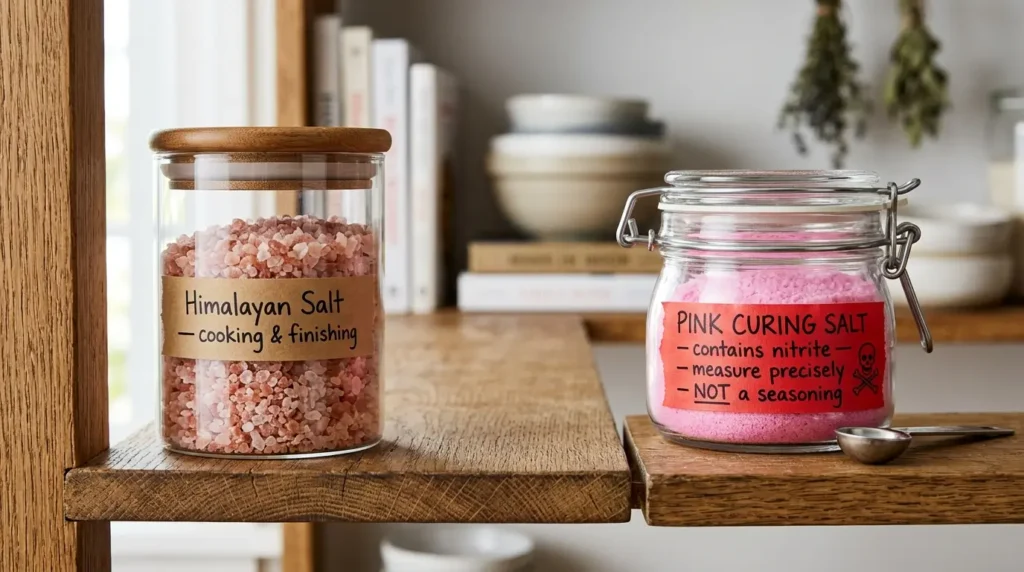
If you keep both products in your kitchen — which is common among home charcutiers who also cook — the risk of mixing them up is not hypothetical. These are practical rules worth following:
Store them in different locations. Pink curing salt should not live next to your cooking salts on the counter or spice rack. Keep it in a dedicated spot — a separate shelf, a locked cabinet, a clearly marked container — somewhere it cannot be grabbed by accident.
Label every container. If you decant into jars, write the full name on the lid and the side in permanent marker. “Pink curing salt — contains nitrite — NOT FOR DIRECT USE” is not excessive. It is accurate.
Use different-sized spoons or scoops. Assign a dedicated measuring spoon to your curing salt so it cannot be used for cooking salt by mistake.
Keep it away from children. Curing salt looks like candy-pink seasoning salt to a child. Store it out of reach and out of sight.
Follow the safe usage guide. For full measurement protocols, safe handling, and the correct ratios for dry cures and wet brines, see our companion article on how to use pink curing salt safely.
The Bottom Line
Pink curing salt and Himalayan pink salt are two unrelated products that share a superficial color resemblance. One is a culinary seasoning mined from ancient salt deposits. The other is a controlled meat-preservation compound containing sodium nitrite. They are not interchangeable in either direction, and the consequences of confusing them range from ruined food to a genuine medical emergency.
The rule is simple: read every label before you use any pink salt. If you are new to the topic, our complete guide to pink curing salt covers everything you need to know about what it is, when you need it, and how to handle it correctly.