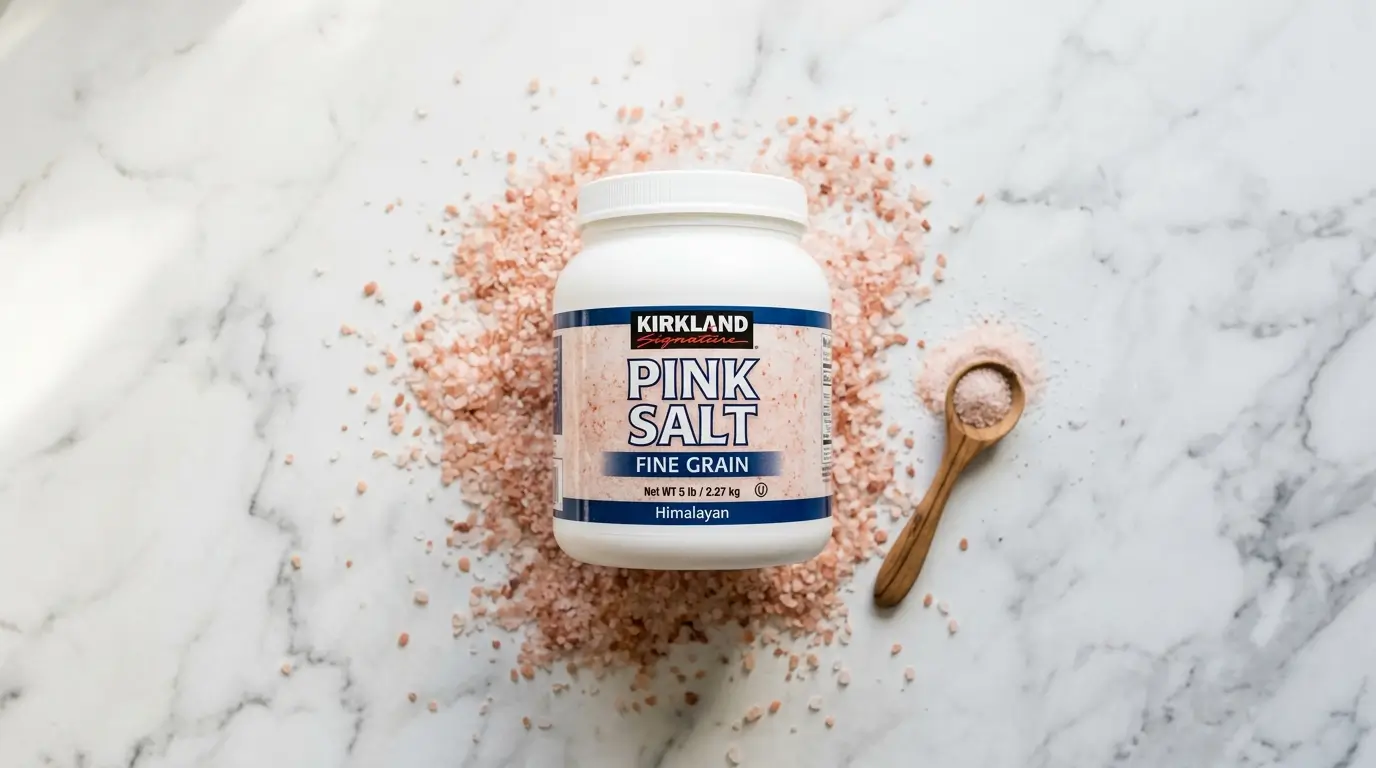
If you’ve stood in a Costco aisle staring at a five-pound jar of pink salt and wondered whether it’s actually worth buying, you’re not alone. The Kirkland Signature Himalayan Pink Salt is one of the most purchased pink salts in the US — and one of the least critically examined. It costs a fraction of what boutique brands charge. The packaging has changed more than once. There’s a dismissed class action in its history. And yet millions of people cook with it every week without any complaints.
This review covers everything: the actual product specs, what’s on the label versus what’s in the jar, how it performs in the kitchen, and an honest price-per-ounce comparison with specialty alternatives. If you’re trying to decide whether this is your everyday salt or whether you should be spending more, here’s a clear answer.
The Quick Take
Kirkland Signature pink salt is a genuinely good everyday Himalayan pink salt at a price no boutique brand can touch. The fine-grain 5-pound bag costs around $7.99 at Costco as of early 2026 — roughly $0.10 per ounce — and it contains no additives, no anti-caking agents, and no fillers. It’s Kosher certified, fine-grained for easy measuring and cooking, and the source (Pakistan’s Himalayan salt deposits) is exactly the same geological origin as every other Himalayan pink salt on the market.
Its weaknesses are real but limited: the color is paler than many boutique salts, the fine grain makes it less versatile than a coarse option for finishing, and the label history has raised legitimate transparency questions. Neither of those things makes it a bad product. They just make it an honest one, once you know what you’re actually buying.
Packaging and Claimed Source
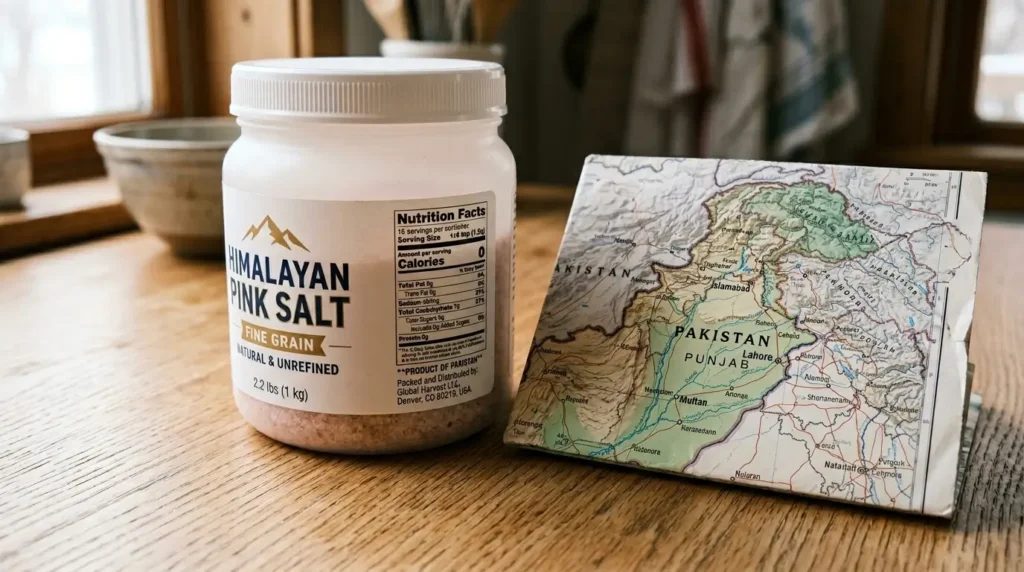
Kirkland currently sells its pink salt in two formats. The first is a 5-pound fine-grain jar (item #1605917), the format most Costco members encounter in-warehouse. The second is a 26-ounce grinder set — two 13-ounce bottles with an adjustable ceramic grinder — priced around $6.99 to $7.39 and available in most warehouse locations.
The current label on both products reads “Pink Salt, Fine Grain, a Product of Pakistan, Packed in USA.” That matters, and it’s worth understanding the history. Earlier versions of the packaging prominently featured a colonial-era map of the Indian subcontinent alongside language describing the salt as coming from “the heart of the Himalayan Mountains” — framing that implied an Indian origin. A 2021 class action lawsuit challenged that framing, arguing the salt actually comes from Pakistan, not India. The case was voluntarily dismissed by the plaintiff in January 2022, and Costco subsequently updated the labeling to reflect the Pakistani origin plainly.
Here’s what you need to know: the updated labeling is accurate, and there’s nothing wrong with Pakistani-origin Himalayan salt. Virtually all Himalayan pink salt sold in the US — regardless of brand or price point — comes from the same general region: the Salt Range mountains in Punjab, Pakistan, anchored by the Khewra Salt Mine. When a boutique brand charges $18 for a pound and lists “from the Himalayan mountains” on the label, the geographic story is essentially the same. Kirkland’s current label is simply more transparent about it. If you want to learn more about evaluating these authenticity claims, our guide on how to spot fake Himalayan pink salt breaks down exactly what legitimate sourcing looks like.
Visual Inspection: Color and Grain
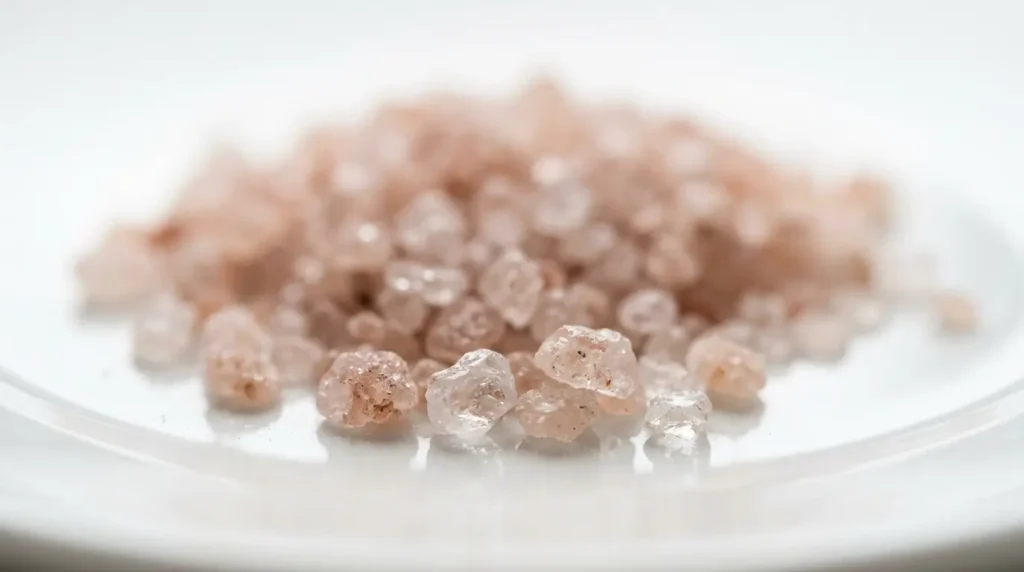
Opening the 5-pound jar, the first thing you notice is the color: a light, dusty rose rather than the deep coral-pink of some premium brands. This is not a defect or a sign of inferior quality — it’s an accurate reflection of how finely processed the salt is. Fine-grinding reduces the surface area of mineral-containing crystals, which makes the color appear more muted. Salt sold as coarse or medium grind from the same mine tends to look noticeably darker and more saturated.
The grain size is consistent and genuinely fine — comparable to fine sea salt and slightly finer than kosher salt. There is no visible clumping straight from a fresh jar, and the salt flows well, which is notable given there are no anti-caking agents in the ingredient list. Humidity will eventually cause some bridging in the jar, but keeping a lid tight and storing it away from the stove solves that easily.
The grinder set uses coarser crystals, and the color there is noticeably deeper — closer to what you’d expect from the product photography on premium brands. The adjustable ceramic mechanism handles the hardness of the salt well; pink salt sits around 7 on the Mohs hardness scale, which destroys many cheap plastic grinders over time. The ceramic burr in the Kirkland grinder is a meaningful quality feature, not just a marketing call-out. (If you’re thinking about standalone grinders for refilling, our best pink salt grinder roundup covers what to look for in more depth.)
Taste Test
The taste of Kirkland Signature pink salt is clean, neutral, and salty — exactly what it should be. In a side-by-side test against table salt, the difference is subtle but present: the pink salt has a slightly rounder finish with less of the sharp metallic edge that iodized table salt often carries. This is consistent with the absence of iodine and anti-caking agents, not evidence of any special mineral complexity.
Compared to premium brands like SaltWorks Sherpa Pink or Himalayan Chef, the taste difference is minimal when the salt is dissolved into cooking. When used as a finishing salt directly on food, the fine grain dissolves almost immediately, which is both a strength (easy to season uniformly) and a limitation (you lose the textural crunch that makes a finishing salt interesting). For finishing applications — scattered on a steak, pressed into chocolate, rimmed on a cocktail glass — you want flakes or medium coarse crystals, not fine powder. That’s a use-case mismatch, not a quality problem.
The grinder version offers a more nuanced experience because you control the grind. At a medium setting, the crystals have enough presence to provide a small burst of saltiness and a faint mineral note when bitten into. That’s about as complex as any mainstream Himalayan pink salt gets.
Mineral Content: What the Label Actually Says
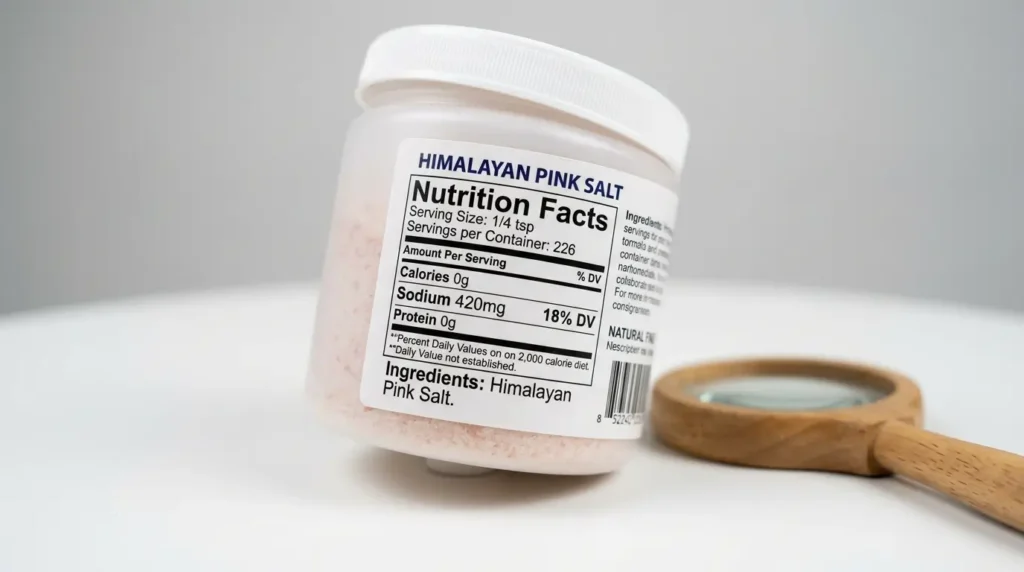
The current 5-pound Kirkland label lists the following nutrition per 1/4 teaspoon (1g serving): 0 calories, 420mg sodium (18% DV). Vitamins and minerals — Vitamin D, Calcium, Iron, Potassium — are all listed at 0% DV.
That last line is worth dwelling on. Some pink salt marketing has long claimed the presence of “84 trace minerals” as a key health differentiator. While trace minerals are measurably present in Himalayan salt at extremely low concentrations, they do not appear at nutritionally meaningful levels in a normal serving of salt. Kirkland’s current label doesn’t make those 84-mineral claims, which reflects an updated approach to responsible labeling. The older branding on some packaging did reference mineral content more expansively, but the current version is cleaner and more accurate.
On the question of heavy metals: independent testing by the consumer watchdog Mamavation, conducted on 23 salt products including the Kirkland brand, found that all samples — including this one — contained trace amounts of heavy metals such as lead and arsenic. Crucially, all levels were reported as below US Federal Safety Limits. This result is consistent across the Himalayan salt category; trace mineral deposits by their nature include both beneficial and incidental elements, all at sub-clinical concentrations in normal use.
Price Per Ounce vs. Boutique Brands
This is where the argument for Kirkland becomes overwhelming for the right buyer.
At $7.99 for 5 pounds (80 ounces), the fine-grain jar comes out to roughly $0.10 per ounce. Compare that to typical boutique alternatives at the same bag size: SaltWorks Sherpa Pink runs around $0.29/oz in bulk; Himalayan Chef sits closer to $0.20/oz; smaller premium brands can reach $0.50/oz or more for specialty cuts. The Kirkland grinder set at $6.99 for 26 ounces works out to about $0.27/oz — still competitive for a packaged grinder, and the ceramic mechanism is better than most similarly priced options.
For people who use pink salt daily across a household — salting pasta water, seasoning roasted vegetables, brining chicken — the value equation at $0.10/oz is hard to argue against. For finishing applications where the visual drama and crystal texture of the salt actually matter, the calculus shifts. You might reach for a small tin of flaky pink salt for $12 when you’re plating desserts or finishing a steak; you’d never drain a five-pound Costco jar for that purpose. Our best Himalayan pink salt brands roundup covers where boutique options genuinely earn their premium — and where they don’t.
Who This Is For
The Kirkland Signature pink salt is the right choice for the home cook who wants to cook exclusively with pink salt without paying a monthly premium for it. It dissolves cleanly, seasons well, contains nothing artificial, is Kosher certified, and comes in a quantity that won’t run out in a week. If you’re cooking for a family, meal-prepping regularly, or simply want a daily-use salt that isn’t iodized table salt, this is the straightforward answer.
It’s also a reasonable starting point if you’re new to Himalayan pink salt and want to try it before committing to a boutique brand. The taste profile is representative of the category, the sourcing is authentic, and the price means you’re not taking a financial risk.
Who Should Skip It
If your primary use is finishing — topping salads, rimming cocktails, scattering over a chocolate bark — the fine grain is the wrong format. You want coarse crystals or flakes for that job, and a five-pound container of fine-ground salt will sit in your pantry unused for most applications. The grinder version partially solves this problem, but a dedicated finishing salt from a small-batch producer is still a different experience.
You should also pass on this if you want the visual depth that darker boutique salts offer. The pale rose color is accurate and natural, but it won’t look like the deep coral in magazine photos. That distinction matters for presentation-focused cooking.
Finally, if a Costco membership isn’t already in your life, the calculus changes. Buying Kirkland salt through third-party resellers or Walmart typically doubles the per-ounce cost and erases the value advantage entirely. The price only makes sense in-warehouse.
The Bottom Line
Kirkland Signature Himalayan Pink Salt is a legitimate, well-priced product that does exactly what it says. The label is now honest about its Pakistani origin. The fine-grain format performs reliably for everyday cooking. And at $0.10 per ounce, it is categorically the best-value Himalayan pink salt available to most US households with a Costco membership.
It is not the most visually striking salt, it is not the best finishing salt, and it is not nutritionally superior to any other sodium chloride. But it is a clean, additive-free, Kosher-certified cooking salt at a price that makes it easy to use generously — which is, ultimately, the best thing you can say about any everyday salt.
Rating: 4.2 / 5 — Exceptional everyday value. Best for high-volume home cooking, not fine finishing.
PrintPink Himalayan Salt Popcorn
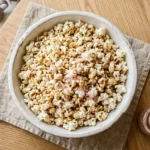
Stovetop popcorn finished with brown butter and fine pink Himalayan salt. Ready in 10 minutes with just 4 ingredients — light, perfectly seasoned, with a subtle mineral finish that table salt simply can’t replicate.
- Prep Time: 2
- Cook Time: 8
- Total Time: 10
- Yield: 4 servings (about 8 cups)
- Category: Snack
- Method: Stovetop
- Cuisine: American
Ingredients
- 3 tablespoons coconut oil (or vegetable oil)
- ½ cup popcorn kernels
- 2 tablespoons unsalted butter
- ½ teaspoon fine Himalayan pink salt, plus more to taste
Instructions
- Heat the coconut oil in a large, heavy-bottomed pot over medium-high heat. Drop in 2–3 test kernels and cover with a lid.
- Once the test kernels pop, add the remaining kernels in a single layer. Replace the lid and shake the pot gently to coat them in oil.
- Cook, shaking the pot every 30 seconds, until popping slows to roughly 2 seconds between pops. Remove from heat immediately and transfer to a large bowl.
- In a small saucepan, melt the butter over medium heat. Continue cooking, swirling occasionally, until the milk solids turn golden-brown and the butter smells nutty — about 3 to 4 minutes. Watch closely; it goes from brown to burnt fast.
- Drizzle the brown butter evenly over the popcorn. Sprinkle with fine pink salt and toss well to coat.
- Taste and adjust salt if needed. Serve immediately.
Notes
- Why fine grain matters: Fine pink salt clings to popcorn far better than coarse crystals, which roll off and collect at the bottom of the bowl. This is the one application where fine grain wins outright.
- Brown butter is optional but worth it: Plain melted butter works, but the nutty depth of brown butter pairs beautifully with the mineral notes of the salt.
- Sweet-salty variation: Drizzle 1 tablespoon of honey over the finished popcorn before tossing.
- Storage: Best eaten fresh. Leftovers keep in an airtight container for up to 2 days but lose their crunch.
- Vegan option: Skip the butter and use an extra tablespoon of coconut oil. The pink salt still shines.