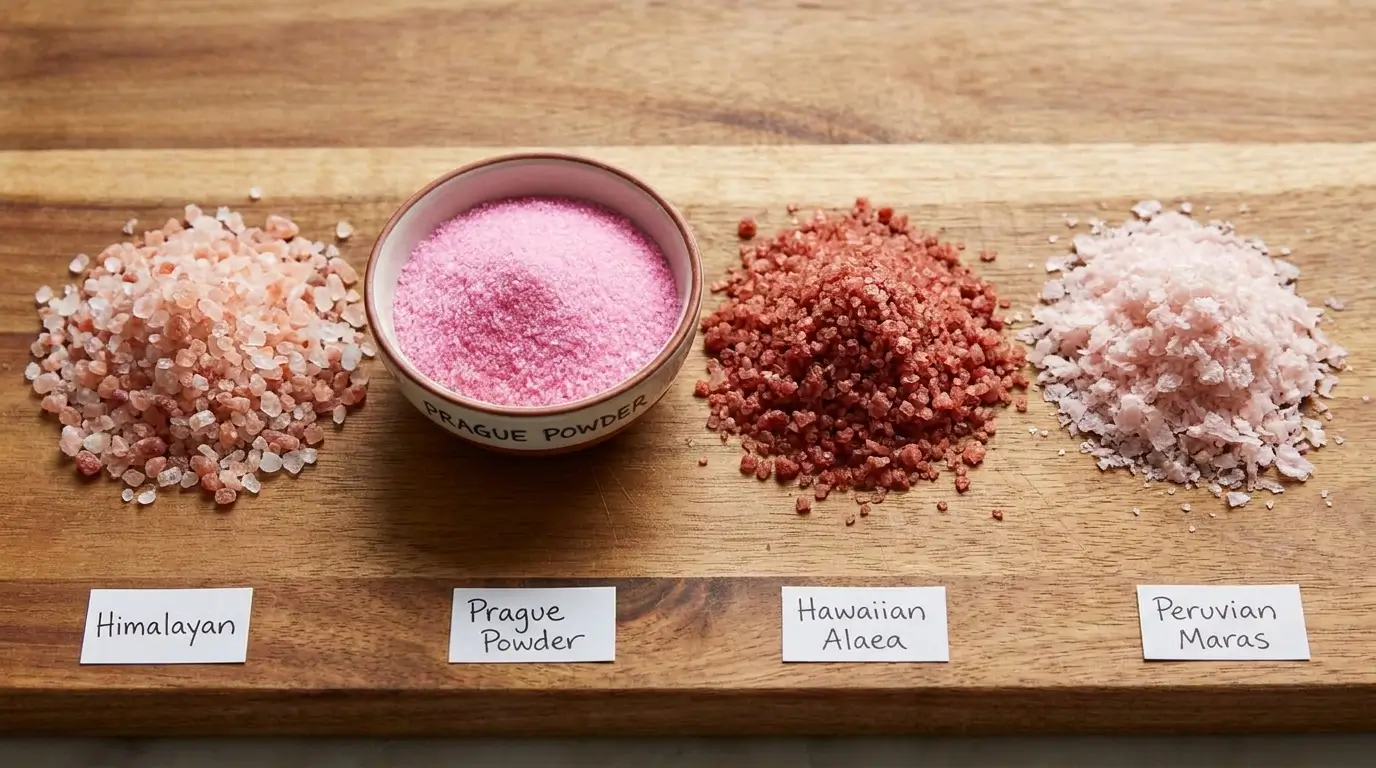
Pick up a bag of “pink salt” at a grocery store and you will almost certainly get Himalayan rock salt from Pakistan. Pick up another bag at a butcher supply shop under the same name and you might be holding sodium nitrite — a completely different substance used to cure meat. Buy a decorative lamp online and the label will say “pink salt” again.
“Pink salt” is not one ingredient. It is a color description that has been applied to at least four distinct products, each with different origins, compositions, and uses. This guide maps all of them clearly so you always know exactly what you are buying, and what to do with it.
What “Pink Salt” Actually Refers To
In everyday language, “pink salt” almost always means Himalayan pink salt — the rose-colored rock salt mined from the Khewra Salt Mine in Punjab, Pakistan. It is the dominant product in the category, the one sold at supermarkets and specialty food stores, and the one people mean when they ask for “pink salt” in a recipe unless the recipe explicitly specifies otherwise.
However, three other products are also legitimately called “pink salt” in different contexts:
- Pink curing salt (also called Prague Powder or Instacure) — a sodium nitrite compound used in meat curing that is dyed pink specifically so it is not confused with regular salt
- Hawaiian Alaea salt — a sea salt mixed with volcanic red clay, traditional to Hawaiian cuisine
- Peruvian Maras salt — a mineral-rich salt from the salt terraces of the Sacred Valley, often pink or pale orange in color
Each of these has its own guide on this site. This article covers all four types at a high level and tells you which one applies to your situation.
The Three Main Types of Pink Salt
1. Himalayan Pink Salt
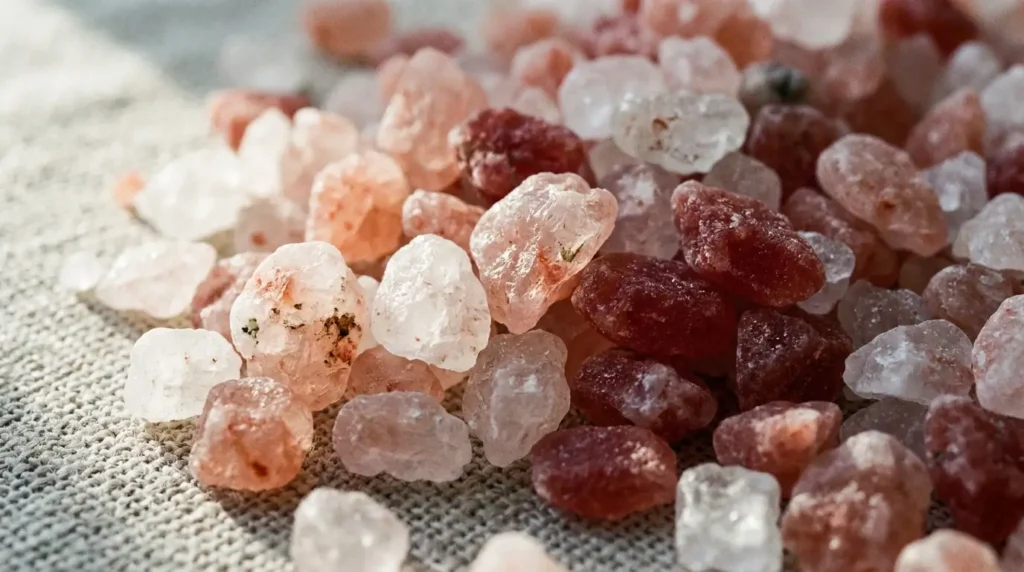
Himalayan pink salt is a rock salt — ancient salt that was once a seabed and was buried, compressed, and preserved underground over roughly 600 million years. It is mined from the Khewra Salt Mine in the Salt Range mountains of Punjab, Pakistan.
The name “Himalayan” is a misnomer in the strict geographic sense. The Khewra mine sits approximately 300 kilometers from the edge of the Himalayan mountain range. The name stuck because the salt is marketed out of the broader Himalayan region and because “Himalayan” carries strong associations with purity and altitude. You can read the full story in our article on where Himalayan pink salt actually comes from.
The pink color comes from trace amounts of iron oxide — the same compound that makes rust red. The concentration varies: some salt from the same mine is nearly white, some is deep rose. Color variation is normal and actually a sign of authenticity, since uniformly dyed counterfeits tend to look too consistent.
Himalayan pink salt is available in several forms: coarse grains (for grinders), fine grains (for direct use in cooking), finishing flakes (large flat crystals for topping dishes), and solid slabs (used as cooking surfaces). For a full breakdown of which form to use when, see our guide to cooking with pink salt.
Taste: Mildly mineral, broadly similar to sea salt. In blind taste tests, most people cannot reliably distinguish Himalayan salt from quality sea salt when dissolved in a dish, but the coarser crystals deliver a more pronounced burst of salinity on the palate as a finishing salt.
Best used for: General seasoning, finishing, grinding at the table, salt block cooking, and anywhere a mild mineral note and visual appeal matter.
2. Pink Curing Salt (Prague Powder)
Pink curing salt is a completely different product and the most important distinction in this entire guide.
Pink curing salt is a mixture of regular table salt and sodium nitrite (and sometimes sodium nitrate), blended in precise ratios and deliberately dyed bright pink to prevent it from being confused with edible salt. It is not a food seasoning. It is a meat-curing compound used to make bacon, ham, jerky, salami, and other cured or smoked meats food-safe.
Sodium nitrite is toxic in the quantities found in pink curing salt if consumed directly. The dye exists precisely to make this mix visually distinct. Never substitute pink curing salt for Himalayan pink salt, and never use it as a table seasoning.
Pink curing salt comes in two formulations: Prague Powder #1 (for short-cure and cooked products like bacon and corned beef) and Prague Powder #2 (for long-cure, dried products like salami and prosciutto). For everything you need to know about using it correctly and safely, see our full pink curing salt guide.
3. Hawaiian Alaea Salt
Hawaiian Alaea salt is a traditional Hawaiian sea salt that gets its pink-to-rust color from volcanic red clay (alaea) mixed into evaporated Pacific seawater. It has been used in Hawaiian cooking and cultural ceremonies for centuries.
Unlike Himalayan salt, which is a rock salt, Alaea is a sea salt — it comes from modern ocean water, not an ancient seabed. The flavor is distinctly earthy and mineral, more complex than most sea salts, and it is an essential ingredient in dishes like kalua pig and poke.
Alaea salt is available in two grades: a coarser traditional grade used in cooking and ceremony, and a fine table-use grade. It is not widely available in supermarkets outside Hawaii but can be found at specialty food retailers. For a head-to-head comparison of flavor, texture, and use cases, see pink salt vs Hawaiian Alaea.
4. Peruvian Maras Salt
Less well-known in North American markets, Maras salt comes from the Maras salt pans in Peru’s Sacred Valley, where naturally salty spring water is channeled into terraced evaporation pools and has been harvested this way since Incan times. The resulting salt ranges from white to pale pink to orange depending on the mineral content of the spring.
Maras salt is a specialty product sold primarily through gourmet food retailers. It is an excellent finishing salt and a genuinely interesting ingredient with a distinct mineral character — not the mild neutrality of Himalayan salt but something more complex. It is not widely discussed in the “pink salt” category in the US, but it belongs here.
Why Is Pink Salt Pink?
The short answer: iron oxide.
For Himalayan pink salt, the color comes from trace amounts of iron oxide (Fe₂O₃) in the mineral deposit — the same compound that gives rust its red color and the Grand Canyon its orange walls. The concentration is very small (typically less than 0.01% by weight), but it is enough to tint the salt from pale blush to deep rose depending on where in the deposit the salt was extracted.
For Hawaiian Alaea, the pink color comes from a different source: the volcanic red clay that is blended into the salt, which is itself rich in iron-bearing minerals.
A common misconception is that a deeper pink color indicates higher mineral content or greater purity. This is not accurate. Color variation in Himalayan salt reflects where the salt was located within the geological deposit, not its quality. Paler salt from the same mine is not inferior; deeply colored salt is not more nutritious. The relationship between color and mineral concentration is far too loose to use as a quality indicator.
For the complete science — including what peer-reviewed mineral analyses actually show — see our article on why pink salt is pink.
Mineral Composition: What’s Actually Inside
This is the section where a lot of pink salt marketing gets overheated, so a grounded summary matters.
Himalayan pink salt is sodium chloride — table salt — with trace amounts of other minerals. Published mineral analyses consistently find roughly 95–98% sodium chloride by weight, with the remaining 2–5% comprising minerals like potassium, magnesium, calcium, iron, and around 80 other trace elements in very small quantities.
The marketing framing often implies these trace minerals confer meaningful health benefits. The reality is more straightforward: the quantities of these minerals in a typical daily serving of Himalayan salt are nutritionally insignificant compared to what you get from a varied diet. A serving of pink salt is not a meaningful source of potassium or magnesium. The minerals are real — they are present — but they do not make pink salt a nutritional supplement.
What the mineral trace content does affect, in practice, is flavor. The slight mineral complexity in coarser Himalayan salt gives it a mildly different mouthfeel and finish compared to refined table salt, which has been stripped of everything except sodium chloride and iodine.
One thing Himalayan pink salt lacks that table salt has: iodine. Standard iodized table salt has added potassium iodide to address widespread iodine deficiency. If Himalayan pink salt is your primary salt, be aware that it is not iodized, and ensure you are getting iodine from other dietary sources (seafood, dairy, eggs, and iodized salt where you use it).
How Pink Salt Is Used in the Kitchen
Himalayan pink salt is versatile across all the same applications as standard table salt and sea salt, with a few specific areas where it excels.
As a cooking salt: Fine-grain Himalayan salt works in any recipe that calls for salt in the cooking process — pasta water, brines, dough, sauces. One important measurement note: coarse Himalayan salt is less dense than fine table salt. A teaspoon of coarse Himalayan salt contains less sodium than a teaspoon of table salt. When substituting, you may need to taste and adjust rather than follow a 1:1 conversion.
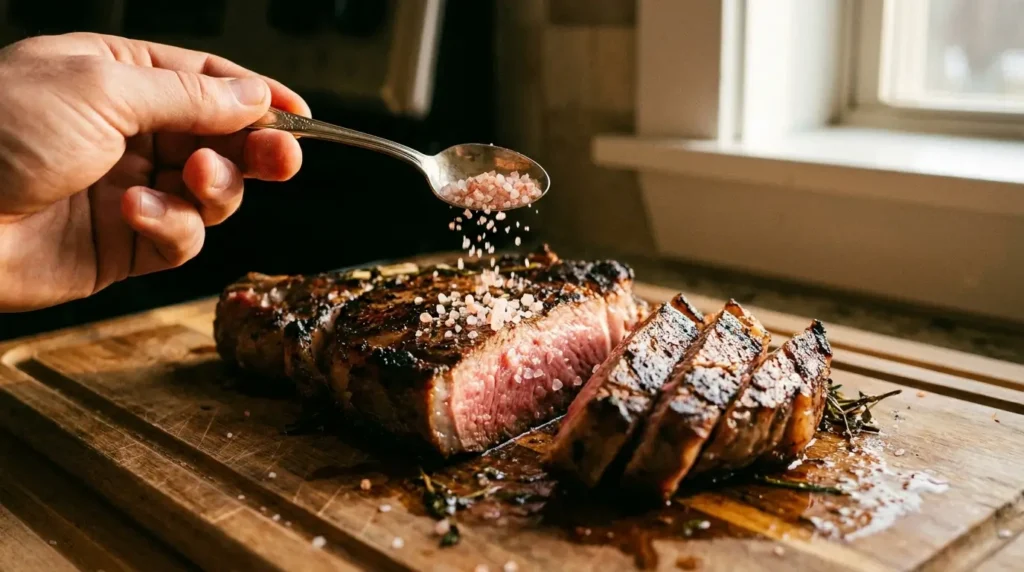
As a finishing salt: This is where Himalayan salt earns its reputation. Finishing a steak, grilled vegetable, or dessert with coarse pink crystals delivers bursts of salinity and visual appeal that dissolved salt cannot. The mineral character is most perceptible when the crystal is on the surface and dissolves on the tongue, not when it is cooked into a dish.
As a finishing flake: Pink salt finishing flakes are a specific product — large, flat crystals similar to Maldon or Fleur de Sel — designed for topping. They provide texture and visual contrast in addition to flavor. They are not appropriate for general cooking use. For a full guide to when and how to use finishing flakes, see pink salt finishing flakes.
On a salt block: Himalayan salt blocks (also called salt slabs) are solid slabs of pink salt that can be heated on a grill or stovetop and used as a cooking surface for proteins, or chilled and used to serve food. They impart a light mineral salinity to food cooked directly on them. The technique has specific requirements — particularly around how slowly you must heat the block to avoid cracking. The full method is in our Himalayan salt block cooking guide.
Grinding at the table: Coarse Himalayan salt in a mill or grinder is one of the most common uses. One important caution: pink salt is harder than most salts (approximately 7 on the Mohs hardness scale, compared to about 2.5 for table salt), and it will destroy cheap ceramic or plastic grinder mechanisms quickly. The grinder must have a ceramic or hardened steel grinding mechanism to hold up. For recommendations, see how to grind pink salt.
How to Buy Pink Salt (and What to Avoid)
The pink salt market has a counterfeiting problem. Studies and investigative reports have found that a significant portion of “Himalayan” salt sold globally is either not from Khewra, is mixed with other salts, or is dyed regular rock salt. The most reliable indicators of genuine Himalayan pink salt:
Color variation: Real Himalayan salt is not uniform. Authentic salt from Khewra ranges from white to pale pink to deep rose within the same bag. A product with perfectly consistent pink coloration throughout is suspicious.
Country of origin: Genuine Himalayan pink salt must originate in Pakistan. The country of origin should be on the label. “Packed in [country]” is not the same as “Product of Pakistan.”
Price floor: Authentic Himalayan pink salt has a minimum cost of production, mining, and export. Product priced far below comparable salts (especially in bulk) is a red flag.
Brand transparency: Reputable brands disclose their sourcing, provide lab testing results, and have a track record you can verify. For a comprehensive review of tested brands, see best Himalayan pink salt brands.
For a full checklist of how to verify authenticity before and after purchase — including at-home tests — see how to spot fake Himalayan pink salt.
Common Misconceptions, Addressed Directly
“Pink salt is healthier than table salt.”
In meaningful dietary terms, no. Both are primarily sodium chloride. The trace minerals in Himalayan salt are real but nutritionally negligible at the amounts consumed in a typical diet. Pink salt is a better culinary choice in certain applications due to texture and mild mineral character — not because of health properties.
“The more minerals, the better the salt.”
More minerals in salt means less sodium chloride, not better health outcomes. The minerals present in any quality cooking salt are trace quantities. Choosing a salt based on its mineral count is like choosing tap water based on trace element content — the differences are real but practically inconsequential compared to your overall diet.
“Pink salt doesn’t have sodium.”
Pink salt is sodium chloride. It has sodium. If you are managing sodium intake for medical reasons, pink salt is not an alternative to regular salt — it is the same substance.
“Pink salt and pink curing salt are interchangeable.”
They are emphatically not. See the pink curing salt guide and the article on pink curing salt vs Himalayan for a full explanation. This is the single most dangerous confusion in the pink salt category.
“A salt lamp made from pink salt purifies air.”
The evidence for this is weak. Salt lamps are beautiful ambient light sources, and there are people who enjoy them greatly. The specific claims about negative ions and air purification are not well-supported by controlled research. For an honest look at what the science says, see Himalayan salt lamps: what they actually do.
Which Pink Salt Do You Need?
If you are seasoning food, finishing a dish, or cooking at home: Himalayan pink salt is almost certainly what you want. It is available everywhere, it performs well across all culinary applications, and it adds a mild mineral complexity that most cooks enjoy.
If you are curing meat (bacon, jerky, salami, charcuterie): pink curing salt (Prague Powder #1 or #2) is what you need, used in precise measured quantities. Read the full guide before using it.
If you are cooking traditional Hawaiian dishes or want a genuinely distinctive finishing salt: Hawaiian Alaea is worth seeking out.
If you want to understand all the ways pink salts compare to other salts on the market — sea salt, kosher salt, Celtic salt, kala namak — start with our pink salt vs other salts guide.
Pink salt is not magic, and it is not a trick. Used well, it is one of the most versatile and satisfying ingredients in a cook’s pantry. That is reason enough to understand it clearly.