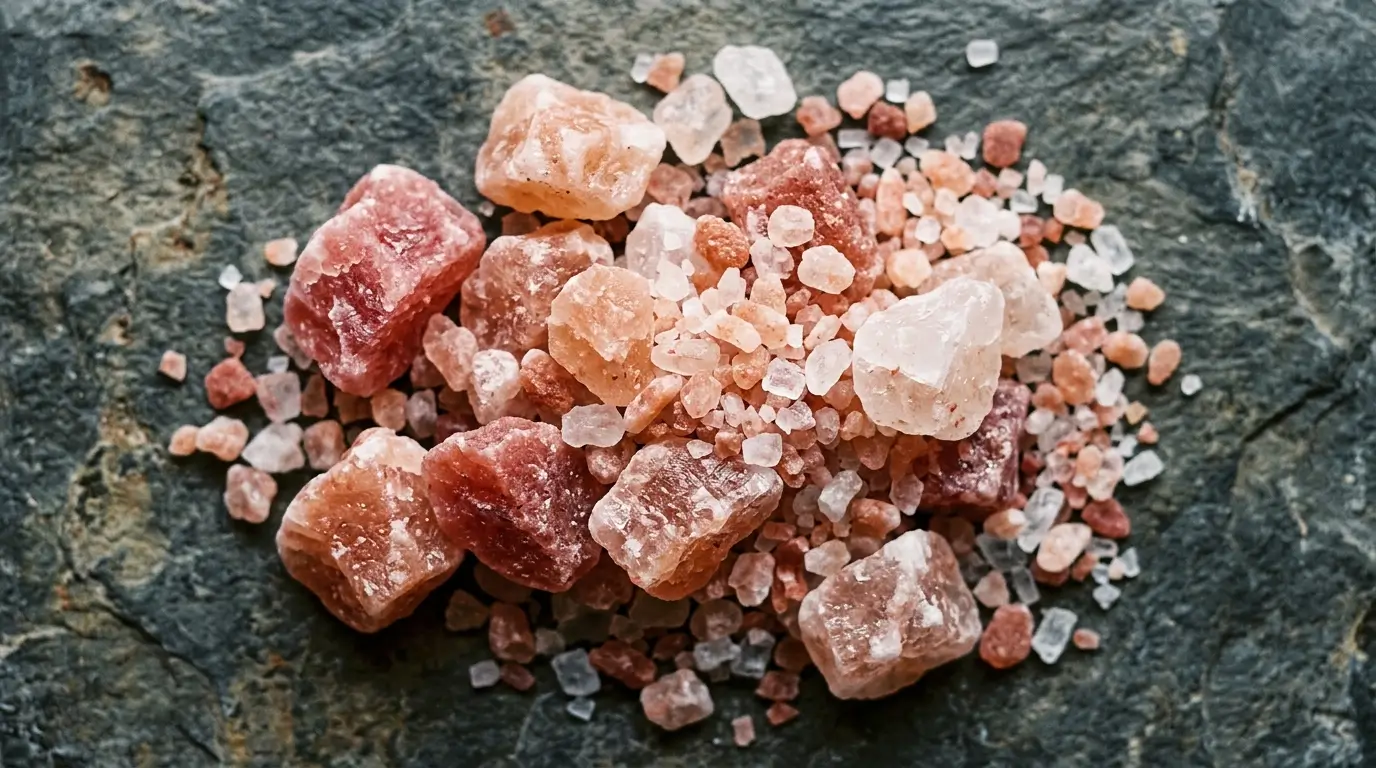
Every authentic grain of Himalayan pink salt in your kitchen, whether it came from a three-dollar grinder or a boutique gourmet tin, was pulled out of the same mountain in Pakistan using a method that has barely changed since the 1870s. That’s not a marketing story. It’s the literal answer to how Himalayan pink salt is mined: workers drill into an ancient underground deposit, set small controlled blasts to loosen the rock, then hand-sort it before it ever reaches a processing line. The process looks a lot more like a century-old coal mine than the polished wellness-brand imagery on most Himalayan salt packaging.
Himalayan pink salt is mined using the room-and-pillar method: miners drill into a roughly 600-million-year-old underground salt deposit, set small controlled charges to break the rock loose, then hand-sort, wash, dry, and grade it before it ships out as food-grade, cosmetic-grade, or decorative salt. Around half the salt in any mined section is deliberately left behind as structural pillars, which is a large part of why the same mine has stayed operational for more than 150 years.
Where Himalayan Pink Salt Actually Comes From
Nearly all of it comes from one place: the Khewra Salt Mine, in the town of Khewra, Jhelum District, Punjab, Pakistan. The mine sits in the Salt Range of the Pothohar Plateau, roughly 160 kilometers south of Islamabad. That location matters, because despite the name, the site isn’t actually inside the Himalayan mountain range. We cover why the geography doesn’t quite match the marketing in more depth elsewhere, but the short version is that the Salt Range is a separate, lower formation south of the Himalayas proper.
Geologists date the salt itself to the Ediacaran and early Cambrian periods, roughly 600 million years ago, when a shallow inland sea evaporated and left thick beds of halite behind. Tectonic pressure later folded and pushed those beds upward into the hills miners now tunnel into. Local legend credits the discovery to Alexander the Great’s cavalry in 326 BC, whose horses were reportedly seen licking salt-streaked rocks near the Jhelum River. Organized extraction didn’t begin until the Mughal era, and the mine wasn’t run at industrial scale until 1872, when a British mining engineer introduced the systematic layout still used today. We go deeper into that timeline, including the full story of where the salt comes from, in a separate guide.
Today the mine is operated by the Pakistan Mineral Development Corporation (PMDC), a state-owned enterprise under Pakistan’s Ministry of Energy. Khewra is widely described as the world’s second-largest salt mine, with estimated reserves ranging from roughly 82 million to 600 million tons depending on which survey you consult.
How Himalayan Pink Salt Is Mined: The Room-and-Pillar Method
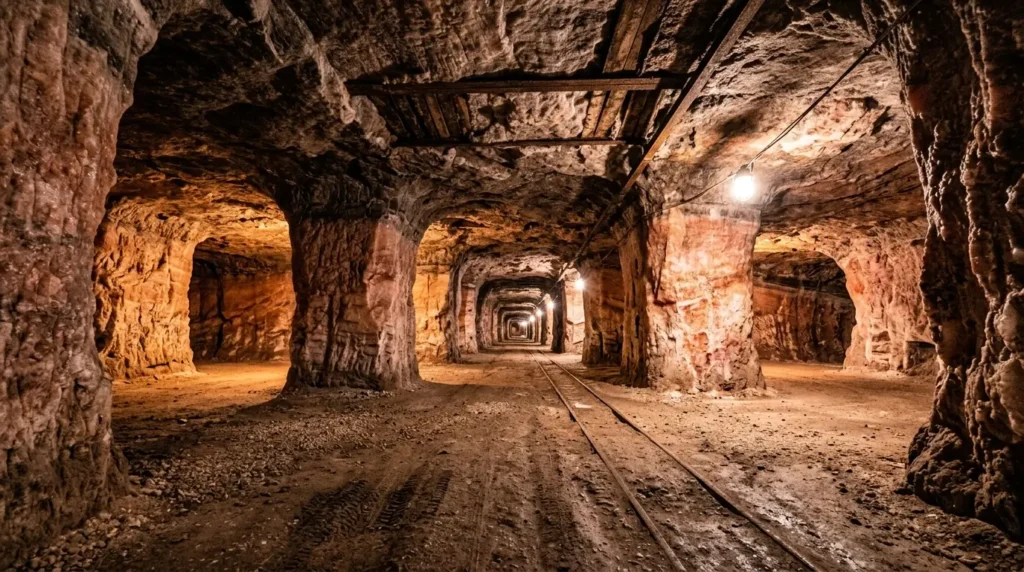
The technique behind almost every photo you’ve seen of Khewra’s glowing tunnels is called room-and-pillar mining. Engineers map out sections of the deposit and clear salt from alternating “rooms,” while leaving thick, evenly spaced columns of untouched salt standing as “pillars” to hold up the rock above. In practice, crews extract about 50% of the salt in a given section and leave the other 50% in place.
That split isn’t a compromise forced by weak material. It’s a deliberate structural choice. A mine with 19 levels, 11 of them below ground, and roughly 40 kilometers of connected tunnels would be prone to collapse if crews cleared every seam completely. Leaving half the deposit standing keeps ceilings from caving in, protects workers below, and is also why visitors can walk safely through chambers that are over a century old.
The mine runs less like one continuous operation and more like dozens of small ones. Crews are typically organized into gangs of 20 to 30 workers, each assigned to a specific section and led by a foreman who checks the rock face for loose material before drilling starts. A six-person team, working together, can clear around 12 tons of usable rock salt in a single shift. Multiply that across roughly 30 active gangs, and you get a sense of how a largely manual process still produces hundreds of thousands of tons a year without any single crew rushing the job.
Hand Extraction vs. Machine: How Himalayan Pink Salt Mining Really Works
Himalayan rock salt sits in an awkward middle ground for mining equipment. It isn’t chemically harder than ordinary table salt; both are the same mineral, halite, and equally soft on the Mohs hardness scale. But it comes out of the ground in large, irregular blocks with a natural cleavage that makes it fracture unpredictably under heavy machinery. Cut it with an aggressive mechanical cutter and it shatters into rubble instead of clean chunks. That’s also the real reason coarse Himalayan rock salt is rougher on a standard kitchen salt grinder than fine table salt: it isn’t a harder mineral, it’s simply a bigger, less uniform one.
So extraction is a hybrid of drilling, light blasting, and hand labor. Miners bore a pattern of holes into the rock face, then load them with small charges of low-force gunpowder, well short of industrial dynamite, that fracture the salt away from the wall without pulverizing it or destabilizing nearby pillars. From there, the work turns manual again. Crews pick through the broken rock by hand, separating high-quality pink and red pieces from darker, impure fragments, before loading everything onto mine carts. Some tunnels still move salt out on mule-drawn carts; newer sections use small electric locomotives instead.
PMDC has stated publicly that it wants to bring in more mechanized cutting equipment to raise output, and limited trials have taken place over the years. For now, the core of the job, drilling, judging a blast, and separating good salt from bad by eye, still depends on people who mostly learned the work from a parent or grandparent in the same mine.
From Raw Salt to Food-Grade: The Processing Steps After Mining
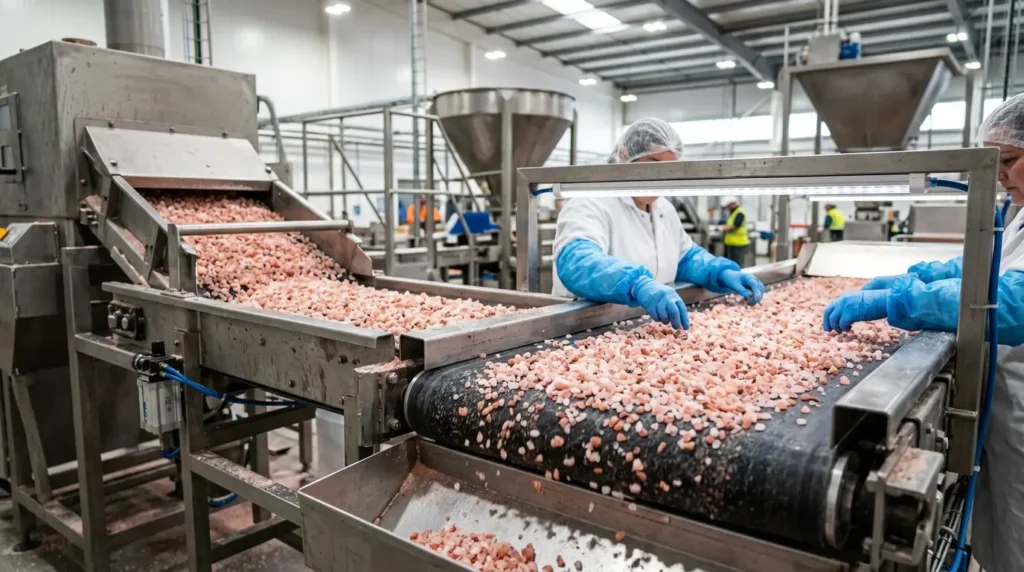
Getting salt out of the mountain is only half the job. Before any of it reaches a spice rack, each batch goes through a fairly consistent sequence on the surface:
- Initial sorting. Workers separate raw rock by color and visible quality at the mine mouth, setting aside the palest, most uniform pink and red pieces for food use and routing darker or streaked chunks toward industrial or decorative purposes.
- Washing. Selected rock is rinsed in clean water to remove surface dust and debris picked up during blasting and transport. No bleaching agents or chemical treatments are used at this stage.
- Drying. Washed salt is dried, either in open air, under direct sun, or in low-temperature drying rooms, to remove surface moisture before crushing.
- Crushing and grinding. Dried rock passes through crushers and mills to reach the size a buyer actually wants, anywhere from large decorative chunks to fine table-salt-sized grains.
- Grading and quality control. Batches are checked again for color consistency and purity, then sorted into commercial grades.
- Packaging. Approved salt is bagged or boxed for its intended market, labeled, and prepared for domestic sale or export.
None of these steps require additives. Part of the reason Himalayan salt is marketed as unrefined is that, unlike iodized table salt, it never goes through chemical purification, so what comes out the other end has been mechanically cleaned and sorted, not chemically altered.
Quality Grading: Not All Mined Salt Becomes Table Salt
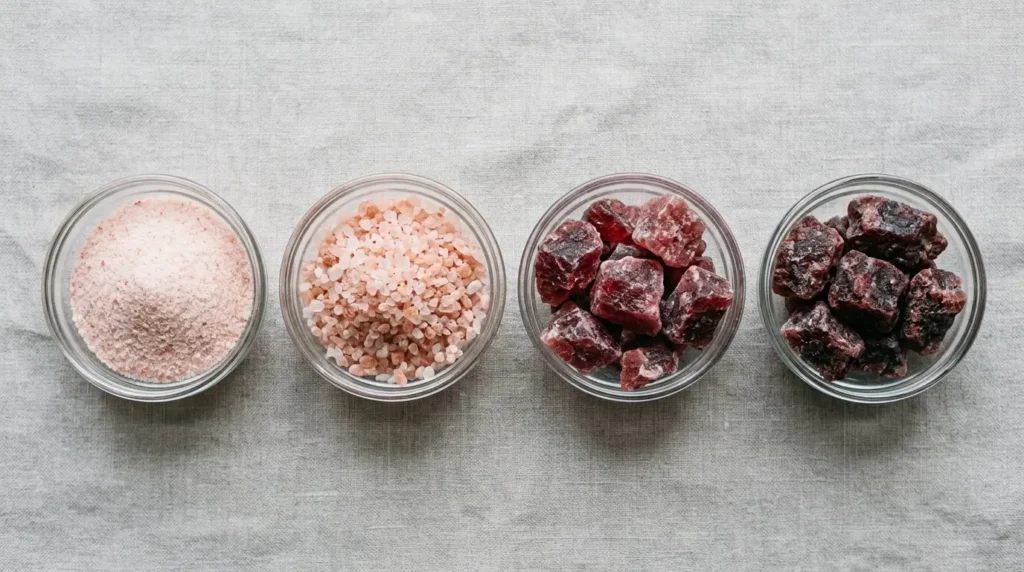
Not every chunk that comes out of Khewra ends up in a saltshaker. Mined rock is split into several commercial grades, and knowing the difference explains why prices vary so much between a bag of fine pink salt and a hand-carved salt lamp.
| Grade | Typical Appearance | Common End Uses |
|---|---|---|
| Food-grade | Pale to medium pink, consistent color, high purity | Table salt, cooking salt, finishing flakes |
| Cosmetic-grade | Light pink, coarser and less uniform than food-grade | Bath salts, scrubs, spa products |
| Decorative-grade | Deep pink to red, larger irregular chunks | Salt lamps, tiles, candle holders, cooking blocks |
| Industrial-grade | Darker, mixed color, lower purity | De-icing, water softening, animal licks, chemical processing |
This is also where counterfeit product tends to slip in. Because decorative and industrial grades are cheaper and far less regulated than food-grade salt, some sellers dye ordinary rock salt or repackage lower grades as premium culinary salt. If you want to know what to check before you buy, our guide to spotting fake Himalayan salt covers the specific warning signs.
The Labor Behind Himalayan Pink Salt Mining
Roughly 700 miners are registered with PMDC to work at Khewra, organized into about 30 gangs of 20 to 30 people each, according to reporting by Dawn, Pakistan’s oldest English-language newspaper. Many are third- or fourth-generation miners; entire extended families in the town have worked the mine since organized British-era production began in the 1870s.
Pay is structured as a daily wage rather than a salary. Registered underground miners have reported earning around 1,500 Pakistani rupees a day, with loaders and surface laborers earning somewhat less, figures that have held roughly steady across separate reporting done years apart. Registered miners also receive medical treatment for themselves and their families through PMDC-run clinics, a benefit workers cite as a real advantage over comparable manual labor in the region. One third-generation miner told Dawn he was “quite satisfied with my work” given the wages and facilities, a sentiment echoed by others interviewed for that report.
None of that erases the physical risk of underground mining. A gang foreman, locally called a Sardar, is responsible for inspecting the rock face for loose material before a crew starts work, and helmets are required on site. Even so, underground mining remains genuinely dangerous work in Pakistan: the International Labour Organization has reported 237 mining deaths across Punjab province between 2019 and 2023. Journalists who have visited Khewra generally note that its long-established, methodically organized tunnels are safer than the smaller, less-regulated mining concessions found elsewhere along the Salt Range.
Is Himalayan Pink Salt Mining Environmentally Sustainable?
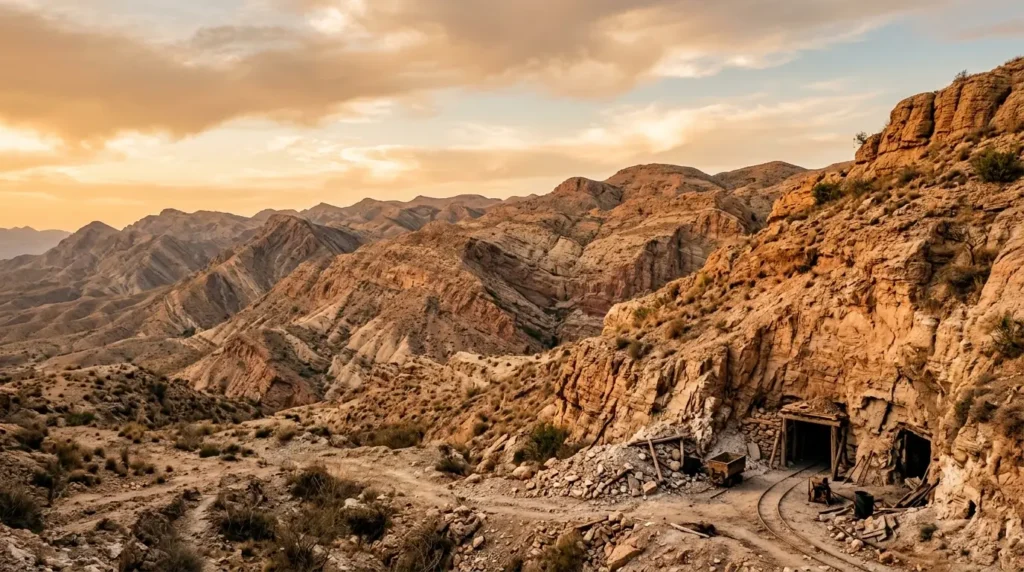
Room-and-pillar mining is, by design, a conservative extraction method. Because roughly half the deposit stays in place as structural support, Khewra isn’t at risk of running out soon. At current production of roughly 350,000 to 450,000 metric tons a year, against reserve estimates ranging from tens of millions of tons into the hundreds of millions, the mine’s remaining working life is generally estimated in centuries rather than decades.
The method also sidesteps a problem that affects other salt production. Solution mining and solar evaporation, the two processes used for most of the world’s salt, both require large volumes of water, and solution mining produces leftover brine that has to be managed or disposed of. Khewra’s salt is dry-mined as solid rock, so there’s no equivalent wastewater or evaporation pond to maintain.
A peer-reviewed environmental impact assessment of Khewra, published in the journal Mining, Metallurgy & Exploration, applied a formal sustainability model to the site and found its operations potentially sustainable for both the environment and the quality of the salt, while also noting that mining activity across the wider region has put real strain on local ecosystems and communities. That’s a more measured verdict than the zero-impact framing you’ll sometimes see on salt packaging, and it’s the more honest one.
The bigger environmental cost is harder to offset than the mining itself: the shipping. Raw and processed salt travels by truck, rail, and container ship from a landlocked mine in Punjab to kitchens on every populated continent, and that international freight adds a real carbon cost that has nothing to do with how the salt was pulled out of the ground.
What This Means When You’re Buying It
Understanding how Himalayan pink salt is mined changes what’s worth paying attention to at the store. Grade matters more than marketing language: a bag labeled food-grade has been through the full wash-dry-grade sequence described above, while a cheap decorative chunk hasn’t and shouldn’t be treated as a seasoning. Color consistency is a genuine quality signal, since it reflects careful sorting at the mine rather than just aesthetics. And if a listing can’t tell you that its salt traces back to Khewra specifically, that’s worth a second look, since the Himalayan pink salt brands we’ve tested and rated all lead back to that single source. The mountain the salt comes from hasn’t changed in 600 million years. What you do with the finished product is the only variable left in your control.